How to Write Meta Ad Hooks That Convert
TL;DR
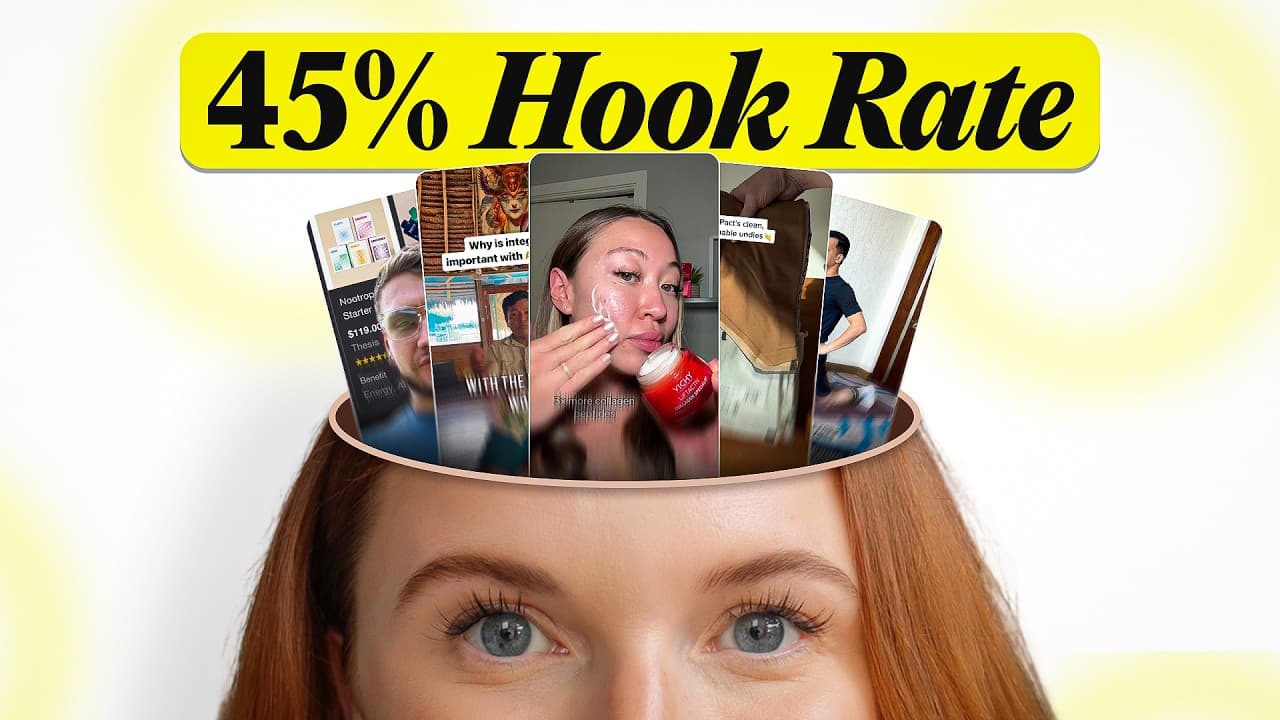
Treat an ad hook as the combined effect of on-screen text, audio, frame-zero visuals, and overall tone, because that package influences who responds and how profitably the ad performs. Test three to six substantially different hook variations, especially by adapting proven ads with trigger words, educational questions, transformations, targeted openings, visual filters, or whispered voice-overs.
Transcript
The nine hook types actually converting on meta right now. What's converting on meta ads today is a little diabolical if I'm being honest. There's never been more noise, more creative volume, and more really smart people doing this work than ever before. So, how are brands expected to actually stand out? And if you don't know me, my name is Dara De... Read More
Key Insights
- A hook is the complete combination of on-screen text, spoken audio, frame-zero imagery, and overall creative tone. This package does more than introduce the script, because it influences which viewers respond to the ad and can eventually affect campaign profitability.
- Trigger-word hooks add an emotionally charged word or phrase to a structure that has already demonstrated performance. The agency commonly uses “ruining my life” and also uploads a brand’s five strongest hooks into Claude to generate trigger-word variations without abandoning the underlying proven structure.
- The “why is it important” hook turns a major value proposition into an educational question. It feels more native and less formal than conventional educational advertising, addresses a question customers may be thinking without saying, and is presented as particularly useful for middle-of-funnel prospects.
- A “day without pain” hook leads with the desired transformation instead of moving directly from a stated problem to the solution. It may work especially well when ads about failed attempts or previous methods customers used to relieve their pain have already performed strongly.
- How-to hooks can match distinct stages of awareness through different questions. “How to know if” helps people recognize a problem, “how do I pick” helps prospects compare solutions, and “how to start” can address either broad beginners or highly aware buyers ready to act.
- The “if you” hook identifies a specific demographic, persona, pain point, or desired transformation while creating curiosity. A practical testing method is to take five or ten existing top hooks and rewrite them with this opening rather than developing every concept from scratch.
- The “this one thing” hook promises simplicity in a complex situation. Its appeal comes from suggesting that one action or insight can provide clarity or partial relief, even when viewers recognize that a single idea may only move them part of the way toward the outcome.
- Native-looking visual and audio treatments can function as hooks without relying on new wording. Snapchat filters can make an ad feel organic or behind the scenes across unexpected demographics, while whispering a proven voice-over can introduce an ASMR-like pattern that has converted across multiple client accounts.
Install to Summarize YouTube Videos and Get Transcripts
Explore YouTube Video Summarizer or Get YouTube Transcript Extractor
Questions & Answers
Q: What makes an effective Meta ad hook?
An effective Meta ad hook is not merely the opening sentence. It is the combined package of what viewers read on screen, what they hear, what they see in frame zero, and the overall feeling communicated by the creative. Together, these elements shape who engages with the ad and can influence its eventual profitability.
Q: How can trigger words improve a Meta ad hook?
Trigger words can add emotional intensity to a hook structure that is already known to convert. One common phrase mentioned is “ruining my life.” The suggested workflow is to gather a brand’s five best hooks, upload them into Claude, and ask it to inject trigger words while preserving the proven structures behind those openings.
Q: Why does the “why is it important” hook work?
The “why is it important” hook frames a major value proposition as an accessible educational question. It can feel more social-first, native, and less stuffy than a conventional educational advertisement. It also states a question that customers may already be considering, making it easier for interested middle-of-funnel prospects to justify saying yes.
Q: How does a transformation-led hook differ from a problem-solution hook?
A transformation-led hook begins with the experience of living without the customer’s pain rather than stating the problem and immediately presenting the solution. The “day without pain” structure reverses the usual sequence. It is recommended when messages about failed attempts or earlier methods customers tried before finding the product have already shown promising performance.
Q: Which how-to hook should be used at each funnel stage?
Use “how to know if” when people are still deciding whether they have a problem. Use “how do I pick” or “how do I choose” when prospects are comparing available solutions. Use “how to start” either for broad top-of-funnel education or for highly aware prospects who need guidance on beginning with the brand or service.
Q: How can the “if you” hook target a specific audience?
The “if you” hook can explicitly signal that an ad is intended for a particular demographic or customer persona. It can also name a narrow pain point or lead with a desired transformation. This specificity creates curiosity and helps align the opening with the intended audience. Existing top hooks can be reformatted into this structure for testing.
Q: Why do apology and “you’re welcome” hooks attract attention?
Apology hooks attract attention because they imply that someone did something wrong, prompting viewers to discover what happened. The transcript describes this as a psychological trick and a cheap creative tactic, although it has produced results. The opposite phrase, “you’re welcome,” has also contributed to top performers, possibly because both approaches create a sense of intimacy.
Q: How should Meta video ad hooks be tested?
Test three to six hook variations within each video creative test. The variations do not need to change only one word, because larger creative swings are encouraged. A practical method is to take several existing top-performing ads, rewrite their openings using the different hook structures, and evaluate those adaptations together in one larger test.
Summary & Key Takeaways
-
Effective Meta ad hooks combine everything viewers read, hear, and see at the opening, including the first frame and the overall creative tone. The recommended concepts include trigger words, educational questions, transformation-led messaging, how-to structures, persona targeting, simplified promises, apology language, native-looking visual treatments, and unexpected audio delivery.
-
Different hooks can address different levels of customer awareness. “How to know if” helps problem-aware audiences identify their need, while “how do I pick” supports people comparing solutions. “How to start” can introduce a broad behavior or encourage highly aware prospects to begin with a particular brand or service.
-
Creative testing should use three to six hook variations for each video test and should involve meaningful differences rather than isolated word changes. A practical approach is to take existing top-performing ads, reformat their openings across several proven hook structures, and evaluate the resulting variations together as one larger creative test.
Read in Other Languages (beta)
Share This Summary 📚
Summarize YouTube Videos and Get Video Transcripts with 1-Click
Try YouTube Summary with ChatGPT & Claude or YouTube Transcript Generator
Explore More Summaries from Dara Denney 📚
Summarize YouTube Videos and Get Video Transcripts with 1-Click
Try YouTube Summary with ChatGPT & Claude or YouTube Transcript Generator