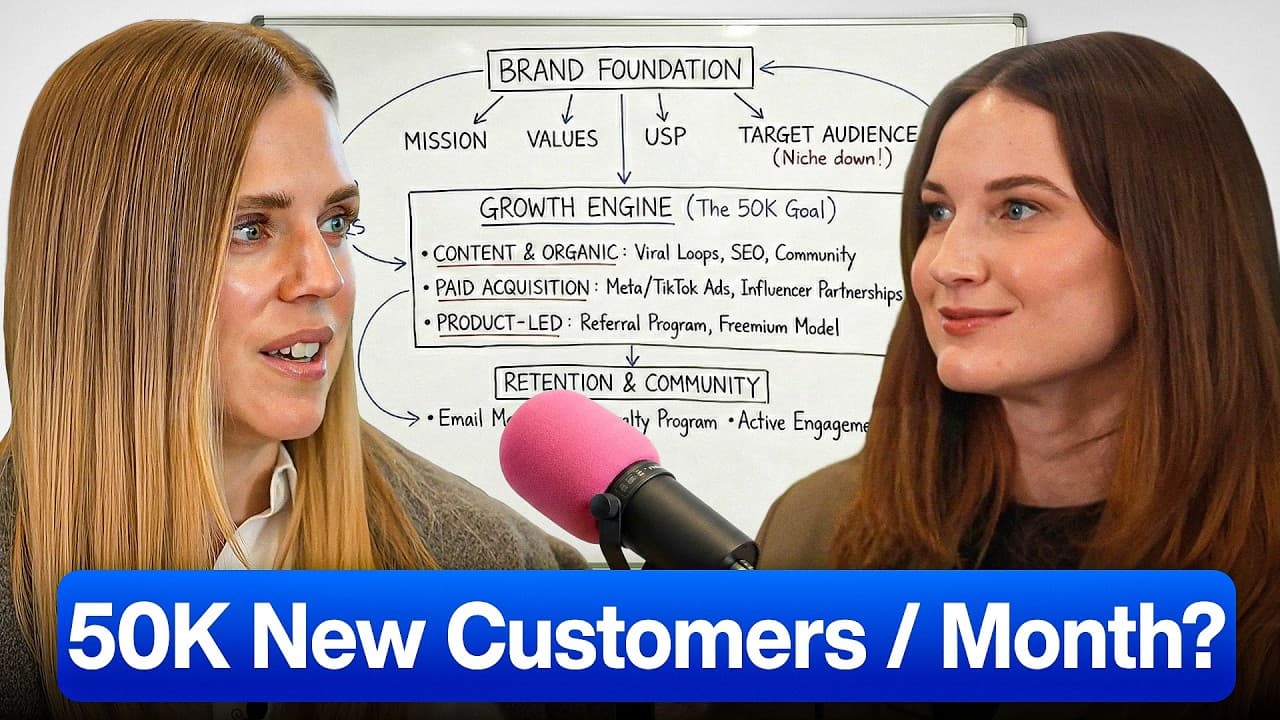
How Pact Scales 50K Monthly Customers Without a Creative Strategist
TL;DR
Pact scales by using value driven ROAS bidding, treating each product category as its own business, and automating creative production with an internal creator and a custom AI uploader. They rely on catalog ads and partnerships with micro creators to keep a lean team nimble while maintaining high ad velocity and relevant creative messaging.
Transcript
Apparel brands are super hard to scale. So, how does this brand manage to acquire 50,000 new customers per month while also having a smaller team? You don't actually have a creative strategist on staff. That's right. But instead you have a That is wild. >> [laughter] >> We have 500 SKUs, but I'd say the biggest game changer that we've had from an o... Read More
Key Insights
- ROAS based bidding helps protect margins by balancing product value and spend, rather than chasing volume alone.
- Catalog ads with product category level ad sets allow scalable, targeted creative while avoiding one ad per SKU.
- An internal creator accelerates content production and improves speed to market, enabling rapid testing and iteration.
- A custom AI uploader streamlines asset management, dramatically reducing manual upload time and enabling more experimentation.
- Partnership ads account for a large share of spend and leverage micro creators to boost authenticity and performance.
- Motion and AI tagging aid in brainstorming, ideation, and analyzing content performance for ongoing optimization.
- Top performing Pact creatives are driven by user generated content and partnerships, not traditional ads.
- The brand emphasizes comfort and accessibility, with messaging that positions clothing as everyday self care.
Install to Summarize YouTube Videos and Get Transcripts
Explore YouTube Video Summarizer or Get YouTube Transcript Extractor
Questions & Answers
Q: What is Pact’s main media buying approach for scale?
Pact uses two core buckets for media buying: business as usual campaigns and dynamic product ads (catalog ads). They rely on value based bidding to optimize for margin and return on ad spend, ensuring that budget is not dumped into low value items such as the lowest price product, while still capturing high value purchases across various SKUs.
Q: How does Pact handle campaign structure given 500 SKUs?
With 500 SKUs, Pact treats each product collection as an individual business unit within campaigns. This allows for collection specific product sets and a tailored creative strategy per category, enabling efficient management and optimization without creating a separate ad for every single SKU.
Q: What role does AI play in Pact’s marketing operations?
AI is central to Pact’s operations, including a custom agent that uploads paid assets rapidly, a creative content manager using AI tools like Motion for ideation and tagging, and internal creators who generate on demand content. This accelerates production, reduces turnaround times, and supports lean team efficiency.
Q: Who produces Pact’s top performing creative and how?
Pact’s top performing creatives come from creator content and user generated content, including internally produced content by their in house creator Paige and partnerships with micro influencers. This approach yields authentic, relatable ads that perform well across the funnel, with most videos lasting around 20 seconds.
Q: What is the significance of the internal creator in Pact’s strategy?
The internal creator is pivotal as a flexible, fast content producer who can deliver ads by a specified time, enabling rapid experimentation and iteration. This role supports agile market responsiveness and helps the brand maintain a steady stream of fresh creative aligned with campaigns and product launches.
Q: How does Pact view the relationship between sustainability messaging and ads on Meta?
Pact notes that sustainability messaging is not easy to market on Meta because the impact is not immediate or tangible for first time buyers. The strategy therefore emphasizes value based messaging and authentic content that communicates the brand’s commitments without being didactic, leveraging creator content and partnerships to convey the sustainability narrative.
Q: What kind of creators does Pact prefer and why?
Pact prefers smaller creators or micro influencers rather than big celebrities. They have found success with these creators because they offer authentic, relatable content and can produce effective partnership ads and creator content at scale, aligning with the lean team approach and driving engagement with targeted audiences.
Q: How does Pact measure and optimize creative performance?
Pact analyzes top performing creatives to identify storytelling structures and patterns, focusing on montage style and listicle formats that communicate vibe and lifestyle rather than explicit value props. They use AI tagging and Motion to generate and analyze content, enabling data driven iteration across SKUs and campaigns.
Summary & Key Takeaways
-
Pact achieves scale with ROAS based bidding and category level ad structuring to protect margins and optimize spend.
-
AI driven automation accelerates asset upload and reduces manual workload, freeing time for strategy and experimentation.
-
A small internal creator and a network of micro influencers power fast, relevant creative that aligns with the brand’s messaging and product mix.
Read in Other Languages (beta)
Share This Summary 📚
Summarize YouTube Videos and Get Video Transcripts with 1-Click
Try YouTube Summary with ChatGPT & Claude or YouTube Transcript Generator
Explore More Summaries from Dara Denney 📚

Summarize YouTube Videos and Get Video Transcripts with 1-Click
Try YouTube Summary with ChatGPT & Claude or YouTube Transcript Generator