How does OpenTelemetry enable hybrid cloud observability
TL;DR
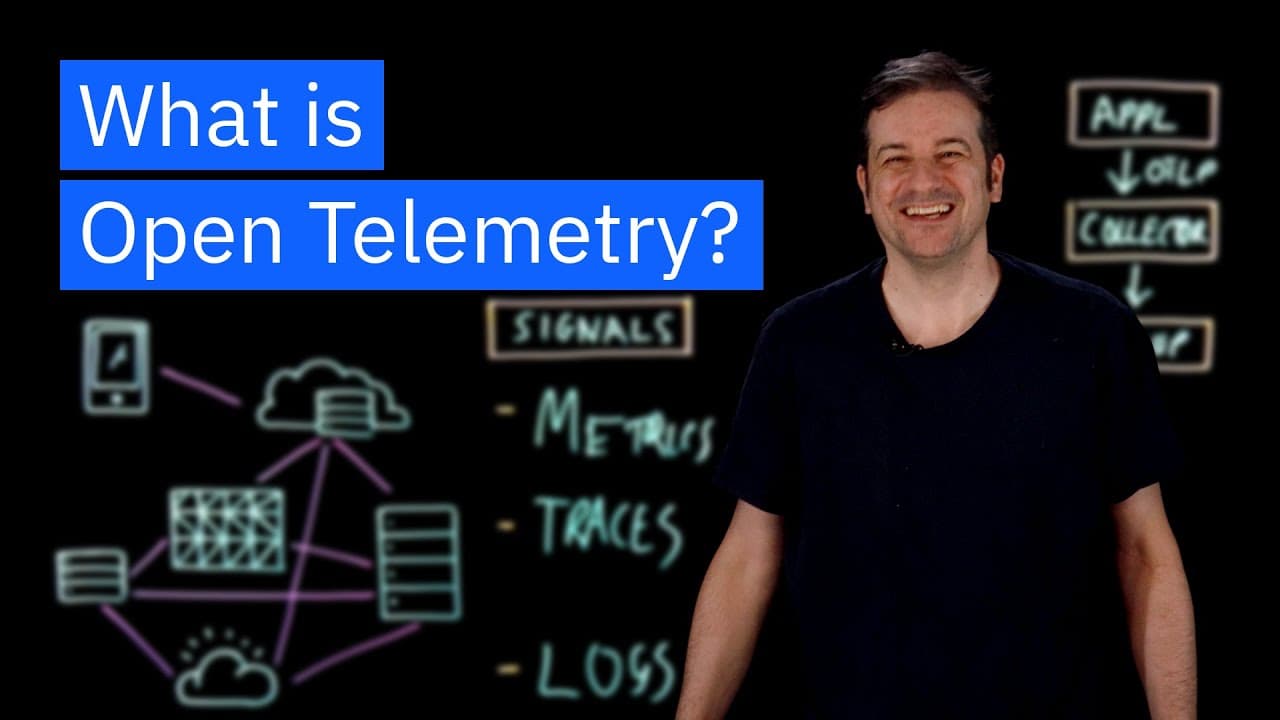
OpenTelemetry is a vendor agnostic observability framework that collects metrics, traces, and logs across mixed environments, enabling end to end visibility. Instrumentation generates signals, OTLP transfers data to collectors for processing and enrichment, and backends provide visualization and analysis to quickly identify performance issues across front ends, cloud services and mainframes.
Transcript
Modern applications do not exist in silos or monolithic technology stacks. Typically today we see front end applications triggered perhaps by mobile devices, connecting to cloud services, and then on to other technologies, including the mainframe. In this video I'm going to be talking about observability, open telemetry and how it can relate to the... Read More
Key Insights
- OpenTelemetry is a vendor agnostic observability framework that handles metrics, traces, and logs.
- Instrumenting applications and environments is required to generate observable signals.
- OTLP is the data format used to transport telemetry information.
- The Open Telemetry collector processes, filters, and enriches signals before sending them on.
- Observability backends analyze and visualize the collected telemetry.
- End to end visibility helps identify performance issues more quickly.
- A common standard across platforms makes integration easier across hybrid stacks.
- OpenTelemetry enables combining signals from multiple environments to observe a complete system.
Install to Summarize YouTube Videos and Get Transcripts
Explore YouTube Video Summarizer or Get YouTube Transcript Extractor
Questions & Answers
Q: What is OpenTelemetry and why is it important for hybrid cloud monitoring
OpenTelemetry is a vendor agnostic observability framework that collects, processes and transmits telemetry data such as metrics, traces and logs. It is important for hybrid cloud monitoring because it enables end to end visibility across front end devices, cloud services and legacy mainframes. By standardizing data collection and transport, organizations can correlate signals from multiple technologies, reduce tool sprawl and speed up detection, isolation and resolution of IT operational issues.
Q: How does instrumentation contribute to OpenTelemetry
Instrumentation refers to adding code or using language specific automatic instrumentation to generate signals from an application or environment. This step is required to observe system behavior and produce data that OpenTelemetry can capture. Without instrumentation, there would be no telemetry data to collect, correlate or analyze, which would hinder full observability across disparate components in a hybrid stack.
Q: What is OTLP and its role in OpenTelemetry
OTLP stands for Open Telemetry Protocol, and it describes the properties of the observed system that are captured as signals. It provides a common data format so that spans from different technologies and systems can be correlated later. OTLP enables consistent data exchange and interoperability between instrumented applications, collectors and backends, facilitating unified analysis across environments.
Q: What does the Open Telemetry collector do
The Open Telemetry collector receives telemetry data from various sources, performs processing such as filtering and enriching, and may correlate data from multiple sources. It can then forward the enriched signals to other collectors or to an observability backend. This central processing helps manage data volume and improves the quality and usefulness of the observability view.
Q: What is the role of an observability backend in this framework
The observability backend ingests processed OTLP data from collectors, analyzes it and creates visualizations to help determine system performance. It combines signals from metrics, traces and logs to provide insights into how the application and infrastructure behave. It is not a product itself but a category of software offerings that implement the OpenTelemetry data into actionable analysis.
Q: How does OpenTelemetry improve detection and resolution of issues
By enriching and correlating telemetry signals across environments, OpenTelemetry provides a complete view of how a user transaction travels from mobile through cloud services to the mainframe. This end to end visibility allows IT operations teams to quickly locate where a problem originates and take timely action, potentially reducing resolution time and operational costs.
Q: Can OpenTelemetry be used with legacy systems
Yes, OpenTelemetry supports older applications and mainframes as part of a complete end to end observability strategy. The framework is designed to bring together telemetry signals from modern cloud native components and legacy systems, enabling a unified view of hybrid applications and their performance, even when older tech is involved.
Q: What makes OpenTelemetry different from vendor specific implementations
OpenTelemetry is not a single product but an open framework managed by the Cloud Native Computing Foundation with broad vendor support. Unlike vendor specific implementations, it provides a standard for generating and transmitting signals, enabling diverse backends to consume the same data. This vendor agnostic approach reduces lock-in and simplifies integration across technologies.
Summary & Key Takeaways
-
This overview explains that OpenTelemetry unifies telemetry data from multiple environments into a single observable view. It describes instrumentation, OTLP signals, and collectors that filter and enrich data before sending it to an observability backend. The result is faster problem detection and resolution across hybrid stacks.
-
It emphasizes that OpenTelemetry is not a product but a framework supported by many vendors and the CNCF, with vendor specific backends consuming the standardized data for analysis and visualization.
-
It also notes that standardization across platforms simplifies integration and enables end to end visibility for both modern cloud apps and older mainframe based systems.
Read in Other Languages (beta)
Share This Summary 📚
Summarize YouTube Videos and Get Video Transcripts with 1-Click
Try YouTube Summary with ChatGPT & Claude or YouTube Transcript Generator
Explore More Summaries from IBM Technology 📚


Summarize YouTube Videos and Get Video Transcripts with 1-Click
Try YouTube Summary with ChatGPT & Claude or YouTube Transcript Generator