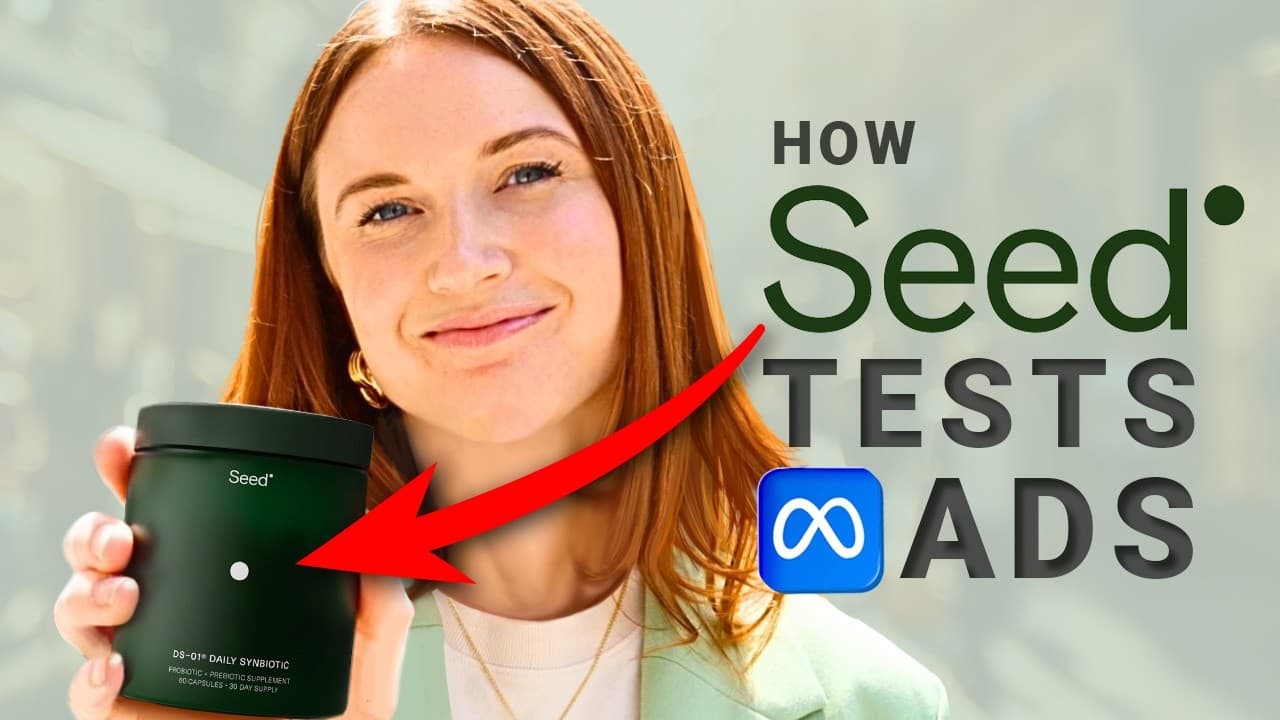
How Seed Health Tests Meta Ads for Better Results
TL;DR
Seed Health tests Meta Ads by grouping roughly 15–20 ads across 3–5 concepts in ASC and letting Meta’s algorithm direct spend toward creatives with scaling potential. After moving away from sandbox tests that forced spend across every ad, Seed gained flexibility to test fewer, more differentiated variations. Its incrementality study also supports maintaining a blend of internal, influencer, and agency creative. Read on for the testing structure and key lessons.
Transcript
my name is Da Denny and welcome to our new series Ad Spend this series isn't about getting you to spend more money on your advertising what we're actually going to be doing is going behind the scenes with real brands who are using meta ads to scale breaking down their creative their growth strategies and everything that's working today in paid soci... Read More
Key Insights
- Seed Health shifted from sandbox testing to ASC testing for better ad scalability.
- ASC testing allows Meta's algorithm to optimize ad spend for better results.
- Creative diversity is crucial; Seed tests fewer, more promising variations.
- Incrementality testing helps Seed understand true ad performance beyond last-touch attribution.
- Whitelisted influencer content often leads to immediate purchases, while other content aids top-of-funnel engagement.
- Seed maintains diversified creative strategies to ensure long-term business growth.
- The synergy between Seed's internal and external creative teams enhances ad performance.
- Tracking and analyzing comprehensive data is vital for effective creative strategy development.
Install to Summarize YouTube Videos and Get Transcripts
Explore YouTube Video Summarizer or Get YouTube Transcript Extractor
Questions & Answers
Q: How does Seed Health test Meta Ads for better results?
Seed groups roughly 15–20 ads from 3–5 concepts in an ASC test and lets Meta’s algorithm decide where the spend goes. Its primary success signal is whether an ad scales, especially whether it scales efficiently; even heavy algorithmic spend without efficiency is treated as a meaningful signal.
Q: Why did Seed replace sandbox creative testing with ASC testing?
Sandbox testing forced spend toward every ad so the team could collect data on each variation. Seed believed this was directing money toward creatives the algorithm already recognized as unlikely to scale, so it adopted ASC testing and reported better results while testing fewer creatives.
Q: How many creative tests and ads does Seed launch each month?
Seed typically runs 4–5 creative tests, or sprints, per month. Each sprint is divided by creative source and contains about 12–25 ad creatives.
Q: How does ASC testing change the number of creative variations Seed produces?
ASC testing lets Seed use one concept without automatically creating 4–5 variations, or explore more variations when the team has strong conviction. Seed keeps a tight cap on agency variations because it expects only 3–5 ads to receive priority even if an ASC contains many more.
Q: What kind of creative differentiation does Seed prioritize?
Seed’s creative strategist identifies visual differentiation as a bigger opportunity than small copy changes. The practical test is whether someone can recognize that two creatives are different within two seconds, which encourages bigger visual swings instead of variations made only for volume.
Q: How do Seed’s internal team and creative agencies divide the work?
Seed’s internal team focuses on graphics, high-production creative, and whitelisted influencer content. Three agencies supplement that work: two focus on UGC, while the third produces graphic-design statics and AI creative; proven internal concepts can then be adapted through each agency’s specialty.
Q: What did Seed learn from its incrementality study?
Whitelisted influencer ads appeared most efficient under Seed’s internal attribution, but the study found that whitelisted and internally produced creative had very similar incrementality. Their last-touch patterns differed, and the holdout cell blending internal, whitelisted, and agency creative delivered the most efficient incremental CPA.
Q: What is Seed’s top-performing Meta Ads creative concept?
Seed identifies the aspirational idea of “pooping every day” as its top Meta value proposition, including situations such as traveling or preparing for a big day. The internal team developed static versions, while outside agencies translated the learning into UGC storylines, scripts, and distinct visual formats.
Summary & Key Takeaways
-
Seed Health transitioned from sandbox to ASC testing on Meta Ads, enabling more efficient ad spend by allowing the algorithm to prioritize promising creatives. This approach focuses on fewer variations, enhancing scalability and performance. Creative diversity and incremental testing are key components of their strategy, ensuring long-term growth.
-
The ASC testing methodology provides flexibility, allowing Seed to test more variations of successful concepts or focus on fewer high-confidence creatives. This shift results in better resource allocation and improved ad performance, as Seed leverages both internal and external creative teams for diverse content creation.
-
Seed's approach highlights the importance of understanding ad performance beyond immediate metrics. Incrementality testing reveals the true impact of different creative sources, ensuring diversified strategies that contribute to overall business success. Seed's collaboration between growth and creative teams exemplifies effective media buying and creative strategy.
Read in Other Languages (beta)
Share This Summary 📚
Summarize YouTube Videos and Get Video Transcripts with 1-Click
Try YouTube Summary with ChatGPT & Claude or YouTube Transcript Generator
Explore More Summaries from Dara Denney 📚


Summarize YouTube Videos and Get Video Transcripts with 1-Click
Try YouTube Summary with ChatGPT & Claude or YouTube Transcript Generator