How Did RBI Prevent an Indian Banking Crisis?
TL;DR
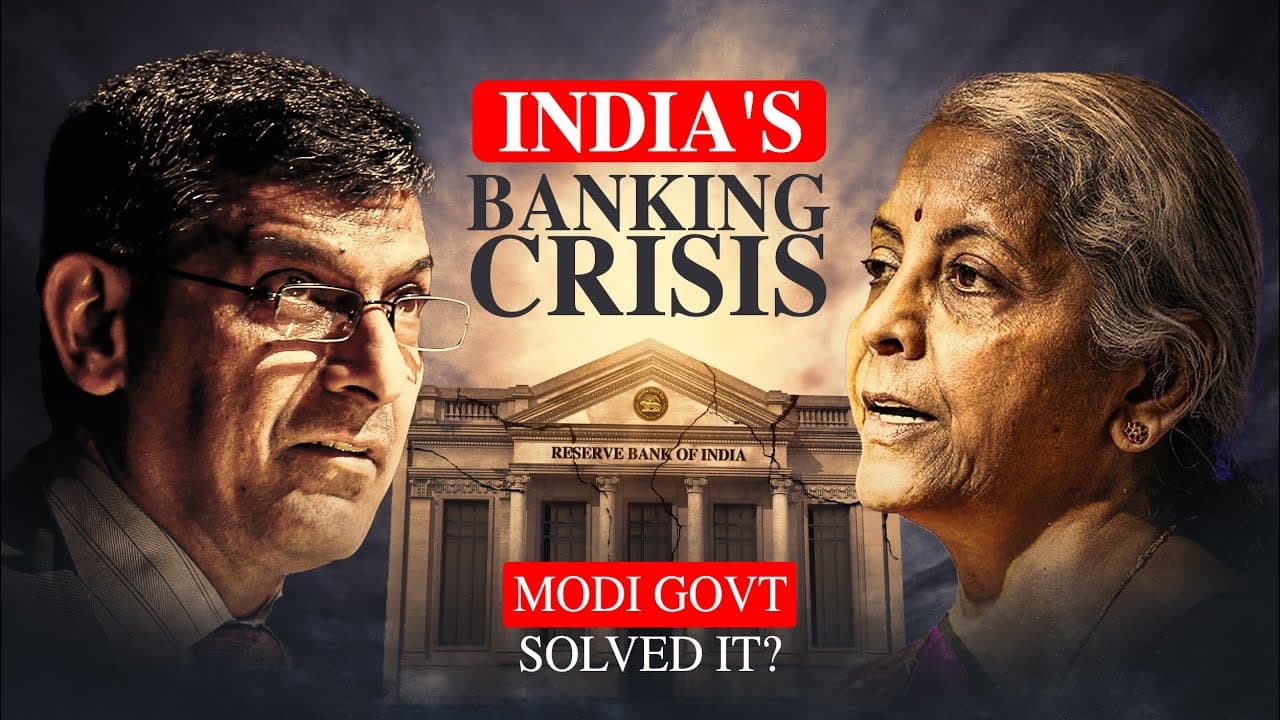
India strengthened its banking system by exposing hidden bad loans, requiring financial buffers, recapitalizing public sector banks, and merging weaker institutions with stronger ones. The crisis had developed after aggressive pre-2008 lending and a decade of regulatory forbearance allowed stressed loans to be labeled as restructured, masking risk until the RBI's asset quality review revealed sharply rising non-performing assets.
Transcript
hi everybody did you ever notice that in 2023 while Banks all across the world were failing not a single Indian Bank failed or faced a crisis in fact our banks were growing at a staggering rate during the exact same time I want to briefly speak about what's happening in Silicon Valley Bank and Signature Bank the abrupt closures of three banks in a ... Read More
Key Insights
- Non-performing assets are loans whose principal or interest payments are unlikely to be recovered, making them an important indicator of bank health. The transcript illustrates this with a bank expecting ₹2 crore of a ₹10 crore loan portfolio to remain unpaid, producing a 20% NPA ratio.
- Public sector bank NPAs fell from approximately 25% in 1992 to less than 5% by 2008, but then began climbing again. The reported ratio rose from below 5% in 2015 to nearly 10% in 2016 and approximately 15% by 2018.
- Aggressive lending before the 2008 crisis created substantial exposure to infrastructure and other projects. Total bank credit increased from ₹7.5 trillion in 2002 to ₹15 trillion in 2005 and ₹33 trillion in 2009, while annual credit expansion reached 31.4% in 2005.
- RBI loan classifications distinguish standard loans from non-performing loans, then divide non-performing loans into substandard, doubtful, and loss categories. These categories reflect how long repayment has been overdue and how much of the outstanding amount the bank expects to lose.
- Asset quality forbearance allowed stressed loans to be labeled as restructured rather than substandard. Because banks did not immediately recognize these loans as NPAs, they avoided associated provisioning requirements and retained more funds for lending and other income-producing activities.
- Provisioning protects banks by requiring them to reserve money against expected loan losses. In the transcript's simplified example, a 15% provision against an outstanding bad loan of ₹8 lakh requires the bank to set aside ₹1.2 lakh that cannot be lent or otherwise deployed.
- The RBI's asset quality review exposed bad loans that had remained hidden in bank balance sheets. According to the transcript, many problematic loans were connected to the 2006 to 2008 lending period, including loans to well-connected promoters with histories of default.
- Bank recapitalization supplied public sector banks with funds needed to absorb losses and remain viable. The government and banks added ₹3.19 trillion from 2015 to 2019, including approximately ₹2.11 trillion in 2018, while weaker public sector banks were merged with stronger institutions.
Install to Summarize YouTube Videos and Get Transcripts
Explore YouTube Video Summarizer or Get YouTube Transcript Extractor
Questions & Answers
Q: What caused India's bad-loan problem after 2008?
India's bad-loan problem originated partly in aggressive lending before the 2008 crisis, when bankers expected rapid economic growth to continue. Public sector banks supplied large amounts of credit to infrastructure and other projects, with total bank credit increasing from ₹7.5 trillion in 2002 to ₹33 trillion in 2009. When projects struggled and borrowers missed payments, many loans became stressed or non-performing.
Q: What is a non-performing asset in banking?
A non-performing asset is a loan for which the borrower is struggling to make required principal or interest payments and repayment is at risk. The transcript gives a simple portfolio example: if a bank lends ₹10 crore and expects ₹2 crore never to be repaid, that ₹2 crore is considered non-performing, producing an NPA ratio of 20%.
Q: How does the RBI classify non-performing loans?
The RBI framework described in the transcript first separates standard loans from non-performing loans. Non-performing loans are then divided into substandard loans, where the borrower has defaulted for less than 12 months, doubtful loans, where repayment has been overdue for more than a year and recovery is expected at a loss, and loss loans, where a loss is considered certain.
Q: How did asset quality forbearance hide bad loans?
Asset quality forbearance allowed banks to treat stressed loans as restructured instead of classifying them as substandard non-performing assets. This delayed recognition of repayment problems and reduced the amount banks had to reserve against expected losses. Banks could therefore keep lending, but their reported loan quality did not fully reflect the risks accumulating within their portfolios.
Q: Why do banks provision money against bad loans?
Provisioning creates a financial buffer against money that may not be recovered from borrowers. The transcript uses a simplified example in which a bank must reserve 15% of an ₹8 lakh outstanding bad loan, equal to ₹1.2 lakh. That reserved amount cannot be used for further lending or other income-producing activities, reducing the chance that loan losses bankrupt the bank.
Q: What did the RBI's asset quality review reveal?
The asset quality review revealed that public sector banks had substantial stressed loans hidden within their balance sheets. Once those loans were recognized more accurately, the reported NPA ratio increased from below 5% in 2015 to nearly 10% in 2016 and approximately 15% in 2018. The review exposed risks that restructuring and forbearance had previously concealed.
Q: How did recapitalization strengthen public sector banks?
Recapitalization strengthened public sector banks by adding real funds that could absorb losses and support continued operations. From 2015 to 2019, the government and banks together added ₹3.19 trillion, described as $38 billion, to public sector bank funds. Approximately ₹2.11 trillion was injected in 2018 alone, when reported non-performing assets had reached especially high levels.
Q: How did bank mergers help prevent a wider crisis?
Bank mergers were used to combine weaker public sector banks with stronger institutions. According to the transcript, this formed part of the broader response alongside recognizing hidden non-performing assets and adding capital. The approach was intended to give vulnerable banks stronger financial support and organizational backing, helping the public banking system withstand losses and continue operating during later economic disruptions.
Summary & Key Takeaways
-
Indian public sector banks entered the post-2008 period with risks created during an earlier lending boom. Bank credit rose rapidly as bankers expected strong economic growth to continue, but many infrastructure and other projects later struggled. The resulting defaults contributed to a major increase in non-performing assets across the banking system.
-
Asset quality forbearance allowed banks to restructure troubled loans instead of immediately classifying them as non-performing. This reduced the reserves banks needed to set aside and permitted further lending, but it also concealed the true condition of their loan books. Hidden stress accumulated for years before becoming visible through regulatory scrutiny.
-
The RBI's asset quality review revealed the scale of previously hidden bad loans, while the government and banks injected ₹3.19 trillion into public sector banks from 2015 to 2019. The response also included merging weaker public sector banks with stronger institutions, helping banks absorb losses and continue operating through subsequent economic shocks.
Read in Other Languages (beta)
Share This Summary 📚
Summarize YouTube Videos and Get Video Transcripts with 1-Click
Try YouTube Summary with ChatGPT & Claude or YouTube Transcript Generator
Explore More Summaries from Think School 📚






Summarize YouTube Videos and Get Video Transcripts with 1-Click
Try YouTube Summary with ChatGPT & Claude or YouTube Transcript Generator