How to Create Beauty Ads With AI in One Hour
TL;DR
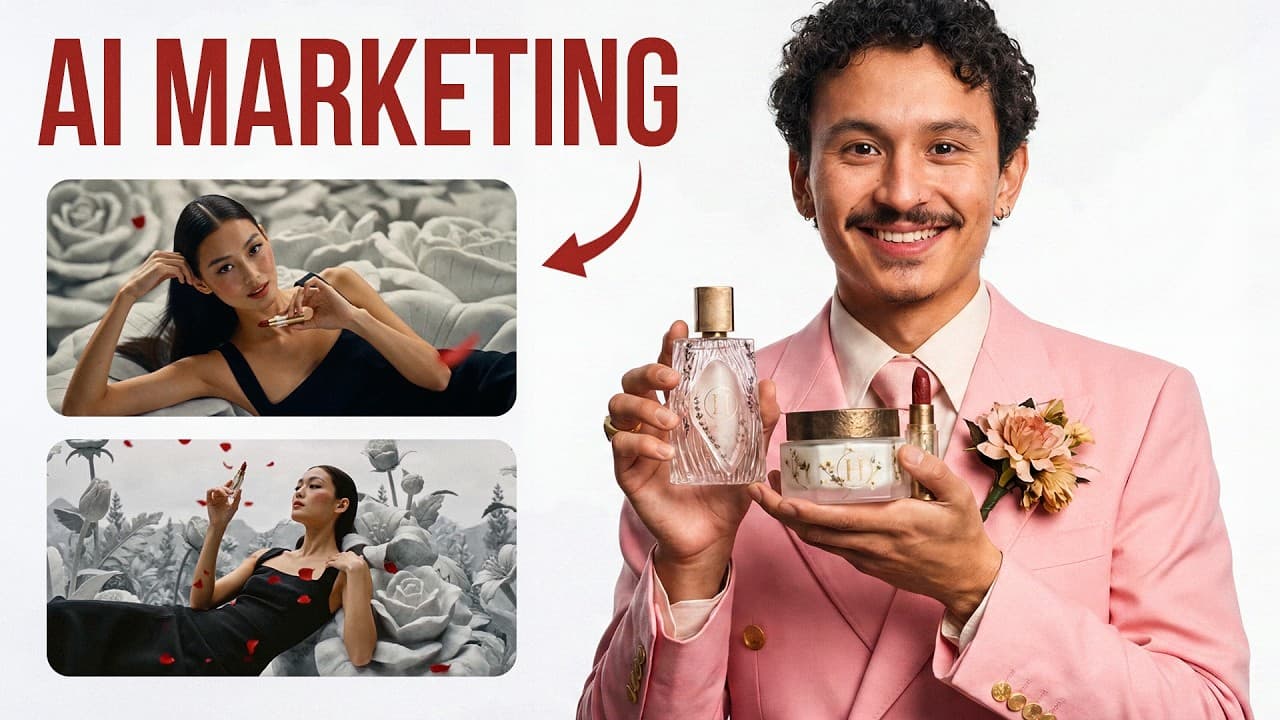
Build the brand foundation first, then reuse the approved logo, product designs, colors, typography, and visual references across every campaign asset. Higgsfield Marketing Studio, GPT Image 2.0, and Soul Cinema can turn that foundation into static visuals, UGC clips, Hyper Motion sequences, and TV-style commercials without an agency or conventional production crew.
Transcript
And this product is literally You see all these people? Watch this. Uh sorry, bro. So, every single one of these >> [music] >> needs an ad. Every single one. But, I found a tool that does all of this. Not this. Hicksfield Marketing Studio. >> [music] >> Beauty marketing is one of the most saturated spaces out there. A brand that didn't exist 3 mont... Read More
Key Insights
- Brand positioning is the foundation of the advertising workflow because the visual direction and identity determine whether later assets feel coherent. The Higgs concept adopts a clean, minimal, expensive-looking style before any campaign content is generated.
- A concise creative direction is sufficient for initial logo exploration. The prompt requests a high-fashion futuristic identity, strict serif typography, a separate symbol, a monogram, black-and-white treatment, and elegant thin-to-medium line work, with four versions generated for comparison.
- The product collection is designed as a focused set of perfume, lip balm, and cream. The chosen direction combines authentic, natural, elegant, and ethereal qualities with pressed flowers, lavender, gold leaf details, brass caps, a gold H monogram, and soft studio lighting.
- A brand kit is the consistency system for subsequent campaign assets. It consolidates the color palette, typography, logo variations, brand elements, product presentation, textures, patterns, brand voice, values, and tagline so newly generated materials fit the same identity.
- Reference images are used to preserve product continuity across static advertisements. The campaign prompt explicitly asks the model to use the attached products exactly as shown and retain their shapes, designs, and proportions instead of redesigning them.
- UGC advertising works by presenting a person speaking directly to the camera about a discovered product. Marketing Studio combines an avatar, uploaded product, setting, spoken line, hook, aspect ratio, quality, and duration to create variations for different audiences.
- Unexpected hooks and settings are tools for capturing attention early. The demonstrated options include product-focused hooks, unusual locations, and a random-object microphone, allowing the same product to appear in substantially different ads without changing its core identity.
- Hyper Motion is a preset for cinematic luxury product advertising. The demonstrated workflow combines a product with a generated Soul Cinema location and a motion prompt describing flowers emerging from desert sand, petals revealing the lip balm, the cap lifting, and the camera pulling back.
Install to Summarize YouTube Videos and Get Transcripts
Explore YouTube Video Summarizer or Get YouTube Transcript Extractor
Questions & Answers
Q: How do you create a luxury beauty brand with AI?
Start by defining the brand's positioning and visual direction before producing advertisements. Generate a logo, symbol, and monogram, then create a focused product collection and a detailed brand kit. For Higgs, the process established an elegant, minimal identity and three products before using those approved references to generate posters, billboards, UGC clips, cinematic sequences, and TV-style commercials.
Q: What should an AI beauty logo prompt include?
A useful logo prompt should name the brand and provide a clear stylistic direction without becoming unnecessarily long. The Higgs prompt requested a high-fashion futuristic logo, a strict serif typeface with a creative edge, a separate symbol, a monogram, black-and-white colors, and elegant thin-to-medium line work. Four versions were generated so the strongest option could be selected.
Q: How do you generate a consistent AI product collection?
Attach the approved logo and describe the entire collection within one coordinated visual concept. The demonstrated prompt requested a luxury beauty set containing a perfume bottle, cream jar, and lipstick tube, supported by pressed flowers, lavender, gold leaf details, brass caps, a gold H monogram, and soft studio lighting. The preferred version then became the reference for later assets.
Q: Why is an AI brand kit important for advertising?
A brand kit keeps generated advertisements visually connected by collecting the identity rules in one reference. The Higgs kit included its logo, color palette, typography, brand elements, product presentation, textures, patterns, brand voice, values, and tagline. Attaching that kit to later generations helped posters and billboard mockups maintain the same colors, products, logos, and overall luxury direction.
Q: How can AI preserve product consistency across ads?
Use approved product images and the brand kit as references, then explicitly instruct the generator not to alter the products. The campaign prompt asked for the attached items to appear exactly as shown while preserving their shapes, designs, and proportions. This reference-based process supported visual continuity across campaign imagery and a photorealistic billboard placed above a city road.
Q: How do you make UGC beauty ads with Marketing Studio?
Choose an avatar, upload an isolated product image, describe the setting and action, and provide any required dialogue. The first example placed a woman in a cozy home as she removed the product cap and spoke directly to the camera. Additional controls allowed the creator to select hooks, unusual settings, a 9 by 16 aspect ratio, 1080p quality, and a 15-second duration.
Q: How can one beauty product target different audiences?
Create multiple variations by changing the avatar, hook, setting, dialogue, or age group while keeping the same product reference. One demonstration used a younger avatar and an unexpected location, while another generated an elegant 60-year-old woman with a random-object microphone. These changes produced distinctly different presentations without requiring a new product design or separate physical shoot.
Q: What is the Hyper Motion workflow for beauty ads?
Select the product, supply a location as the second input, and describe the desired movement in a concise prompt. For the lip balm example, a Soul Cinema location provided the backdrop, while the motion prompt directed flowers to burst from desert sand, petals to reveal the product, the cap to lift, and the camera to pull back at the end.
Summary & Key Takeaways
-
The workflow begins by defining a fictional luxury beauty brand called Higgs. GPT Image 2.0 generates a high-fashion logo, separate symbol, monogram, and three-product collection. Simple prompts establish an elegant visual direction using black, white, lavender, cream, gold, pressed flowers, brass caps, and soft studio lighting.
-
The selected logo and product collection become references for a detailed brand kit containing colors, typography, logo variations, textures, patterns, brand voice, values, and a tagline. Reusing those references helps posters, campaign images, and billboard mockups preserve the products' shapes, designs, proportions, and overall visual identity.
-
Marketing Studio produces several advertising formats from the established assets. UGC clips combine products with avatars, settings, hooks, dialogue, and audience variations, while Hyper Motion creates cinematic product sequences. The broader production cycle also includes Wildcard and TV Spot commercials, giving creators and marketers multiple campaign formats from one brand foundation.
Read in Other Languages (beta)
Share This Summary 📚
Summarize YouTube Videos and Get Video Transcripts with 1-Click
Try YouTube Summary with ChatGPT & Claude or YouTube Transcript Generator
Explore More Summaries from Higgsfield AI 📚


Summarize YouTube Videos and Get Video Transcripts with 1-Click
Try YouTube Summary with ChatGPT & Claude or YouTube Transcript Generator