What Is In-AI Advertising and Its Societal Impact?
TL;DR
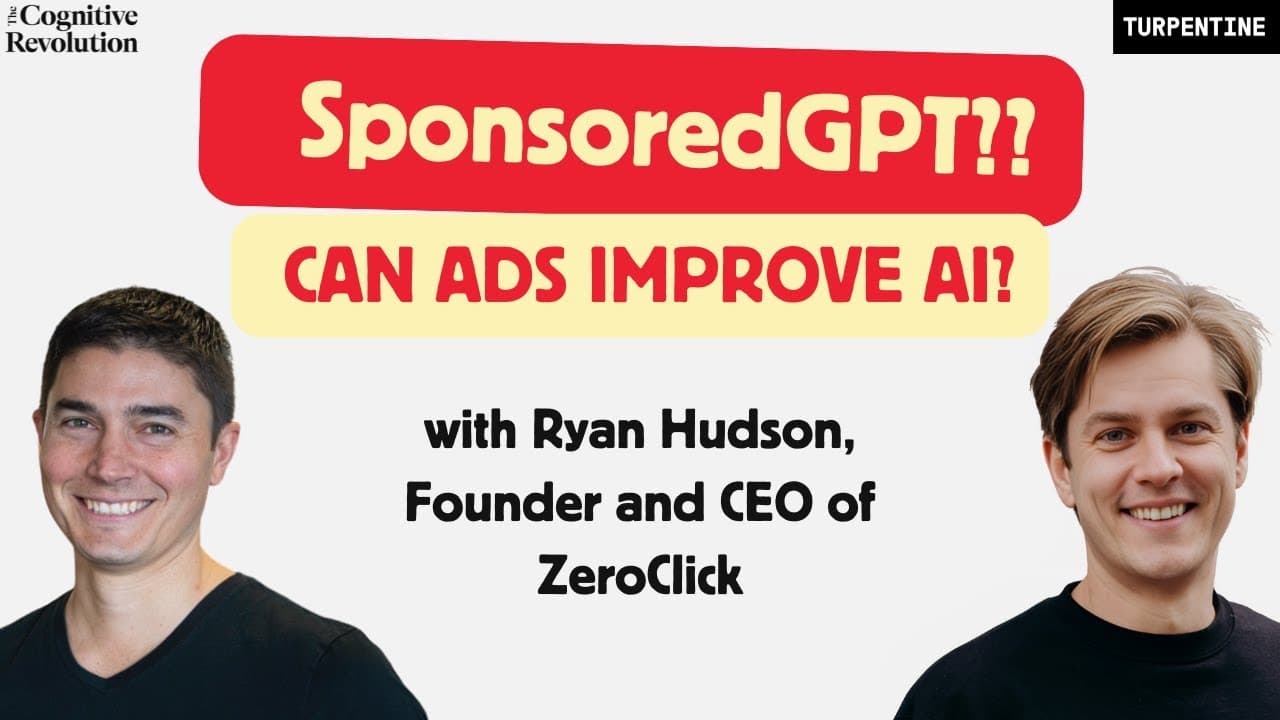
In-AI advertising is emerging as a new frontier where AI platforms incorporate advertising content during inference, potentially enabling free-tier AI services. ZeroClick, led by Ryan Hudson, aims to build this infrastructure, raising questions about balancing user benefit and commercial interests. As AI becomes integral to daily life, ensuring that it serves users without exploiting attention is crucial for societal well-being.
Transcript
This podcast is supported by Google. Hey everyone, Shishta here from Google Deep Mind. The Gemini 2.5 family of models is now generally available. 2.5 Pro, our most advanced model, is great for reasoning over complex tasks. 2.5 Flash finds the sweet spot between performance and price. And 2.5 Flash Light is ideal for low latency, high volume tasks.... Read More
Key Insights
- ZeroClick is developing an advertising platform for AI systems, focusing on paid inference time consideration.
- Ryan Hudson previously founded Honey, an online shopping tool acquired by PayPal for $4 billion.
- AI advertising could make ad-supported free tiers viable for AI applications, similar to social media platforms.
- The platform aims to enhance user experience by providing relevant commercial information contextually.
- Concerns arise about AI advertising potentially exploiting user attention, similar to social media's attention economy.
- ZeroClick's system matches user queries with ad campaigns using technologies like MCP server integration.
- The platform aspires to be the 'Stripe for AI advertising,' offering common infrastructure for developers.
- Societal implications include the need for AI to truly serve users, not just capture their attention for ads.
Install to Summarize YouTube Videos and Get Transcripts
Explore YouTube Video Summarizer or Get YouTube Transcript Extractor
Questions & Answers
Q: How does in-AI advertising work?
In-AI advertising integrates advertising content during AI inference, allowing AI systems to consider paid content while generating responses. This approach involves matching user queries with advertiser campaigns using technologies like vectorization and MCP server integration, enabling contextual ad delivery that can support free-tier AI services.
Q: What are the potential benefits of in-AI advertising?
In-AI advertising could make ad-supported free tiers viable for AI applications, similar to social media platforms. By providing relevant commercial information contextually, it enhances user experience and creates monetization opportunities for developers, potentially democratizing access to AI services and supporting diverse applications.
Q: What concerns exist about in-AI advertising?
Concerns about in-AI advertising include the potential for AI systems to exploit user attention, similar to social media's attention-driven models. There's a risk that AI might prioritize ad content over user interests, leading to ethical questions about AI's role in society and the need to ensure it truly serves users' best interests.
Q: How does ZeroClick plan to implement in-AI advertising?
ZeroClick's platform uses technologies like MCP server integration to match user queries with active ad campaigns quickly. The system is designed to be easily integrated by developers, offering common infrastructure to support AI applications. ZeroClick aims to be the 'Stripe for AI advertising,' facilitating monetization for free-tier AI services.
Q: What is the significance of Ryan Hudson's background in AI advertising?
Ryan Hudson, founder of ZeroClick, previously founded Honey, an online shopping tool acquired by PayPal for $4 billion. His experience in e-commerce and advertising technology informs ZeroClick's approach to building an AI advertising platform, focusing on creating value for users and developers while addressing societal concerns about AI's impact.
Q: How does in-AI advertising compare to traditional advertising?
In-AI advertising differs from traditional advertising by integrating ads directly into AI inference processes, allowing for contextual ad delivery based on user queries. Unlike traditional ads that appear separately, in-AI ads are considered part of the AI's response, potentially enhancing user experience by providing relevant information seamlessly.
Q: What role does AI play in the attention economy?
AI's role in the attention economy involves balancing user benefit with commercial interests. While AI can enhance user experience with contextual information, there's a risk of prioritizing ad content over user needs, similar to social media's attention-driven models. Ensuring AI serves users' best interests is crucial for ethical AI development.
Q: What is the future potential of in-AI advertising?
The future potential of in-AI advertising includes expanding beyond text to multimodal formats, such as visual ads, enhancing AI experiences by showing real products. As AI becomes integral to daily life, in-AI advertising could transform monetization and user engagement, but must be carefully managed to avoid ethical pitfalls and ensure user trust.
Summary & Key Takeaways
-
ZeroClick is pioneering in-AI advertising, allowing AI systems to consider advertiser content during inference time. This approach could make ad-supported free AI services viable, benefiting both developers and users by providing relevant commercial information contextually. However, it raises concerns about AI's role in attention economy, similar to social media.
-
Ryan Hudson, CEO of ZeroClick, discusses the company's journey from creating ad blockers to building an AI advertising platform. The aim is to support free-tier AI applications through paid inference time consideration, enhancing user experience with relevant ads while addressing societal concerns about AI's influence on user attention.
-
In-AI advertising presents opportunities and challenges, as it could transform AI monetization and user experience. ZeroClick's platform aims to provide infrastructure for developers, but the industry must ensure AI serves users' best interests, avoiding pitfalls seen in social media's attention-driven models.
Read in Other Languages (beta)
Share This Summary 📚
Summarize YouTube Videos and Get Video Transcripts with 1-Click
Try YouTube Summary with ChatGPT & Claude or YouTube Transcript Generator
Explore More Summaries from Cognitive Revolution "How AI Changes Everything" 📚

Summarize YouTube Videos and Get Video Transcripts with 1-Click
Try YouTube Summary with ChatGPT & Claude or YouTube Transcript Generator