What Are Vectors and How Are They Used in Linear Algebra?
TL;DR
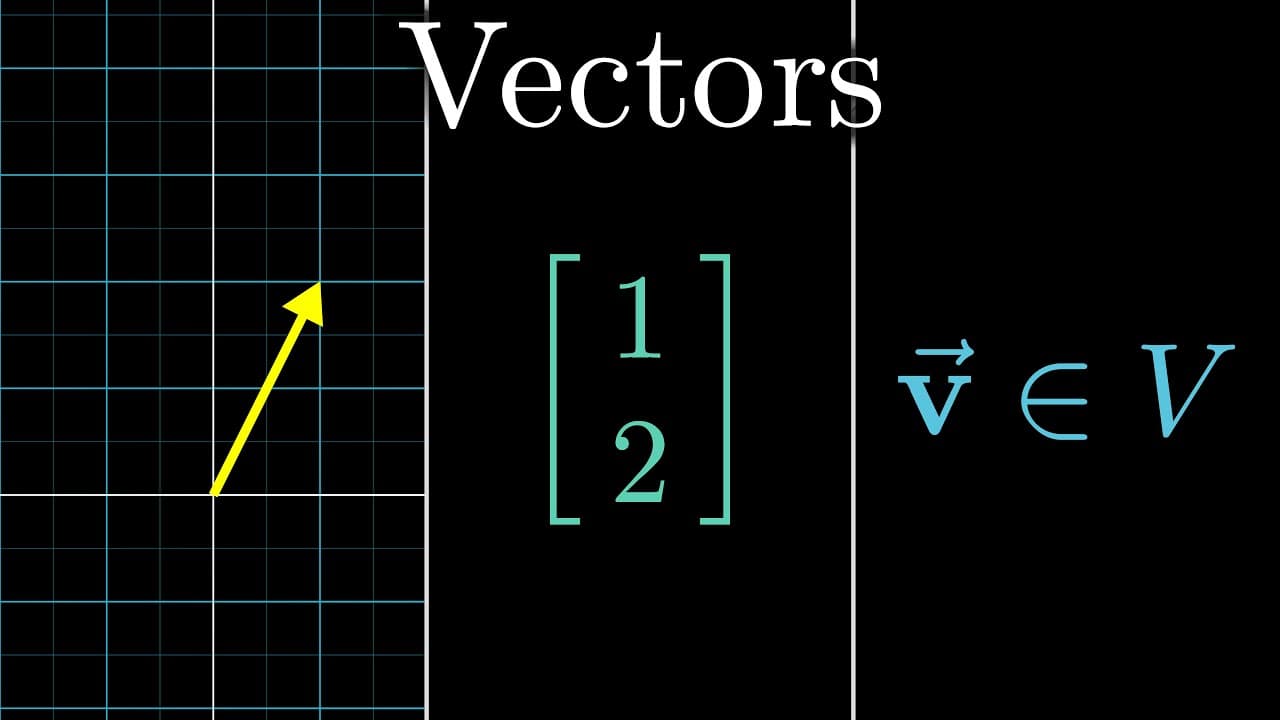
Vectors are fundamental building blocks in linear algebra, viewed as arrows in space, ordered lists of numbers, or abstract mathematical objects. They are typically represented as starting from the origin in a coordinate system. Two key operations associated with vectors are vector addition, which involves positioning vectors tip-to-tail, and scalar multiplication, which scales their length.
Transcript
The fundamental, root-of-it-all building block for linear algebra is the vector. So it's worth making sure that we're all on the same page about what exactly a vector is. You see, broadly speaking, there are three distinct but related ideas about vectors, which I'll call the physics student perspective, the computer science student perspective, a... Read More
Key Insights
- 👾 Vectors can be understood as arrows in space, ordered lists of numbers, or abstract mathematical objects.
- 😄 In linear algebra, vectors are often rooted at the origin in a coordinate system for ease of representation and visualization.
- ✖️ Vector addition involves moving the tail of one vector to the tip of another, while scalar multiplication scales a vector by a number.
- 👾 Linear algebra provides a powerful language for conceptualizing space and representing data numerically.
- ❓ The ability to translate between geometric and numerical representations of vectors is a fundamental skill in linear algebra.
- 👖 The concepts of span, bases, and linear dependence are important in understanding and manipulating vectors.
- 🖐️ Linear algebra plays a crucial role in various fields such as physics, computer graphics, and data analysis.
Install to Summarize YouTube Videos and Get Transcripts
Explore YouTube Video Summarizer or Get YouTube Transcript Extractor
Questions & Answers
Q: How can vectors be understood from a physics student perspective?
From a physics perspective, vectors are arrows with defined length and direction. They can be moved around in space while maintaining their identity.
Q: How does the computer science perspective define vectors?
In computer science, vectors are represented as ordered lists of numbers. The order of the numbers matters, and the length of the list determines the dimensionality of the vector.
Q: How does linear algebra generalize these views?
The mathematician's perspective generalizes the physics and computer science views, focusing on the operations of vector addition and scalar multiplication. It abstracts away from specific representations and focuses on the properties of these operations.
Q: What is the purpose of a coordinate system in linear algebra?
A coordinate system, like the xy-plane, helps visualize vectors rooted at the origin. It allows for the translation between geometric representations of vectors and their numerical representations as coordinates.
Key Insights:
- Vectors can be understood as arrows in space, ordered lists of numbers, or abstract mathematical objects.
- In linear algebra, vectors are often rooted at the origin in a coordinate system for ease of representation and visualization.
- Vector addition involves moving the tail of one vector to the tip of another, while scalar multiplication scales a vector by a number.
- Linear algebra provides a powerful language for conceptualizing space and representing data numerically.
- The ability to translate between geometric and numerical representations of vectors is a fundamental skill in linear algebra.
- The concepts of span, bases, and linear dependence are important in understanding and manipulating vectors.
- Linear algebra plays a crucial role in various fields such as physics, computer graphics, and data analysis.
- Linear algebra allows for a global view of operations on vectors and can reveal patterns in data.
Summary & Key Takeaways
-
Vectors can be viewed from different perspectives: as arrows pointing in space, as ordered lists of numbers, or as more abstract mathematical objects.
-
In the context of linear algebra, vectors are often rooted at the origin in a coordinate system.
-
Vector addition involves moving the tail of one vector to the tip of another, while scalar multiplication involves scaling a vector by a number.
Read in Other Languages (beta)
Share This Summary 📚
Summarize YouTube Videos and Get Video Transcripts with 1-Click
Try YouTube Summary with ChatGPT & Claude or YouTube Transcript Generator
Explore More Summaries from 3Blue1Brown 📚

Summarize YouTube Videos and Get Video Transcripts with 1-Click
Try YouTube Summary with ChatGPT & Claude or YouTube Transcript Generator