How to compute eigenvalues of a 2x2 matrix fast
TL;DR
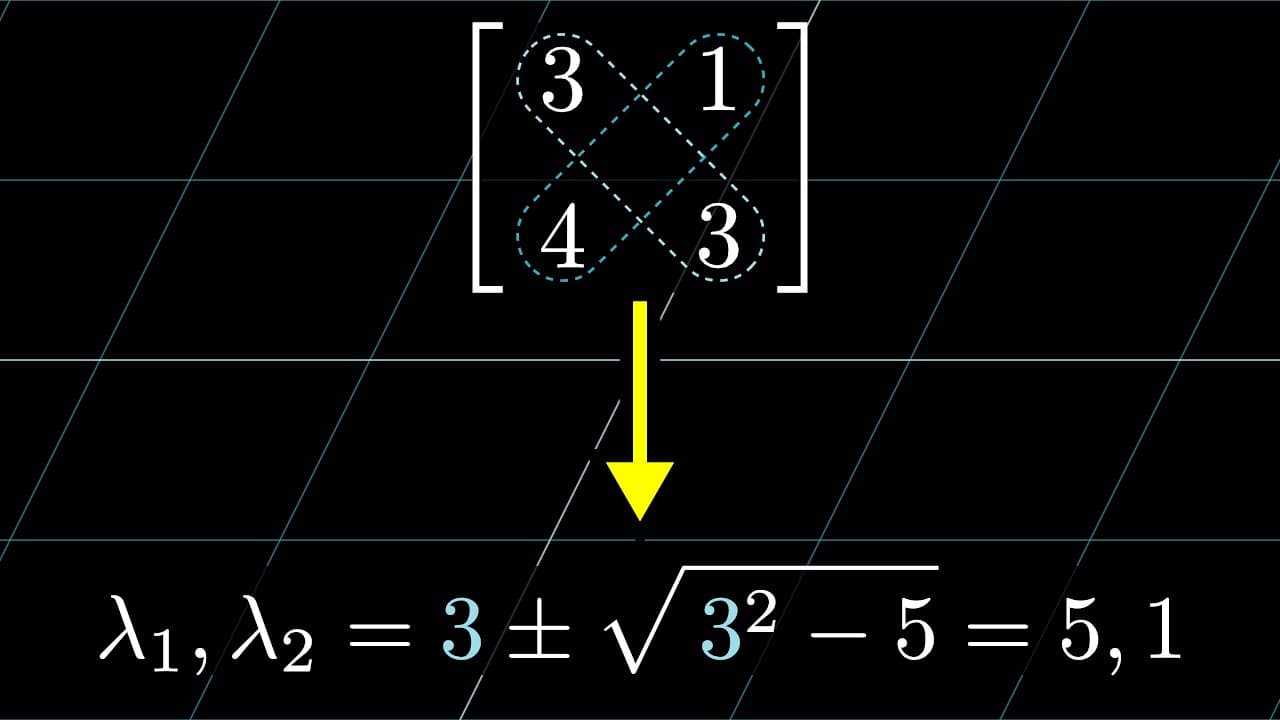
The quick trick uses the mean of the eigenvalues which equals the mean of the diagonal entries, and the product equals the determinant. From those two numbers you recover the eigenvalues as m ± sqrt(m^2 − p). This avoids expanding a characteristic polynomial and works well for 2x2 matrices, with intuition from determinant and trace.
Transcript
This is a video for anyone who already knows what eigenvalues and eigenvectors are, and who might enjoy a quick way to compute them in the case of 2x2 matrices. If you're unfamiliar with eigenvalues, go ahead and take a look at this video here, which is actually meant to introduce them. You can skip ahead if all you want to do is see the trick, but... Read More
Key Insights
- The mean of the eigenvalues equals the mean of the diagonal entries of the matrix.
- The product of the eigenvalues equals the determinant of the matrix.
- If the mean is m and the product is p, the eigenvalues are m plus or minus the square root of m^2 minus p.
- This method uses a difference of squares to recover the two eigenvalues.
- For a 2x2 matrix, eigenvalues can be obtained without fully forming the characteristic polynomial.
- The Pauli spin matrices provide concrete examples where this method applies and yields ±1 as eigenvalues.
- The technique highlights that mean and product contain enough information to reconstruct two numbers.
- In some cases, the traditional determinant-based approach may be faster, but the mean-product trick shines in quick mental calculations.
Install to Summarize YouTube Videos and Get Transcripts
Explore YouTube Video Summarizer or Get YouTube Transcript Extractor
Questions & Answers
Q: What is the quick trick to find eigenvalues of a 2x2 matrix in one line?
The quick trick is to compute the mean of the eigenvalues, which equals the mean of the diagonal entries, and the product of the eigenvalues, which equals the determinant. Then the eigenvalues are obtained as the mean plus or minus the square root of the mean squared minus the product. This gives you the two eigenvalues directly without expanding the characteristic polynomial.
Q: Why does the mean of the eigenvalues relate to the diagonal entries for a 2x2 matrix?
For a 2x2 matrix, the eigenvalues satisfy that their sum equals the trace of the matrix, which is the sum of the diagonal entries. This means the average (mean) of the two eigenvalues equals the average of the two diagonal entries. This relationship allows you to set up a simple system using the mean and the product to recover the eigenvalues.
Q: What role does the determinant play in this method?
The determinant equals the product of the two eigenvalues. This provides the second piece of information needed, together with the mean, to recover the two eigenvalues. With the mean m and product p, you can solve for the two eigenvalues as m plus or minus the square root of m squared minus p.
Q: How do you handle the two eigenvalues using m and p?
You assume the eigenvalues are m plus or minus some distance d, where d squared equals m squared minus p. This leads to the two eigenvalues being m plus d and m minus d, and since d is the square root of m^2 minus p, you obtain the eigenvalues directly as m ± sqrt(m^2 − p).
Q: Can this method be used for matrices beyond 2x2?
The method is described specifically for 2x2 matrices because the mean and product information uniquely determine the two eigenvalues in that case. For larger matrices, the eigenvalue problem becomes more complex and the simple mean-product formula does not directly give all eigenvalues without additional steps.
Q: What is the intuition behind using mean and product to find eigenvalues?
The mean and product of two numbers capture their sum and multiplicative extent, which are the two essential invariants (trace and determinant) of a 2x2 operator. Using these two invariants to reconstruct the numbers relies on the algebraic identity that two numbers with a given sum and product are roots of a quadratic, recoverable by a square root operation.
Q: What example is used to illustrate the trick in the video?
The video uses a concrete 2x2 matrix as an example where the mean of the eigenvalues equals the mean of the diagonal entries and the determinant gives the product of the eigenvalues. By applying m plus or minus sqrt(m^2 minus p), the eigenvalues are obtained quickly, showing how the trick unfolds in practice.
Q: Why might the traditional method still be faster in some cases?
In cases where the characteristic polynomial is already simple or when the matrix has structure such as being diagonal, the traditional method may directly yield eigenvalues without invoking the mean-product trick. The video notes that for some matrices the standard approach could be as fast or even faster, but the quick trick shines in general 2x2 cases and mental math.
Summary & Key Takeaways
-
The method hinges on two key facts: the mean of the eigenvalues equals the mean of the diagonal entries, and the product of the eigenvalues equals the determinant. With those two numbers, you solve for the eigenvalues by recovering two numbers with a given mean and product. This yields a fast, head-friendly solution.
-
The approach is particularly efficient for 2x2 matrices, and you can see the speedup when considering combinations of Pauli spin matrices or similar cases. It foregrounds a difference-of-squares structure that simplifies the calculation dramatically.
-
The technique is presented as a quick, generalizable trick: read off the mean and product, then compute the distance from the mean using the square root of m^2 minus p to find the eigenvalues themselves.
Read in Other Languages (beta)
Share This Summary 📚
Summarize YouTube Videos and Get Video Transcripts with 1-Click
Try YouTube Summary with ChatGPT & Claude or YouTube Transcript Generator
Explore More Summaries from 3Blue1Brown 📚






Summarize YouTube Videos and Get Video Transcripts with 1-Click
Try YouTube Summary with ChatGPT & Claude or YouTube Transcript Generator