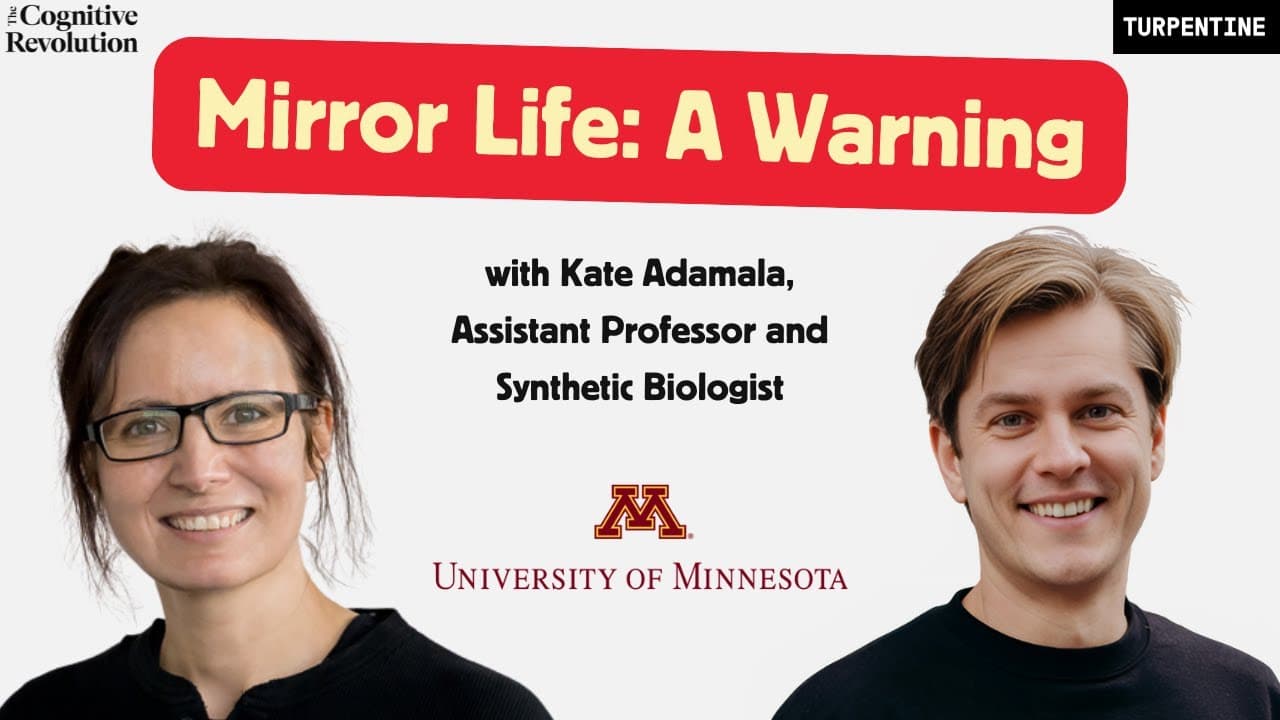
Don't Make Mirror Life: Synthetic Biologist Kate Adamala on Risks & Responsibility
TL;DR
Kate Adamala warns against developing mirror life due to potential risks.
Transcript
Hello and welcome back to the cognitive revolution. Today my guest is Kate Admala, professor of genetics at the University of Minnesota and synthetic biologist who recently made headlines for coordinating a diverse group of prominent researchers to issue a collective warning against the creation of mirror life. We begin with a discussion of the ori... Read More
Key Insights
- Kate Adamala, a synthetic biologist, initially supported mirror life research but now warns against it due to potential ecological and health risks.
- Mirror life involves creating organisms with mirror-image molecules, which could evade immune systems and disrupt ecosystems if released.
- The concept of mirror life parallels AI safety concerns, highlighting the need for cautious innovation in transformative technologies.
- Adamala emphasizes the importance of responsible scientific advancement, advocating for a pause in mirror life research until more is understood.
- The scientific community can coordinate to identify and avoid dangerous research directions, as demonstrated by Adamala's coalition against mirror life.
- Synthetic biology aims to expand the chemical capabilities of life, but must balance potential benefits with the risks of unintended consequences.
- The discussion draws analogies between synthetic biology and AI, suggesting similar ethical and safety considerations in both fields.
- Adamala's journey underscores the necessity of reevaluating scientific pursuits in light of new evidence and potential societal impacts.
Install to Summarize YouTube Videos and Get Transcripts
Explore YouTube Video Summarizer or Get YouTube Transcript Extractor
Questions & Answers
Q: What is mirror life and why is it considered risky?
Mirror life refers to organisms composed of mirror-image molecules, which could evade immune systems and disrupt ecosystems if released. The risk lies in their potential to grow unchecked, as they are not recognized by natural predators or immune systems, posing ecological and health threats.
Q: How does mirror life relate to AI safety concerns?
Mirror life and AI share parallels in the need for cautious innovation. Both fields offer transformative benefits but also pose poorly understood risks. The discussion emphasizes the importance of evaluating the implications of new technologies and adjusting research directions to avoid potential dangers.
Q: What was Kate Adamala's personal journey regarding mirror life?
Kate Adamala initially supported mirror life research for its potential benefits but shifted her stance after recognizing the significant risks involved. Her journey involved collaborating with experts to assess the risks and ultimately leading a coalition to issue a warning against developing mirror life.
Q: What are the potential benefits of synthetic biology?
Synthetic biology aims to expand the chemical capabilities of life, offering potential benefits in medicine, agriculture, and environmental sustainability. It seeks to engineer organisms to produce valuable compounds, improve health outcomes, and create sustainable alternatives to petrochemicals.
Q: What are the challenges in understanding and defining life?
Defining life is challenging due to its complexity and emergent properties. Traditional definitions, such as self-replication and Darwinian evolution, have limitations. This ambiguity complicates efforts to create synthetic life, as researchers must navigate the unknowns of what constitutes life.
Q: How does the scientific community address dangerous research directions?
The scientific community can coordinate to identify and avoid dangerous research directions by building coalitions and issuing warnings, as demonstrated by Adamala's efforts against mirror life. Such collaboration helps set ethical standards and guide responsible innovation in transformative fields.
Q: What are the ethical considerations in genetic editing and synthetic biology?
Ethical considerations in genetic editing and synthetic biology involve balancing potential benefits with risks of unintended consequences. The discussion highlights the need for responsible innovation, public engagement, and regulatory frameworks to ensure that scientific advancements align with societal values.
Q: What role does imagination play in scientific discovery and risk assessment?
Imagination is crucial in scientific discovery and risk assessment, as it allows researchers to envision possibilities and anticipate potential outcomes. The discussion underscores the importance of considering both the positive and negative implications of new technologies, fostering a proactive approach to innovation.
Summary & Key Takeaways
-
Kate Adamala discusses the potential and risks of synthetic biology, particularly the concept of mirror life, which involves organisms made of mirror-image molecules. She highlights the parallels between synthetic biology and AI, emphasizing the need for responsible innovation to prevent unintended consequences.
-
Adamala recounts her shift from supporting mirror life research to leading a coalition against it, citing ecological and health risks. She stresses the importance of scientific communities coordinating to identify and avoid particularly dangerous research directions.
-
The episode concludes with reflections on maximizing benefits while minimizing risks in both synthetic biology and AI. Adamala's insights offer a model for responsible scientific advancement and highlight the critical role of ethical considerations in transformative research.
Read in Other Languages (beta)
Share This Summary 📚
Summarize YouTube Videos and Get Video Transcripts with 1-Click
Try YouTube Summary with ChatGPT & Claude or YouTube Transcript Generator
Explore More Summaries from Cognitive Revolution "How AI Changes Everything" 📚


Summarize YouTube Videos and Get Video Transcripts with 1-Click
Try YouTube Summary with ChatGPT & Claude or YouTube Transcript Generator