How to Write YouTube Titles That Earn More Clicks
TL;DR
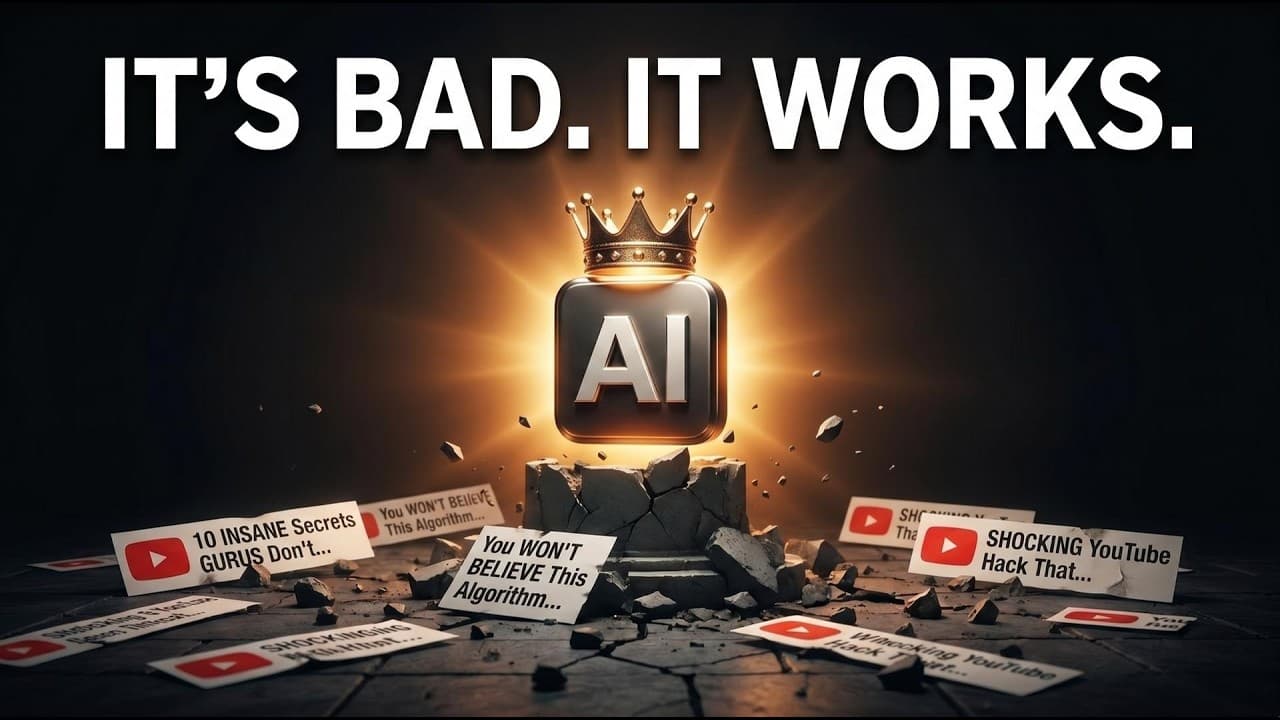
Write YouTube titles for unfamiliar viewers, not for yourself as the creator. Across an eight-week test, AI-assisted titles passed the creator's 1,000-view benchmark on seven of eight videos, while two manually chosen titles received only 700 and 600 first-day views. Use AI as a brainstorming partner, then apply human judgment instead of accepting every suggestion blindly.
Transcript
Your video's title is either the reason someone clicks or the reason they scroll straight past you. And I'm going to guess that you probably think you're writing good titles because I thought the same too. And I was consistently wrong because I ran an 8week test. One video a week, a total of eight videos. And I wrote the titles myself for some of t... Read More
Key Insights
- A YouTube title is a major factor in whether someone clicks or continues scrolling. The experiment separates that function from content quality: the title earns the initial click, while the content determines whether the viewer stays after opening the video.
- The eight-week test produced seven videos that reached at least 1,000 views within roughly the first 24 hours. The only video below that benchmark during the initial sequence used the creator's own carefully selected title and received 700 views.
- Creator bias is a consequence of knowing too much about the finished video. A title may feel clear and compelling to its creator because they already understand the topic, purpose, and strongest moments, while an unfamiliar viewer lacks all of that context.
- Viewer-focused framing is more effective than emphasizing what the creator did. The creator contrasted a title about sacrificing six videos with an AI-assisted title about why YouTube stops pushing videos, and the latter helped produce 8,800 first-day views.
- The strongest early result came from an AI-assisted title that generated more than 5,000 views in the first 24 hours. That upload later reached about 60,000 views and brought the channel more than 800 new subscribers, according to the creator.
- Trend relevance is not sufficient to secure clicks by itself. A video timed around Google's rollout of more AI features on YouTube reached approximately the 1,000-view benchmark, but the creator concluded that its viewer-oriented framing still mattered alongside the timely topic.
- Content quality and click generation are separate problems for creators. The video in which the creator had invested the most effort received only 600 views in its first 24 hours when paired with his own title, making it the experiment's weakest performer.
- AI works best here as a brainstorming partner rather than an automatic decision-maker. The creator pushed back on suggestions, explored multiple angles, and retained final control because VidIQ sometimes pursued keywords and search volume, which he did not consider sufficient explanations for views.
- More videos from this channel:
- More from this channel: Kevin Chee
Install to Summarize YouTube Videos and Get Transcripts
Explore YouTube Video Summarizer or Get YouTube Transcript Extractor
Questions & Answers
Q: How can creators write YouTube titles that get more clicks?
Creators can improve titles by framing them around what an unfamiliar viewer wants to understand, rather than around the work the creator performed. The experiment's strongest comparison replaced a title about sacrificing six videos with one about why the YouTube algorithm stops pushing videos. The revised framing addressed a viewer's question and helped the upload reach 8,800 views in its first 24 hours.
Q: Why can a creator's own YouTube titles underperform?
A creator's titles can underperform because the creator already knows the video's topic, importance, and best moments. That context makes a descriptive title feel more compelling than it may appear to a person encountering the channel for the first time. In the experiment, two titles personally selected by the creator produced only 700 and 600 views during their first 24 hours.
Q: Did AI-generated titles outperform manually written titles in the test?
The AI-assisted approach produced a clear advantage within this eight-video experiment. Seven uploads reached the benchmark of 1,000 views in approximately their first 24 hours, while manually selected titles produced results of 700 and 600 views. The best AI-assisted title accompanied a video that earned 8,800 first-day views, although the creator did not claim that VidIQ is always correct.
Q: Should creators publish AI-generated titles without reviewing them?
Creators should not blindly publish the first title an AI provides. The creator used VidIQ as a brainstorming partner, challenged its recommendations, explored alternative angles, and made the final decision himself. Human review remained important because the tool sometimes favored keywords and search volume, while the creator believed those factors alone did not account for whether a video received views.
Q: What first-day view benchmark was used in the title experiment?
The creator set 1,000 views in the first 24 hours as the experiment's benchmark. Results below that level counted as business as usual, while results above it indicated that something was working. Seven of the eight tested videos reached the benchmark, including one trend-related upload that hit approximately 1,000 views just beyond the first 24 hours.
Q: What was the best-performing title result in the experiment?
The best-performing upload received 8,800 views in its first 24 hours. Its AI-assisted title focused on why the YouTube algorithm stops pushing videos, whereas the creator's preferred title emphasized that he had sacrificed six videos to prove YouTube was not luck. The result supported his conclusion that viewer questions can be more clickable than creator-centered experiences.
Q: Can a timely YouTube trend make a weak title successful?
A timely trend may place a video in front of interested viewers, but the experiment suggested that the title must still persuade them to click. The creator published one video while Google was introducing more AI into YouTube. It reached approximately the 1,000-view benchmark, and he attributed getting over the line to its framing rather than to the trend alone.
Q: What is the difference between a video's title and its content?
The title and content solve two distinct problems. The title gives a scrolling viewer a reason to click, while the content gives that person a reason to stay. The creator's most labor-intensive video became the experiment's weakest performer with 600 first-day views, illustrating that pride in the content does not ensure that its packaging will attract an audience.
Summary & Key Takeaways
-
The creator tested AI-assisted title development across eight weekly uploads, using 1,000 views in the first 24 hours as the benchmark. Seven videos reached that target, while the strongest result earned 8,800 views. The experiment suggested that title framing can substantially affect whether viewers click, independently of content quality.
-
The clearest pattern was the difference in perspective. The creator's titles often emphasized his actions, experiments, or experiences, while VidIQ's suggestions emphasized questions and problems viewers wanted to understand. A title can accurately describe a video yet still underperform if it assumes knowledge that a new viewer does not possess.
-
The creator did not recommend accepting AI output without review. He treated VidIQ as a brainstorming partner, challenged its suggestions, tested different angles, and made the final selection himself. AI helped expose creator bias, but human judgment remained necessary because the tool sometimes prioritized keywords and search volume more heavily than he considered appropriate.
Read in Other Languages (beta)
Share This Summary 📚
Summarize YouTube Videos and Get Video Transcripts with 1-Click
Try YouTube Summary with ChatGPT & Claude or YouTube Transcript Generator
Explore More Summaries from Kevin Chee 📚
Summarize YouTube Videos and Get Video Transcripts with 1-Click
Try YouTube Summary with ChatGPT & Claude or YouTube Transcript Generator