Pushdown Automata (Graphical Notation)
TL;DR
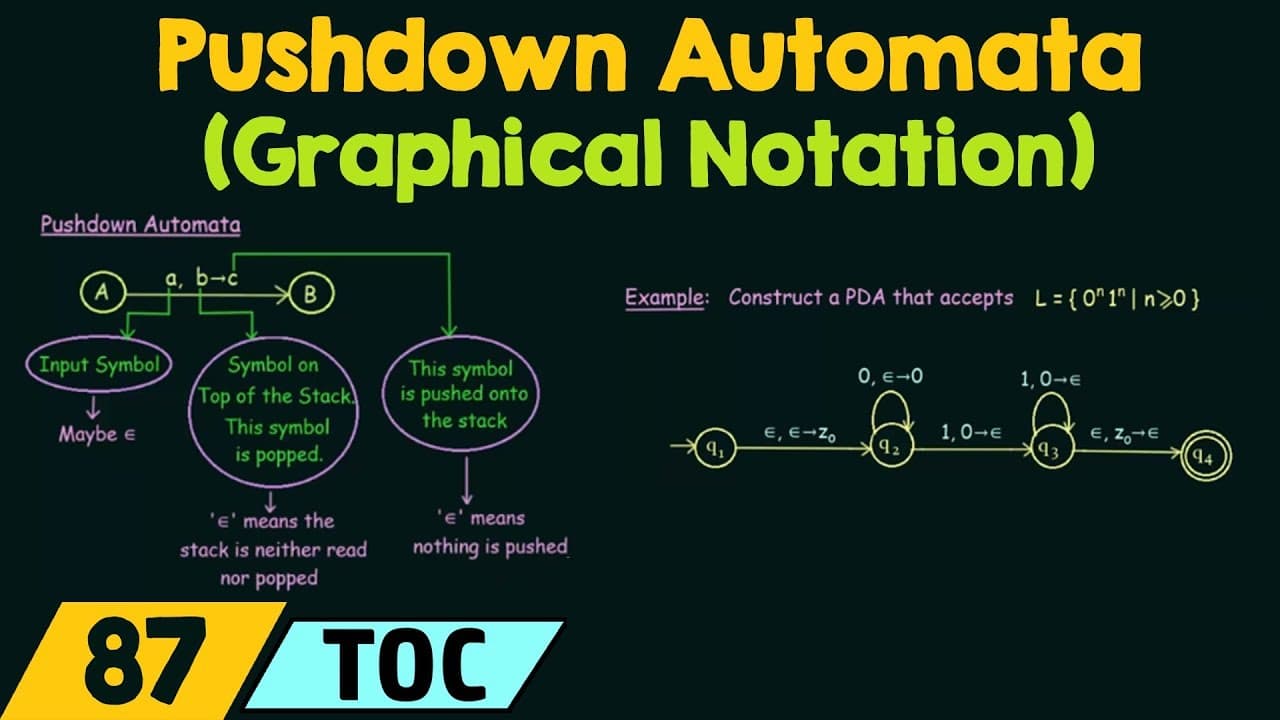
This lecture discusses the graphical notation used to represent pushdown automata, which consists of circles representing states, arrows representing transitions, and symbols denoting input, stack elements, and stack operations.
Transcript
in the last lecture we have studied about the formal definition of pushed on automata and we saw how pushed on automata can be formally defined using those seven tuples now in this lecture we will be seeing how can we graphically denote pushdown automata so we'll be studying about the graphical notation of pushdown automata now when we studied abou... Read More
Key Insights
- ❓ Pushdown automata can be represented graphically using transition diagrams.
- 💘 The graphical notation includes circles for states and arrows for transitions.
- 🔣 Symbols in the diagrams represent input, stack elements, and stack operations.
- 🤬 Stack symbols can be popped, pushed, or remain unchanged.
- ⚧️ The symbol "Z0" or the dollar symbol represents the bottommost element of the stack, indicating the end of the stack.
- 🔣 Pushdown automata diagrams can be non-deterministic, allowing for multiple transitions or no transitions on certain input symbols.
Install to Summarize YouTube Videos and Get Transcripts
Explore YouTube Video Summarizer or Get YouTube Transcript Extractor
Questions & Answers
Q: How is a pushdown automata represented graphically?
Pushdown automata are represented using transition diagrams, with circles representing states and arrows representing transitions based on input symbols and stack operations.
Q: What does the input symbol represent in a pushdown automata diagram?
The input symbol represents the symbol received by the pushdown automata and is similar to the input symbol in finite state machines.
Q: How are stack symbols represented in a pushdown automata diagram?
Stack symbols are represented by the symbol on the topmost element of the stack. They can be popped (removed), pushed (inserted), or remain unchanged (epsilon).
Q: What does the symbol "Z0" or the dollar symbol represent in a pushdown automata diagram?
The symbol "Z0" or the dollar symbol represents the bottommost element of the stack, indicating the end of the stack. It helps in checking if the stack is empty or not.
Key Insights:
- Pushdown automata can be represented graphically using transition diagrams.
- The graphical notation includes circles for states and arrows for transitions.
- Symbols in the diagrams represent input, stack elements, and stack operations.
- Stack symbols can be popped, pushed, or remain unchanged.
- The symbol "Z0" or the dollar symbol represents the bottommost element of the stack, indicating the end of the stack.
- Pushdown automata diagrams can be non-deterministic, allowing for multiple transitions or no transitions on certain input symbols.
- Two cases for accepting a language in a pushdown automata are reaching a final state and having an empty stack.
Summary & Key Takeaways
-
Pushdown automata can be graphically represented using transition diagrams, similar to finite state machines.
-
In these diagrams, circles represent states, arrows represent transitions, and symbols denote input, stack elements, and stack operations.
-
The input symbol represents the symbol received by the pushdown automata, while the stack symbol represents the topmost symbol on the stack.
-
Stack symbols can be popped (removed) or pushed (inserted), and the stack can also remain unchanged (represented by epsilon).
Read in Other Languages (beta)
Share This Summary 📚
Summarize YouTube Videos and Get Video Transcripts with 1-Click
Try YouTube Summary with ChatGPT & Claude or YouTube Transcript Generator
Explore More Summaries from Neso Academy 📚



Summarize YouTube Videos and Get Video Transcripts with 1-Click
Try YouTube Summary with ChatGPT & Claude or YouTube Transcript Generator