How to Do Non-Sleep Deep Rest (NSDR) to Restore Energy
TL;DR
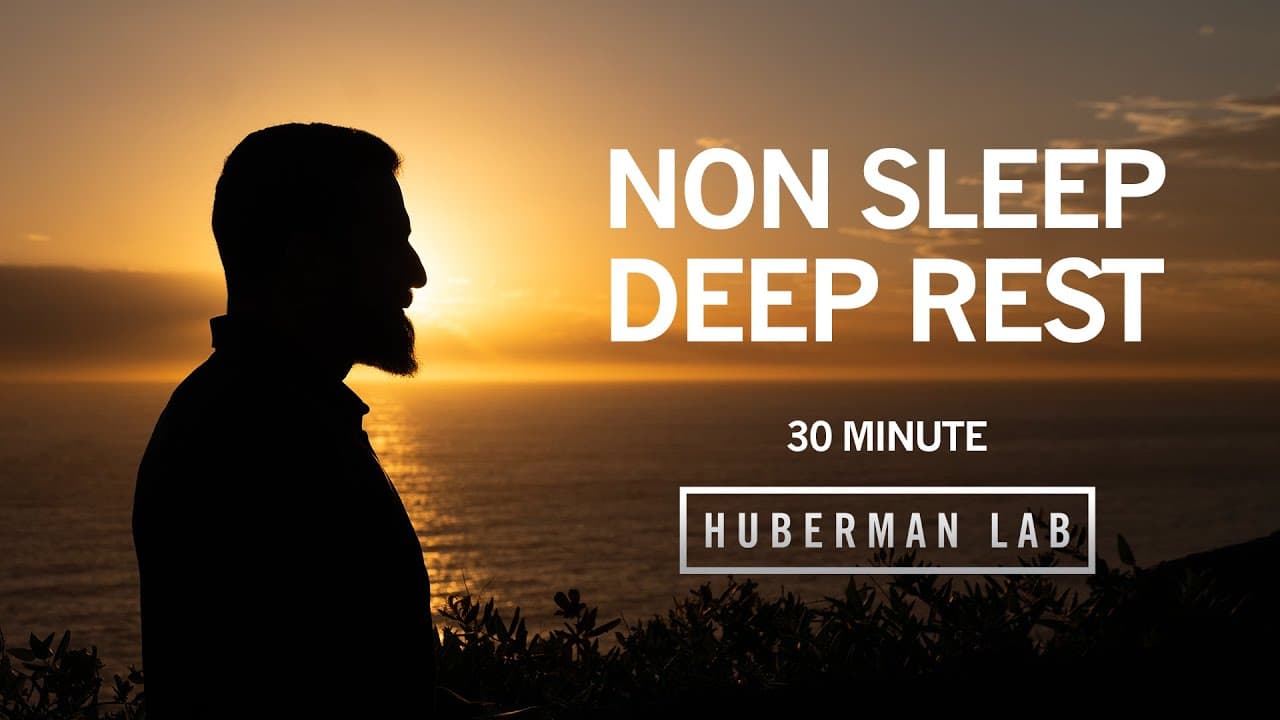
Non-sleep deep rest lets you control your nervous system's relaxation state through slow breathing and directed attention, restoring mental and physical vigor in about 30 minutes. Done seated or lying down with eyes closed, it can even partially offset the negative consequences of getting too little sleep, and can be practiced any time of day or night.
Transcript
Welcome to this 30-minute non-sleep deep rest protocol. Non-sleep deep rest is a powerful tool that can allow you to control the relaxation state of your nervous system and your overall state of mind. It can restore mental and physical vigor, and it can be done any time of day or night. It can even partially offset the negative consequences of gett... Read More
Key Insights
- Non-sleep deep rest is a tool that lets you control the relaxation state of your nervous system and overall state of mind, restoring mental and physical vigor at any time of day or night.
- NSDR can even partially offset the negative consequences of getting too little sleep, making it useful when your rest has been insufficient.
- Specific forms of breathing place the body into deep relaxation by slowing the heart rate down, which is why deep nasal inhales and long mouth exhales are central to the protocol.
- Sensations are the conversion of physical events like photons, mechanical pressure, and sound waves into electrical and chemical signals in your neurons, and are simply present around and inside you.
- Perception is the subset of sensations you happen to focus on at a given moment, and you can control it even though you cannot control which sensations exist.
- Exteroception is paying attention to things around you beyond your skin, while interoception is paying attention to the surface of your skin and inward inside your body.
- The exhale technique uses thinly pursed lips, as if breathing through a small straw, to lengthen and complete the out-breath and relax the nervous system.
- Deliberately moving toes, fingers, ankles, or the chin during the practice demonstrates that you direct your own perceptions and actions, confirming control over your nervous system.
Install to Summarize YouTube Videos and Get Transcripts
Explore YouTube Video Summarizer or Get YouTube Transcript Extractor
Questions & Answers
Q: What is non-sleep deep rest (NSDR)?
Non-sleep deep rest is a powerful tool that allows you to control the relaxation state of your nervous system and your overall state of mind. It can restore mental and physical vigor and can be done any time of day or night. It shifts your brain state from thinking, stress, planning, and anticipation toward one of pure sensation and deep relaxation, and it can even partially offset the negative consequences of getting too little sleep.
Q: How does NSDR help when you have not slept enough?
According to the protocol, non-sleep deep rest can partially offset the negative consequences of getting too little sleep. It works by placing you into a state of deep relaxation through specific breathing that slows your heart rate down, and by shifting your focus away from stress and planning toward pure sensation. Because it can be done any time of day or night, it offers a way to recover mental and physical vigor even when your actual sleep has been insufficient.
Q: How should you breathe during NSDR?
You breathe normally throughout unless instructed otherwise. The key pattern is a big, deep inhale through your nose until your lungs are full, followed by a long, slow exhale until your lungs are empty through your mouth, with thinly pursed lips as if breathing through a small straw. If you cannot breathe through your nose, you can inhale through your mouth. This deep-inhale, complete-exhale pattern is known to slow your heart rate down and relax your nervous system.
Q: What is the difference between sensation and perception?
Sensations are the conversion of physical events in the world, such as photons of light, mechanical pressure on the skin, and sound waves, into electrical and chemical signals in your neurons or nerve cells. You cannot directly control which sensations are around and inside you; they are just there. Perception is simply the sensations you happen to be focused on at a given moment, and unlike sensations, your perception is something you can control and direct.
Q: What are exteroception and interoception?
These are the two kinds of perception described in the protocol. Exteroception is when you pay attention to things around you, beyond the confines of your skin. Interoception is when you pay attention to things at the level of the surface of your skin and inward, inside your body. During NSDR you deliberately shift between them, for example listening to sounds in your environment for exteroception and focusing on what your feet or abdomen are sensing for interoception.
Q: What position should you be in to do NSDR?
You should do the protocol seated or lying down, so if you are not already in one of those positions you are asked to get into one before starting. You also close your eyes for the duration of the practice. From there you breathe normally, imagine your body sinking into whatever surface it is in contact with, and follow the guided attention and breathing instructions. The relaxed, supported posture supports the deep relaxation the protocol is designed to produce.
Q: How is the spotlight technique used in NSDR?
You imagine standing over yourself, looking down at your body, and holding a flashlight or spotlight that you direct at different areas. You begin at the feet, focusing on whatever they are in contact with, then expand the beam upward to include the shins, calves, thighs, waist, abdomen, chest, arms, back, and face. You also brighten and dim the spotlight in your mind's eye, sometimes until your body is barely a silhouette, while focusing your perception on what each illuminated part senses.
Q: Why do you make small deliberate movements during NSDR?
At several points you deliberately move your toes, one or two fingers on each hand, your ankles, knees, or your chin and head a centimeter to each side. As you do so, you take notice that you made that decision. These movements demonstrate that you are in control of your nervous system, meaning you direct your own perceptions and actions. After each movement you return your body to stillness while remaining completely relaxed.
Summary & Key Takeaways
-
Non-sleep deep rest is a 30-minute protocol that lets you control your nervous system's relaxation state and shift your brain from thinking, stress, planning, and anticipation toward pure sensation and deep relaxation. It restores mental and physical vigor and can partially offset the effects of too little sleep.
-
The practice is done seated or lying down with eyes closed, breathing normally except when instructed to inhale deeply through the nose and exhale completely through thinly pursed lips. This breathing pattern slows the heart rate down, while imagining the body sinking into its supporting surface deepens relaxation.
-
Attention is directed with an imagined spotlight moving across the body, from the feet upward through the legs, abdomen, chest, arms, back, and face, focusing on whatever each part senses. Small deliberate movements of toes, fingers, and head reinforce that you direct your own perceptions and actions.
Read in Other Languages (beta)
Share This Summary 📚
Summarize YouTube Videos and Get Video Transcripts with 1-Click
Try YouTube Summary with ChatGPT & Claude or YouTube Transcript Generator
Explore More Summaries from Huberman Lab Clips 📚




Summarize YouTube Videos and Get Video Transcripts with 1-Click
Try YouTube Summary with ChatGPT & Claude or YouTube Transcript Generator