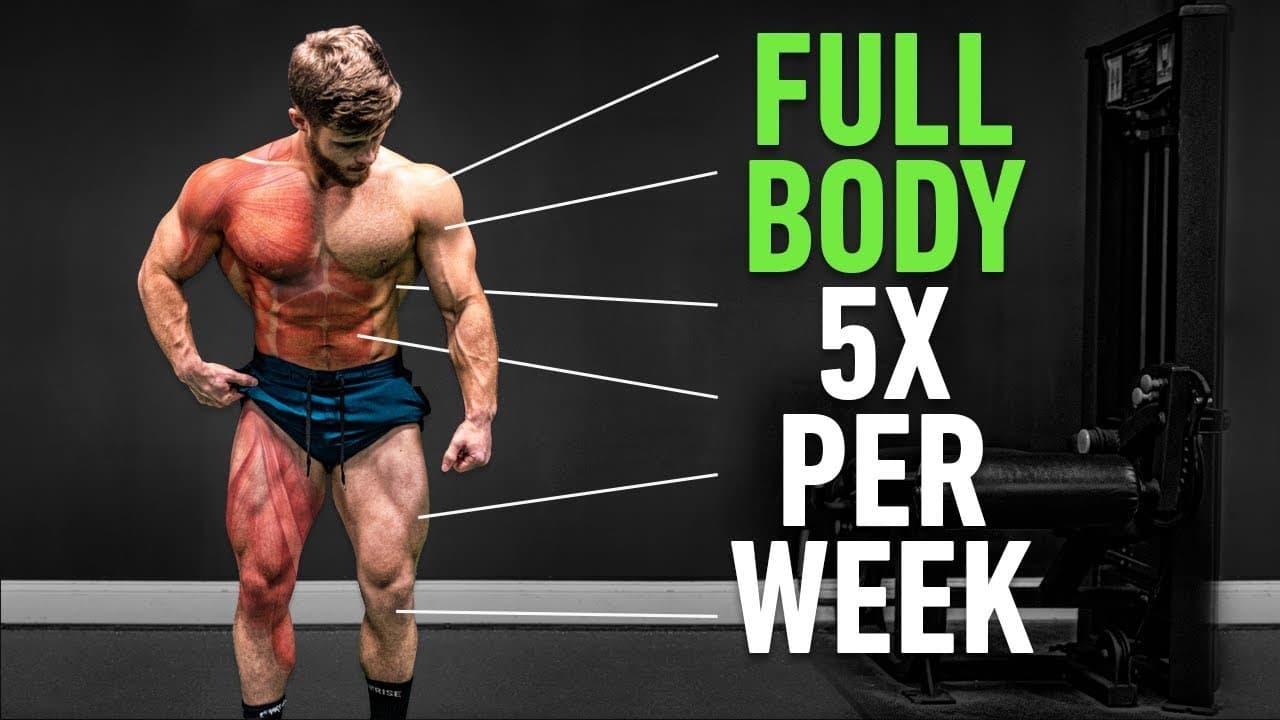
How to Train Full Body Five Days per Week
TL;DR
High-frequency full-body training works by spreading weekly volume across more sessions, which can improve set quality, manage fatigue, and reduce wasted work. It is most appropriate for intermediate or advanced lifters, while beginners may do well with lower frequencies. Start around RPE 7–8, control per-session volume, and move closer to failure as recovery adapts.
Transcript
full body five days a week this is the training split I've been running for the last six months and I think it's great now when I explain this setup to your average gym bro they tend to look at me like I've got 10 heads sometimes they'll suggest that body part splits make more sense where you just destroy one or two muscles a day and then give them... Read More
Key Insights
- Training frequency is more relevant for experienced lifters because the post-training increase in muscle protein balance may return toward baseline faster as training experience grows. The transcript reports an elevation lasting about two days in new lifters but only around 12 hours in experienced trainees.
- The evidence connecting frequent muscle protein synthesis spikes to long-term hypertrophy remains disputed. Critics question whether mixed muscle protein synthesis adequately represents contractile tissue growth, while another protein researcher cited in the transcript maintained that protein synthesis can predict hypertrophy.
- The Norwegian frequency project compared full-body training three versus six days per week while holding weekly volume constant. After 15 weeks, the six-day group reportedly gained nearly twice as much size and strength and increased its lifts by 10 percent versus 5 percent.
- The Norwegian project requires cautious interpretation because its complete results were never published in a peer-reviewed journal. A later six-week replication using early intermediate lifters found similar strength and size gains with three-day and six-day programs, showing that either frequency can be effective.
- High-frequency training is valuable because it spreads weekly volume across more sessions. This distribution can reduce fatigue within each workout, preserve energy for individual exercises, and improve set quality even when total weekly volume remains unchanged.
- Weekly volume is only part of effective programming because per-workout volume also matters. The transcript identifies 10–20 working sets per muscle per week as a useful general range and suggests a per-workout ceiling of roughly 5–10 sets before additional work risks becoming junk volume.
- Full-body sessions can support training intensity by limiting each muscle to roughly one exercise per workout. A lifter may perform three leg-press sets with greater focus and performance when they do not follow squats and lunges within a long, fatiguing leg session.
- Recovery is manageable when a traditional body-part workout is divided across four or five days rather than repeated in full every day. During the first weeks, lifters should control volume and intensity, use complete warm-ups, and stay near RPE 7–8 until adaptation improves recovery.
Install to Summarize YouTube Videos and Get Transcripts
Explore YouTube Video Summarizer or Get YouTube Transcript Extractor
Questions & Answers
Q: How does five-day full-body training work?
Five-day full-body training divides the weekly work for each muscle across several sessions. Training the chest every day, for example, does not mean repeating a complete chest workout five times. It means distributing the exercises and sets from a typical chest day across four or five workouts, allowing each session to contain less local fatigue and more focused work.
Q: Why can high-frequency training improve muscle growth?
High-frequency training may improve muscle growth by creating more frequent training stimuli and, more practically, by distributing weekly volume across multiple workouts. Spreading the work can prevent too many sets from being performed after fatigue has reduced their quality. It may also let experienced trainees accumulate more productive volume while maintaining appropriate intensity and recovery throughout the week.
Q: How much weekly volume should each muscle receive?
The transcript identifies 10–20 working sets per muscle each week as a generally supported range for most muscles. That total should not automatically be concentrated in one workout. Because the suggested per-workout ceiling is around 5–10 sets per muscle, dividing weekly volume across more sessions can help preserve set quality and limit work that may provide little additional hypertrophy.
Q: What is junk volume in high-frequency training?
Junk volume refers to additional sets that contribute little to muscle growth because too much work has already been completed for that muscle in the same session. The transcript suggests that a per-workout ceiling may exist around 5–10 sets per muscle. High-frequency programming reduces this risk by placing the weekly sets in several shorter, less fatiguing workouts.
Q: Can muscles recover when trained on consecutive days?
Muscles can recover between consecutive sessions when daily volume and intensity remain controlled. A high-frequency plan distributes one large body-part workout across the week instead of performing that entire workout every day. The repeated bout effect may also improve recovery after two or three weeks, reducing soreness as the body adapts to the recurring training stimulus.
Q: How hard should high-frequency workouts be at first?
The first few weeks should generally be performed around RPE 7–8 rather than the usual RPE 8–9 described in the transcript. Stopping farther from failure helps compensate for the shorter recovery period between sessions. As soreness declines and the repeated bout effect develops, the lifter can gradually resume training closer to failure without unnecessarily overwhelming recovery.
Q: Is five-day full-body training suitable for beginners?
Five-day full-body training is presented primarily as an intermediate-to-advanced approach. The transcript says beginners can progress well without training each muscle more than once weekly, while the description recommends a three-day full-body fundamentals program for people with only a year or two in the gym. Higher frequency becomes more compelling when experienced trainees need a new stimulus and better volume distribution.
Q: Is five-day full-body training better than other splits?
Five-day full-body training is not described as universally superior to push-pull-legs, upper-lower, or body-part splits. Its main advantages are distributing volume, managing fatigue, reducing soreness, and improving focus on each exercise. The best split is the one that organizes appropriate weekly volume and intensity while permitting recovery, and the preferred arrangement can depend on experience and current motivation.
Summary & Key Takeaways
-
Five-day full-body training distributes work for each muscle across the week instead of concentrating it in a single demanding session. This arrangement can make each set more productive because fewer exercises compete for energy within one workout. The approach is designed mainly for intermediate and advanced trainees seeking continued progress.
-
The proposed hypertrophy framework combines weekly volume, workout volume, intensity, and recovery. A general weekly target is 10–20 working sets per muscle, while the suggested per-workout ceiling is approximately 5–10 sets per muscle. More frequent sessions can distribute that work and reduce the risk of accumulating junk volume.
-
Recovery depends on keeping individual sessions controlled rather than repeating a complete body-part workout every day. Early sessions should generally stay around RPE 7–8, with thorough warm-ups and modest volume. After two or three weeks, the repeated bout effect may reduce soreness and permit training closer to failure again.
Read in Other Languages (beta)
Share This Summary 📚
Summarize YouTube Videos and Get Video Transcripts with 1-Click
Try YouTube Summary with ChatGPT & Claude or YouTube Transcript Generator
Explore More Summaries from Jeff Nippard 📚



Summarize YouTube Videos and Get Video Transcripts with 1-Click
Try YouTube Summary with ChatGPT & Claude or YouTube Transcript Generator