How to Start a Business With No Money Using Lean Startup
TL;DR
The core method is to build a minimal viable product, measure customer response, and learn quickly to guide the next steps. Start with less than a thousand dollars, leverage AI and outsourcing to test demand before heavy spending. Focus on reducing waste and uncovering true product market fit through iterative learning.
Transcript
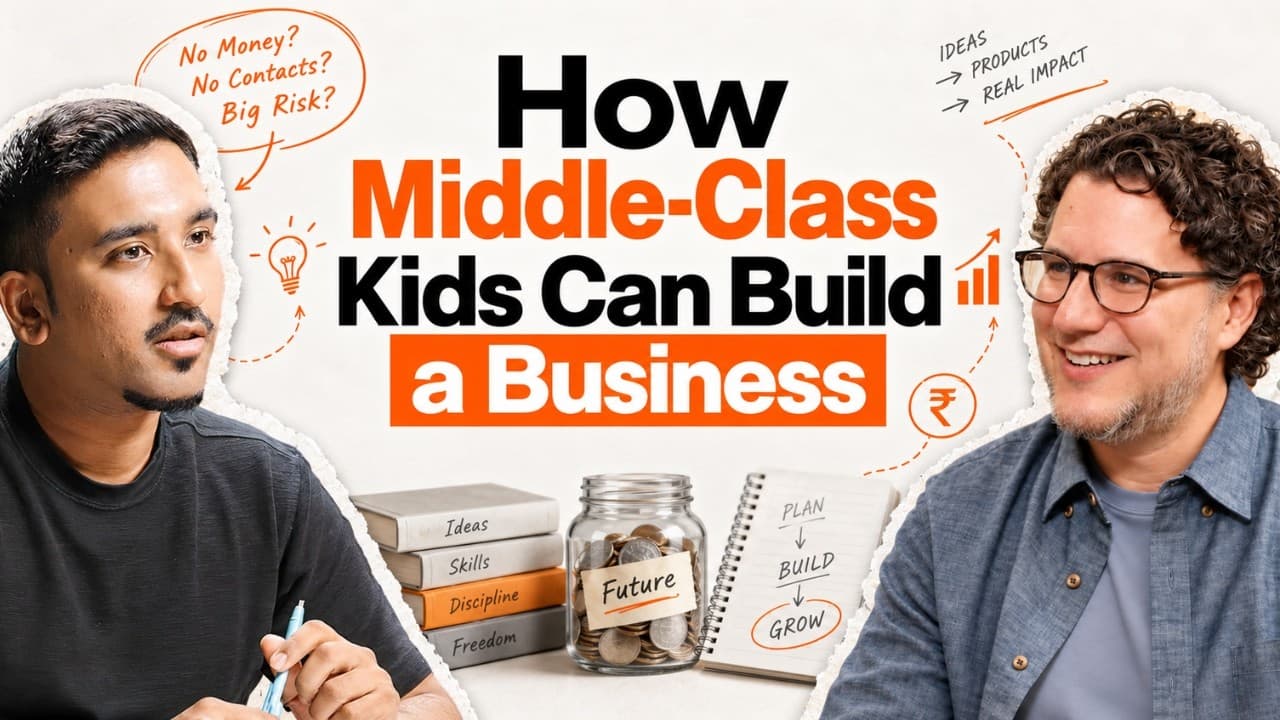
When you grow up, you tend to get told that the world is the way it is. Your life is just to live your life inside the world. Try not to bash into the walls too much. But life that that's a very limited life. If you come from a middle-ass family and you have the burning desire to build a business, this episode is for you. Because since childhood, w... Read More
Key Insights
- The build, measure, learn loop is a core lean startup concept used to validate ideas through rapid iterations.
- With under $1,000, founders can deploy affordable tools and AI to prototype and test markets without heavy capital.
- An MVP or demo can validate demand before building full products, saving cost and time.
- Entrepreneurs should focus on learning what customers actually want rather than flashy branding or office spaces.
- You can leverage external resources or outsourcing to reduce upfront costs while still learning fast.
- Early customer validation is crucial to determine if the problem is worth solving and if there is willingness to pay.
- Low-cost experimentation can reveal product market fit more reliably than traditional business plans.
- Outsiders or younger founders may see opportunities longer-standing incumbents miss, providing an edge in identifying gaps in the market.
Install to Summarize YouTube Videos and Get Transcripts
Explore YouTube Video Summarizer or Get YouTube Transcript Extractor
Questions & Answers
Q: A real search query about starting with no funds, how can I begin quickly?
Start with the build, measure, learn loop. Build a simple prototype or demo that conveys how your idea would work. Then measure how users interact and what they value, using the data to learn what to build next. This approach minimizes risk and accelerates iteration before investing significant money.
Q: Why is a low budget an advantage for a young founder?
A small budget forces focus on the essential learning steps and customer problems rather than expensive vanity projects. It also reduces risk of sunk costs and encourages creative use of affordable tools, AI, and outsourcing to validate demand and product viability.
Q: How does Dropbox illustrate the lean startup method without building a full product?
The founder created a crude demo video to show the concept and asked people to join a wait list. This validated demand before full development, showing that the idea could attract interest and justify further investment while keeping costs low.
Q: What should a 21-year-old do first to test a coffee brand idea?
Begin with an MVP concept or a simple prototype that demonstrates the core value. Use surveys or a waitlist, a landing page, or a small experiment to gauge interest and willingness to pay, then iterate based on feedback and learning.
Q: What is the main purpose of the build, measure, learn loop?
To convert ideas into testable products, observe customer reactions, quantify outcomes, and learn what to improve next. Every dollar spent should accelerate learning, while wasteful activities that do not contribute to learning are avoided.
Q: How can AI level the playing field for a new founder with limited funds?
AI tools reduce the cost of development, testing, and deployment, enabling rapid prototyping, data analysis, and customer insights at a fraction of traditional costs. This helps a young founder test ideas and iterate faster with less capital.
Q: What role does market gap discovery play in lean startup thinking?
Identifying a gap in the market is about recognizing problems that customers struggle with but may not even be aware of. Lean startup emphasizes validating whether a solution to that gap generates real demand before scaling.
Q: What mistake do founders often make when chasing growth, according to the lean framework?
They chase vanity metrics or funds without validating product market fit. Lean startup stresses learning over chasing growth for its own sake, ensuring that growth is grounded in real customer value and sustainable demand.
Summary & Key Takeaways
-
A minimal viable approach accelerates learning by turning ideas into testable demos or MVPs, allowing founders to validate demand before investing heavily.
-
Entrepreneurs should distinguish essential activities from distractions that do not speed learning, thereby avoiding wasted time and money.
-
Real power comes from rapid cycles of build, measure, learn, using feedback to evolve the product and business model.
Read in Other Languages (beta)
Share This Summary 📚
Summarize YouTube Videos and Get Video Transcripts with 1-Click
Try YouTube Summary with ChatGPT & Claude or YouTube Transcript Generator
Explore More Summaries from Think School 📚






Summarize YouTube Videos and Get Video Transcripts with 1-Click
Try YouTube Summary with ChatGPT & Claude or YouTube Transcript Generator