How to Pronounce Plural Nouns in English
TL;DR
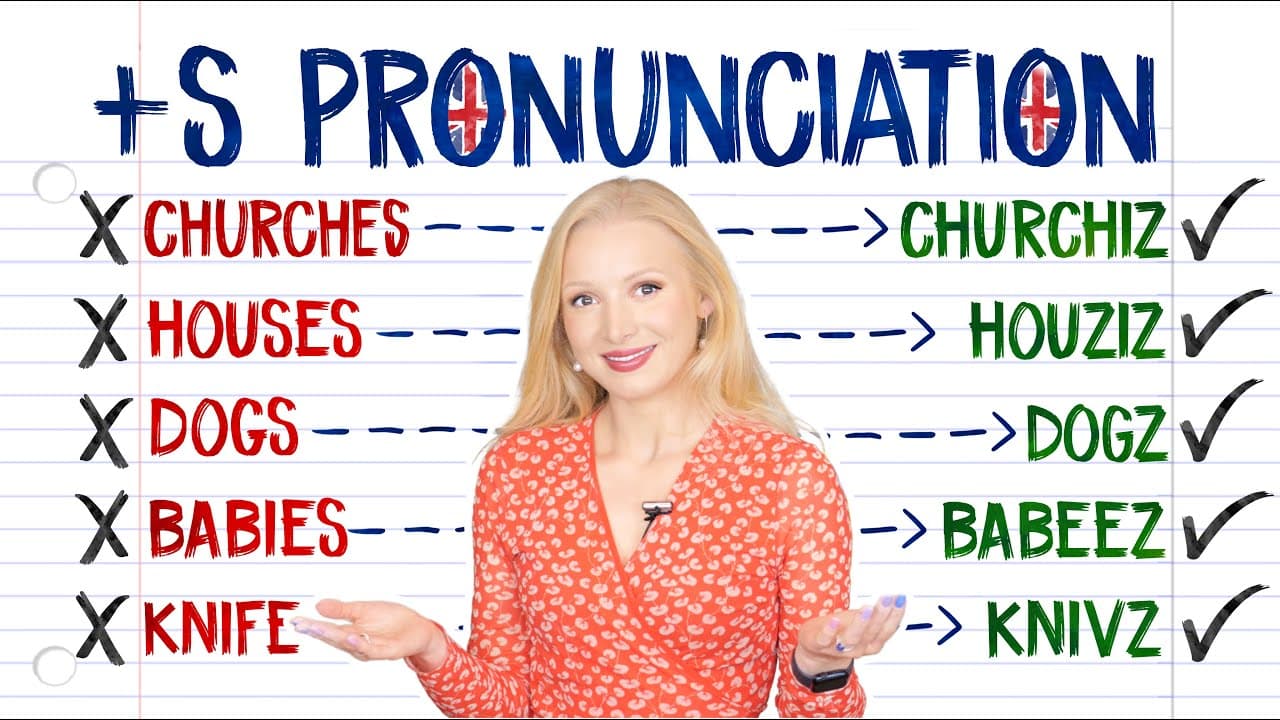
Pronouncing plural nouns in English involves three sounds: /s/, /z/, and /iz/. Use /s/ after voiceless consonants like 'p' or 't', /z/ after voiced consonants like 'b' or vowels, and /iz/ after sibilant sounds like 's' or 'z'. Understanding these rules helps in mastering English pronunciation.
Transcript
- Hello, lovely students, and welcome back to "English With Lucy." Today, I've got a and we are also going to Today's topic is Plural Nouns. And that might seem quite simple or quite easy to some of you, but trust me, lots of Why do we say "one book," but Yet, we say "one dog," "two To make things even more complicated, we say "one house," "two hou... Read More
Key Insights
- Plural nouns in English can end with /s/, /z/, or /iz/ sounds.
- The /s/ sound is used after voiceless consonants such as 'p', 't', 'k', 'f', and 'h'.
- The /z/ sound follows voiced consonants like 'b', 'g', 'l', 'm', 'n', 'r', 'v', and vowels.
- The /iz/ sound is used after sibilant sounds such as 's', 'z', 'ch', 'sh', and 'x'.
- Irregular plural nouns often involve spelling changes, such as 'baby' to 'babies' and 'knife' to 'knives'.
- Words ending in 'o' can form plurals by adding either 's' or 'es', depending on the word.
- A voiced sound causes vibration in the throat, unlike a voiceless sound.
- Free resources like PDFs and quizzes can aid in learning these pronunciation rules.
Install to Summarize YouTube Videos and Get Transcripts
Explore YouTube Video Summarizer or Get YouTube Transcript Extractor
Questions & Answers
Q: How do you pronounce plural nouns ending in /s/?
Plural nouns ending in /s/ are pronounced with a voiceless 's' sound, similar to a snake's hiss. This occurs after voiceless consonants like 'p', 't', 'k', 'f', and 'h'. For example, 'books' and 'cups' use the /s/ sound. To check, place your hand on your throat; there should be no vibration.
Q: When should plural nouns end with /z/?
Plural nouns end with /z/ after voiced consonants like 'b', 'g', 'l', 'm', 'n', 'r', and vowels. The /z/ sound is similar to a bee's buzz and involves vibration in the throat. Examples include 'dogs' and 'beds'. This sound is more common than the /s/ sound.
Q: What is the rule for using /iz/ at the end of plural nouns?
The /iz/ sound is used for plural nouns ending in sibilant sounds like 's', 'z', 'ch', 'sh', and 'x'. This sound adds an extra syllable, as in 'kisses' or 'watches'. It's essential for maintaining the natural rhythm of English speech.
Q: How do irregular plural nouns differ in pronunciation?
Irregular plural nouns often involve spelling changes rather than simply adding 's' or 'es'. Examples include changing 'baby' to 'babies' and 'knife' to 'knives'. These changes affect pronunciation, requiring learners to memorize specific forms to ensure correct usage.
Q: How do words ending in 'o' form their plurals?
Words ending in 'o' can form plurals by adding either 's' or 'es'. For instance, 'piano' becomes 'pianos', while 'tomato' becomes 'tomatoes'. The choice between 's' and 'es' depends on the specific word, and learners should familiarize themselves with common examples.
Q: What is a voiced sound in terms of pronunciation?
A voiced sound in pronunciation causes vibration in the vocal cords. To identify a voiced sound, place your hand on your throat while speaking; you should feel a vibration. Voiced sounds contrast with voiceless sounds, which do not produce such vibrations. Examples include 'b', 'd', and 'g'.
Q: What resources are available for learning plural noun pronunciation?
Free resources such as PDFs and quizzes are available to aid in learning the pronunciation of plural nouns. These materials provide comprehensive rules and examples, allowing learners to practice and reinforce their understanding. Access to these resources is often provided through educational platforms or websites.
Q: Why is it important to learn the rules for pronouncing plural nouns?
Learning the rules for pronouncing plural nouns is crucial for clear and accurate communication in English. Proper pronunciation helps avoid misunderstandings and ensures that speech sounds natural and fluent. Mastery of these rules enhances overall language proficiency and confidence in speaking.
Summary & Key Takeaways
-
Pronouncing plural nouns involves understanding when to use /s/, /z/, or /iz/. The /s/ sound follows voiceless consonants, while /z/ follows voiced consonants or vowels. The /iz/ sound is used after sibilant sounds. Mastering these distinctions is key to accurate English pronunciation.
-
Irregular plurals often involve spelling changes, such as 'baby' to 'babies' and 'knife' to 'knives'. Words ending in 'o' may take 's' or 'es' to become plural. Learning these rules helps in avoiding common pronunciation errors.
-
Free educational resources, including a PDF and quiz, are available to reinforce the rules for pronouncing plural nouns. These tools, along with practice, can significantly improve English pronunciation skills.
Read in Other Languages (beta)
Share This Summary 📚
Summarize YouTube Videos and Get Video Transcripts with 1-Click
Try YouTube Summary with ChatGPT & Claude or YouTube Transcript Generator
Explore More Summaries from English with Lucy 📚





Summarize YouTube Videos and Get Video Transcripts with 1-Click
Try YouTube Summary with ChatGPT & Claude or YouTube Transcript Generator