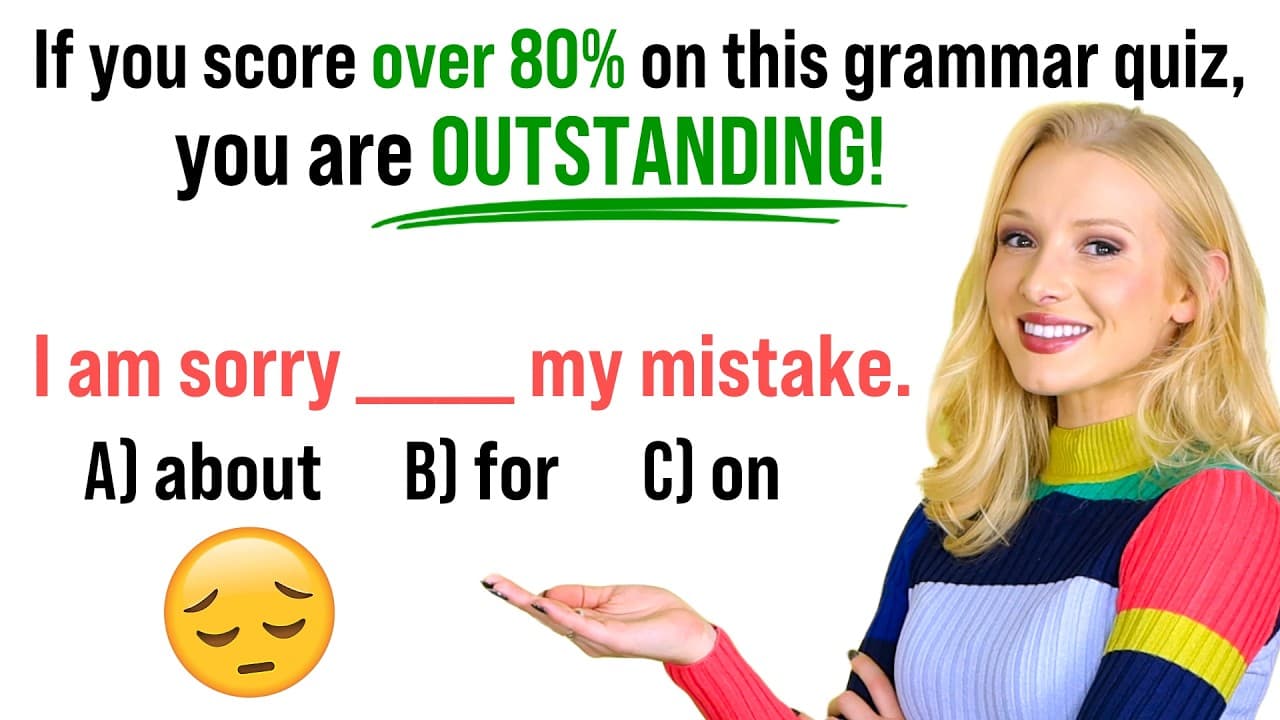
English with Lucy Level Test: Can You Score 12/15 on This English Grammar Test?
TL;DR
The English with Lucy level test checks your grammar through 15 questions that progress from lower-level structures to harder ones, with 12 correct answers identified as the outstanding benchmark. It covers tense choice, articles, word order, prepositions, compound adjectives, phrasal verbs, reported speech and fixed expressions. Read on for direct explanations of the test’s trickiest grammar points.
Transcript
Hello and welcome back to English if you can get 12 or more out of 15, going to be a great way for you to figure out don't worry if you find it challenging—it's meant if you really want to get a more complete I've developed a really in-depth online English perfect for helping you understand a bit more find the perfect study materials that match the... Read More
Key Insights
- The present simple describes a usual or regular situation, while the present continuous describes a temporary situation happening around the present period. The contrast appears in the example of normally living somewhere but temporarily staying with a sister.
- Existential “there” introduces the existence of something, as in the statement that a school once stood on a particular corner. The lesson contrasts this grammatical function with “their” and “here,” which cannot fill the same role.
- Place normally precedes time when both adverbials appear together at the end of a sentence. The correct pattern places the location first and the time expression afterward, illustrating a common English word-order convention.
- “Gone” indicates that someone went to a place and has not returned, while “been” indicates that the person visited and came back. In “She’s gone to the cinema,” the contracted form represents “she has.”
- Ellipsis removes repeated language when a conjunction such as “and” or “or” connects ideas and the missing information remains clear. In the beach example, the second “she” can be omitted because the same person performed both actions.
- A compound adjective such as “90-year-old” uses a singular unit and hyphens before the noun it modifies. The hyphens clarify that the words work together as one adjective describing the sailor.
- Personal pronouns must appear between the verb and particle in a separable phrasal verb. Consequently, a structure like “pick me up” is correct, while placing “me” after the particle is incorrect.
- “Be used to” means that an experience is normal or familiar and is followed by a noun phrase, pronoun, or -ing form. By contrast, “used to” without “be” describes a past situation that is no longer true.
Install to Summarize YouTube Videos and Get Transcripts
Explore YouTube Video Summarizer or Get YouTube Transcript Extractor
Questions & Answers
Q: What does the English with Lucy level test assess?
The English with Lucy level test assesses grammar through 15 questions that move from lower-level structures to harder ones. The questions cover areas including verb tenses, articles, word order, prepositions, compound adjectives, phrasal verbs, reported speech and fixed expressions.
Q: What score is outstanding on this English grammar test?
A score of 12 or more correct answers out of 15 is the stated benchmark. The questions become progressively harder, so the lesson advises completing them in order without skipping ahead.
Q: When should you use the present simple and present continuous?
Use the present simple for a usual or regular situation. Use the present continuous for a temporary situation around the present period, such as normally living somewhere but currently staying with a sister.
Q: What is the difference between “been” and “gone”?
Use “gone” when someone went somewhere and has not returned yet. Use “been” when someone visited a place and came back, so “She’s gone to the cinema” means she is still away.
Q: How should a compound age adjective be written?
An age used before a noun as a compound adjective takes hyphens and keeps the unit singular. The test therefore uses “the 90-year-old sailor,” with all three words functioning together as an adjective.
Q: What is the difference between “used to” and “be used to”?
“Be used to” describes something that is normal or familiar and can be followed by a noun phrase, pronoun or an -ing form. “Used to” without “be” describes a past situation that is no longer true.
Q: Where does a personal pronoun go in a separable phrasal verb?
A personal pronoun goes between the verb and the particle in a separable phrasal verb. For example, “Can you pick me up later?” is correct, while placing “me” after “pick up” is incorrect.
Q: How do you report an accusation with “accuse”?
Use “accuse” followed by the object, the preposition “of” and an -ing form. The direct statement “You lied!” can therefore be reported as Peter accusing the other person of lying.
Summary & Key Takeaways
-
The test begins with lower-difficulty questions about present simple versus present continuous, existential “there,” the placement of place and time adverbs, “been” versus “gone,” and the omission of repeated words after conjunctions. Each answer includes a grammatical explanation rather than merely identifying the correct option.
-
The medium-difficulty section examines generic reference with “the” plus a singular noun, regional alternatives for “different,” hyphenated compound adjectives, the standard phrase “by accident,” and pronoun placement in separable phrasal verbs. The explanations also acknowledge variation between British and North American English usage.
-
The advanced questions distinguish “used to” from “be used to,” form a past expectation with “should have,” transform direct speech using “accuse someone of” plus an -ing form, compare color qualities naturally, and complete a reformulation with “suit yourself.” A result of 12 out of 15 meets the stated benchmark.
Read in Other Languages (beta)
Share This Summary 📚
Summarize YouTube Videos and Get Video Transcripts with 1-Click
Try YouTube Summary with ChatGPT & Claude or YouTube Transcript Generator
Explore More Summaries from English with Lucy 📚



Summarize YouTube Videos and Get Video Transcripts with 1-Click
Try YouTube Summary with ChatGPT & Claude or YouTube Transcript Generator