How to Fix Five Common English Grammar Mistakes
TL;DR
Use singular nouns in hyphenated compound adjectives, say “despite” without “of,” and choose “tell somebody something” instead of “say somebody.” Use “earn” for salary, “meet” for a first introduction, “get to know” for gradual familiarity, and “know” for an established state of familiarity.
Transcript
Do you make common mistakes like these in a good time despite of the rain.' 'He contain a super common mistake but don't worry. errors - 5 errors in total and help I need to tell you about something completely free eBook. It changes everything and How to Fix them.' This powerful eBook errors English learners make immediately. Inside, plus 30 more m... Read More
Key Insights
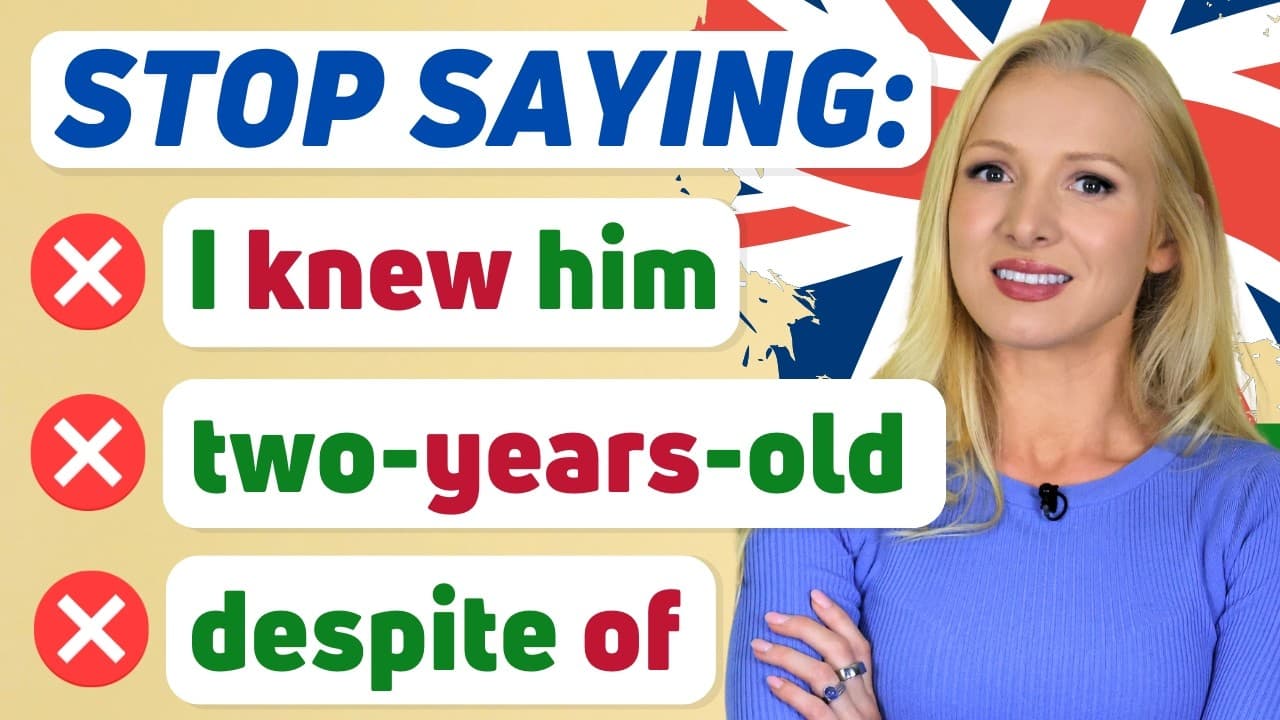
- A compound adjective containing a number uses a singular noun, regardless of how large the number is. Write “a two-hour drive,” “a five-minute walk,” “a ten-day holiday,” and “a two-year-old cat,” with a hyphen and without pluralizing the noun.
- “Despite” is used without “of,” while “in spite of” requires “of” and is written as three separate words. Both expressions introduce a contrast in which the result is surprising, as in continuing an activity even though rain, tiredness, or fear creates difficulty.
- The verb “say” does not directly take a person as its object in the structures taught here. Use “say something,” “say something to somebody,” or omit the listener, as in “She said she was tired” and “We said goodbye to everyone.”
- The verb “tell” can directly identify the listener through the pattern “tell somebody something.” Therefore, “She told me she was tired” is correct, while “She said me she was tired” should become either “She said she was tired” or the version with “told me.”
- “Earn” is the appropriate verb for salary and business profit. A person earns a yearly salary, and a company can earn money from its business, whereas “win” generally describes receiving something through luck, success in a competition, or gaining something such as support.
- “Win” and “earn” can sometimes overlap when describing something gained or deserved. The lesson notes that either verb can work with respect and reputation, although “win” has stronger associations with support and competitions, while “earn” emphasizes deserving the result.
- “Meet” refers to seeing or being introduced to someone, often for the first time. “Get to know” refers to gradually becoming familiar with a person or subject, while “know” describes the established state of already having that familiarity or knowledge.
- “Get to know” is the natural choice for gradually becoming familiar with a culture or with colleagues over time. Saying “meet the culture” or using “know” for the developing process does not express the intended gradual change as clearly or naturally.
Install to Summarize YouTube Videos and Get Transcripts
Explore YouTube Video Summarizer or Get YouTube Transcript Extractor
Questions & Answers
Q: How do you form compound adjectives with numbers?
Use a hyphen to connect the number and measurement when they work together as an adjective before a noun, and keep the measurement singular. Correct examples from the lesson include “a two-hour drive,” “a five-minute walk,” “a ten-day holiday,” and “a two-year-old cat.” Forms such as “two-hours drive” and “five-minutes walk” are incorrect because adjectives are not pluralized in this structure.
Q: Should you say “despite” or “despite of”?
Use “despite” by itself, without “of.” For example, say “despite the rainy weather,” not “despite of the rainy weather.” If you want a structure containing “of,” use “in spite of.” The lesson presents “despite” and “in spite of” as expressions for a surprising contrast, with “in spite of” described as slightly more informal.
Q: Is “in spite” written as one word or two words?
“In spite” is written as two separate words, and the full expression is “in spite of,” which contains three words. The lesson specifically warns against writing “inspite” as one word. This differs from “despite,” which is one word and appears alone without “of” when it introduces the same kind of contrasting information.
Q: What is the difference between “say” and “tell”?
Use “say” in patterns such as “say something” or “say something to somebody.” Use “tell” in the pattern “tell somebody something.” For example, “She said she was tired” and “She told me she was tired” are both correct. “She said me she was tired” is incorrect because “say” does not directly take the listener in that structure.
Q: When should “to” follow the verb “say”?
Add “to” when naming the person who receives what is said. The lesson gives patterns such as “say something to somebody” and the example “We said goodbye to everyone.” Likewise, “She didn’t say anything to me” needs “to” before “me.” If the listener is omitted, “say something” can stand without that preposition.
Q: What is the difference between “win” and “earn”?
Use “win” when something is obtained through luck or success in a competition, such as winning first prize. Use “earn” for salary, business profit, or something deserved, such as earning £30,000 a year or earning a rest after running 20km. The lesson also notes that respect and reputation can sometimes work with either verb.
Q: Can you say that someone wins a salary?
No, the lesson uses “earn” for money received as salary. The correct form is “She earns a good salary,” and the quiz likewise corrects a sentence about John receiving $40,000 a year to “John earns $40,000 a year.” “Win” is instead associated with luck, competitions, prizes, support, and similar achievements.
Q: What is the difference between “meet,” “get to know,” and “know”?
“Meet” means to see or be introduced to someone, often for the first time. “Get to know” describes the gradual process of becoming familiar with a person or subject over time. “Know” describes the established state of familiarity or knowledge. Therefore, becoming familiar with colleagues or a culture is naturally expressed with “get to know.”
Summary & Key Takeaways
-
Hyphenated compound adjectives that include numbers use a singular noun, even when the number is greater than one. Correct forms include “a two-hour drive,” “a five-minute walk,” “a ten-day holiday,” and “a two-year-old cat.” The number does not make the noun inside the adjective plural.
-
“Despite” and “in spite of” both introduce a surprising contrast, but their structures differ. “Despite” appears without “of,” while “in spite of” contains three separate words. With reporting verbs, use “say something,” “say something to somebody,” or “tell somebody something,” depending on whether the listener is included.
-
“Earn” describes receiving salary, profit, or something deserved, while “win” commonly refers to luck, competitions, support, or prizes. “Meet” describes an introduction, “get to know” describes gradual familiarity, and “know” describes an existing state. These distinctions make descriptions of people, cultures, work, and achievements sound more natural.
Read in Other Languages (beta)
Share This Summary 📚
Summarize YouTube Videos and Get Video Transcripts with 1-Click
Try YouTube Summary with ChatGPT & Claude or YouTube Transcript Generator
Explore More Summaries from English with Lucy 📚






Summarize YouTube Videos and Get Video Transcripts with 1-Click
Try YouTube Summary with ChatGPT & Claude or YouTube Transcript Generator