How to Use 60 Commonly Confused English Words
TL;DR
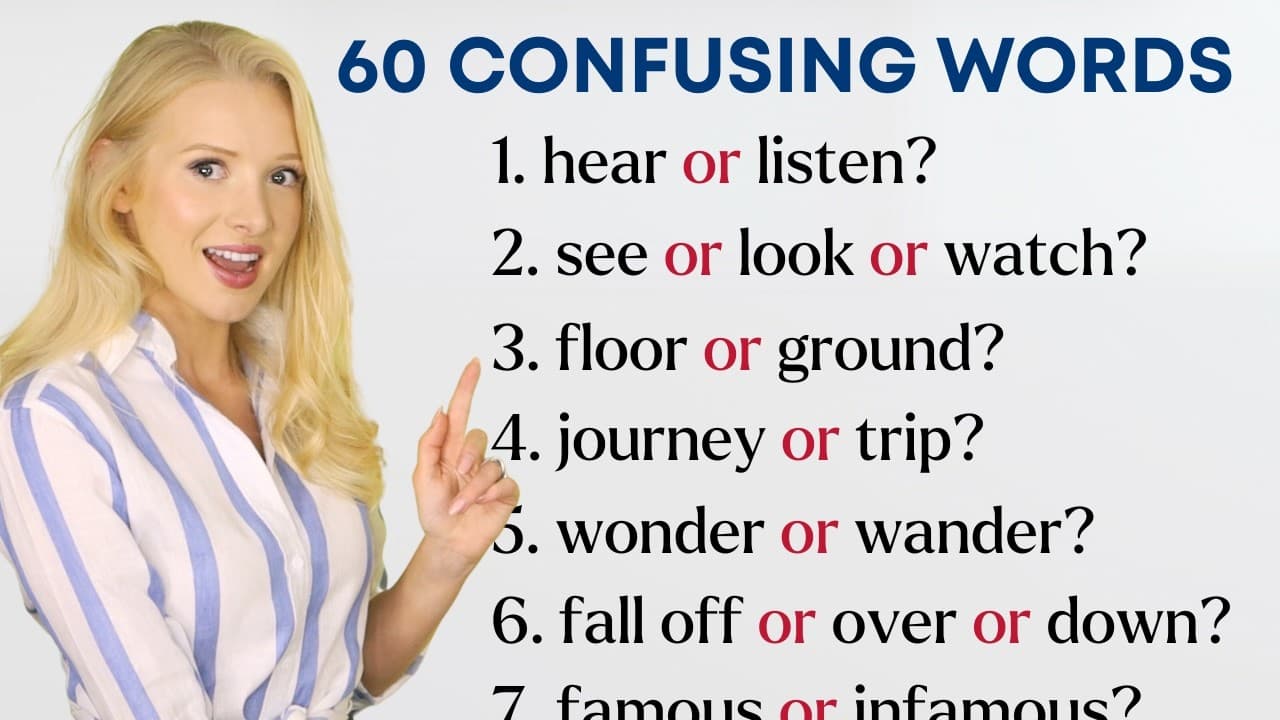
Understanding the nuances between similar English words can significantly improve language proficiency. This video clarifies the differences between 60 commonly confused words by categorizing them into nouns, verbs, adjectives, and phrasal verbs. With clear examples and explanations, viewers will gain confidence in using these words correctly in everyday conversations.
Transcript
English can be incredibly confusing. There are so many words that my students mix up and get wrong. Effect with an A and effect with an E. Complimentary with an I and complimentary with an E. Today I am going to teach you the 60 most confusing words in English. I'm going to clarify them for you. You're going to understand them so well that you don'... Read More
Key Insights
- Effect with an 'A' is a verb meaning to influence, while effect with an 'E' is a noun referring to the result of a change.
- Complimentary with an 'I' means expressing praise or free of charge; with an 'E', it means things that enhance each other.
- Travel is the general activity, journey refers to the act of moving from one place to another, and trip involves going somewhere and returning.
- Shade is a cooler area where sunlight is blocked, while a shadow is the dark shape created when something blocks light.
- Rob is used with a place or person, while steal is used with the thing taken.
- Distinct means clearly different, whereas distinctive means having a special quality that makes something easy to recognize.
- Classic refers to high-quality, timeless items, while classical relates to traditional culture and certain music.
- To bring up means to raise a child, while to grow up means to develop from a child into an adult.
Install to Summarize YouTube Videos and Get Transcripts
Explore YouTube Video Summarizer or Get YouTube Transcript Extractor
Questions & Answers
Q: How do you differentiate between effect and affect?
Effect with an 'A' is typically a verb that means to influence or change something. For example, 'The weather affects my mood.' Effect with an 'E' is usually a noun referring to the result of a change, such as 'The new law had a positive effect on the economy.'
Q: What is the difference between complimentary and complementary?
Complimentary with an 'I' can mean expressing praise or being free of charge, like a complimentary breakfast. Complementary with an 'E' refers to things that enhance or complete each other, such as complementary colors that look good together.
Q: When should you use uninterested versus disinterested?
Uninterested means not interested or lacking interest in something, such as 'He was uninterested in the movie.' Disinterested means impartial or not influenced by personal interest, like 'A disinterested judge is fair and unbiased.'
Q: How can you remember the difference between shade and shadow?
Shade refers to a cooler, darker area where sunlight is blocked, often used to escape heat, like 'We sat in the shade.' A shadow is the dark shape that appears on a surface when something blocks light, focusing on the outline or shape, such as 'The tree cast a shadow.'
Q: What is the distinction between rob and steal?
Rob is used when referring to taking from a place or person, like 'The bank was robbed.' Steal is used with the object taken, such as 'They stole a car.' Rob focuses on the victim, while steal focuses on the item.
Q: How do you use the words distinct and distinctive?
Distinct means clearly different or separate, like 'There are distinct differences between the two proposals.' Distinctive means having a special quality that makes something easy to recognize, such as 'He has a distinctive accent that is easily recognizable.'
Q: What is the difference between classic and classical?
Classic refers to something high-quality and timeless, often used for books, films, or cars, like 'A classic novel.' Classical relates to traditional culture, music from the mid-18th to early-19th centuries, or ancient Greek/Roman culture, such as 'Classical music by Beethoven.'
Q: How should you use bring up versus grow up?
To bring up means to raise a child, focusing on care and education, like 'They brought up their children in the countryside.' To grow up means to develop from a child into an adult, referring to the process of maturing, such as 'I grew up in New York.'
Summary & Key Takeaways
-
This video helps learners distinguish between 60 confusing English words by providing clear explanations and examples. It covers nouns, verbs, adjectives, and phrasal verbs, offering insights into their correct usage.
-
Viewers will learn the differences between commonly misused pairs like effect/affect, complimentary/complementary, and uninterested/disinterested, enhancing their language skills.
-
The video includes quizzes and examples to reinforce learning, and offers a free ebook with additional information and exercises for further practice.
Read in Other Languages (beta)
Share This Summary 📚
Summarize YouTube Videos and Get Video Transcripts with 1-Click
Try YouTube Summary with ChatGPT & Claude or YouTube Transcript Generator
Explore More Summaries from English with Lucy 📚




Summarize YouTube Videos and Get Video Transcripts with 1-Click
Try YouTube Summary with ChatGPT & Claude or YouTube Transcript Generator