How to Speak English Naturally with Shadowing
TL;DR
Shadowing improves English speaking by having you talk along with a chosen speaker while closely matching pronunciation, rhythm, stress, and connected speech. Listen to each passage first, notice features such as weak forms and sound linking, then speak simultaneously with the recording and replay difficult sections until matching the model becomes easier.
Transcript
Hello, lovely students, and I have a very special lesson for practise your speaking and Today, we're going to do some shadowing. You are going to become my shadow. Shadowing is a repetition your pronunciation and aid you to In addition to the amazing speaking practice you're getting I've also created a It has the full transcription plus information... Read More
Key Insights
- Shadowing is a speaking exercise in which a learner talks along with a speaker with as little delay as possible. It differs from ordinary repetition because the learner does not wait for the model to finish before beginning the same words.
- The primary focus of shadowing is mimicking pronunciation rather than understanding every unfamiliar vocabulary item. The recommended sequence is to listen to the passage, notice the pronunciation features that shape natural speech, and then reproduce the passage aloud alongside the original speaker.
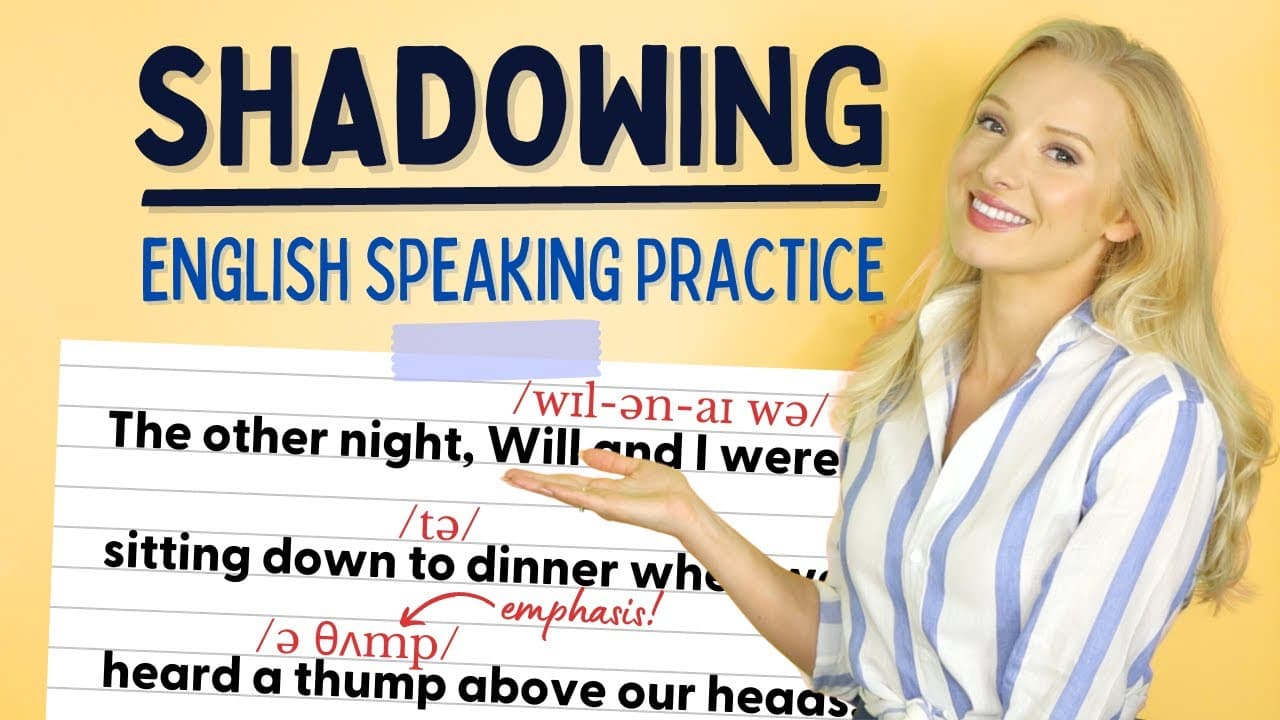
- Natural sentence stress highlights the most interesting or important information. In the sentence about hearing a thump above their heads, “thump” receives the strongest stress because it carries the surprising event that moves the story forward.
- Weak forms make common grammatical words less prominent in connected speech. The lesson demonstrates reduced pronunciations in expressions containing “were,” “to,” and “a,” as well as the compressed form “balls’d” instead of pronouncing “balls had” separately and fully.
- Connected speech links sounds across word boundaries. Phrases such as “live in an old” and “shrugged it off” flow together because the consonant at the end of one word connects with the sound at the beginning of the next word.
- A full grammatical form can create deliberate emphasis. Although contractions are commonly used in informal speech, the teacher says “I am” in full and stresses “not” in “I am not joking” to underline the seriousness of the statement.
- Assimilation can change a sound under the influence of a neighboring sound. In “on my,” the lesson identifies the final /n/ sound changing toward /m/, which helps the phrase flow more naturally during continuous speech.
- Effective shadowing requires repetition, patience, and humility because it is described as an advanced technique. Learners who cannot immediately keep pace are encouraged to replay difficult sections, practise with different recordings, and choose speakers whose pronunciation they want to resemble.
Install to Summarize YouTube Videos and Get Transcripts
Explore YouTube Video Summarizer or Get YouTube Transcript Extractor
Questions & Answers
Q: How do you practise English speaking with shadowing?
Start by listening to a short passage without speaking. Next, notice how the speaker uses pronunciation, stress, weak forms, and connected speech. Play the passage again and speak at the same time as the recording with as little delay as possible. Try to match the speaker closely, and replay any section that is difficult to follow or reproduce.
Q: What is the difference between shadowing and repeating?
Shadowing requires you to speak along with the model while the model is still talking, with as little delay as possible. Repetition usually means waiting until the speaker finishes and then saying the same words. The simultaneous nature of shadowing makes you copy the speaker’s timing, rhythm, pronunciation, stress, reductions, and sound connections more directly.
Q: What should you focus on during English shadowing practice?
The primary focus should be reproducing the speaker’s pronunciation rather than understanding every difficult word immediately. Listen for rhythm, stressed words, reduced grammatical forms, linked sounds, assimilation, intrusion, and contractions. After identifying these features, speak along with the passage and imitate how the complete sentence flows instead of pronouncing every word as a separate unit.
Q: How does sentence stress make English sound more natural?
Sentence stress gives greater prominence to the information that matters most in a statement. In the practice sentence about Lucy and Will hearing something above their heads, “thump” is stressed most strongly because it is the interesting and unexpected event. Copying this pattern helps a learner reproduce the speaker’s intended emphasis instead of giving every word equal weight.
Q: What are weak forms in the shadowing lesson?
Weak forms are reduced pronunciations used for words or grammatical elements that do not carry the main emphasis. The lesson demonstrates reductions in words such as “were,” “to,” and “a.” It also presents “balls’d” as a reduced version of “balls had.” Learners are asked to imitate these forms so their connected speech matches the model more closely.
Q: How does connected speech link English words together?
Connected speech allows the ending sound of one word to flow into the beginning of the next. The lesson demonstrates this with phrases including “live in an old” and “shrugged it off.” Instead of treating each word as an isolated item, the learner should copy the continuous sound sequence while shadowing the full sentence alongside the recording.
Q: Why does the speaker say “I am” instead of “I’m”?
The speaker deliberately uses the full form “I am” to create emphasis, even though contractions are generally used in informal speech. She also stresses “not” in the sentence “I am not joking.” Together, the full form and the stressed negative word make the statement sound more forceful and communicate that the frightening reaction being described was genuine.
Q: What should you do if shadowing feels too difficult?
Do not worry if you cannot speak along successfully at first, because the lesson describes shadowing as an advanced technique that takes time and humility to master. Replay difficult parts and practise them again. You can also use different audio recordings and select a speaker whose way of speaking resembles the pronunciation you want to achieve.
Summary & Key Takeaways
-
Shadowing means speaking along with a recording with as little delay as possible, rather than waiting to repeat each sentence afterward. The lesson recommends listening first, studying the speaker’s pronunciation, and then copying the passage aloud. Its main purpose is to develop more natural spoken English through focused imitation and repeated practice.
-
The guided story demonstrates several features of natural pronunciation, including the schwa, elision, weak forms, linking, assimilation, intrusion, contractions, and sentence stress. Learners hear each section before speaking along with it. The teacher also identifies important sound changes and explains why particular words or grammatical forms receive extra emphasis.
-
The practice passage tells how Lucy and Will heard thumps, a louder thud, and apparent footsteps above them during dinner. Will went upstairs with their dog, Diego, to investigate. The alarming sounds turned out to be tennis balls that had fallen and rolled down the landing, leaving the couple feeling slightly silly.
-
Key Insights Insufficient?
Read in Other Languages (beta)
Share This Summary 📚
Summarize YouTube Videos and Get Video Transcripts with 1-Click
Try YouTube Summary with ChatGPT & Claude or YouTube Transcript Generator
Explore More Summaries from English with Lucy 📚






Summarize YouTube Videos and Get Video Transcripts with 1-Click
Try YouTube Summary with ChatGPT & Claude or YouTube Transcript Generator