How to Test Your English Level from A1 to C2
TL;DR
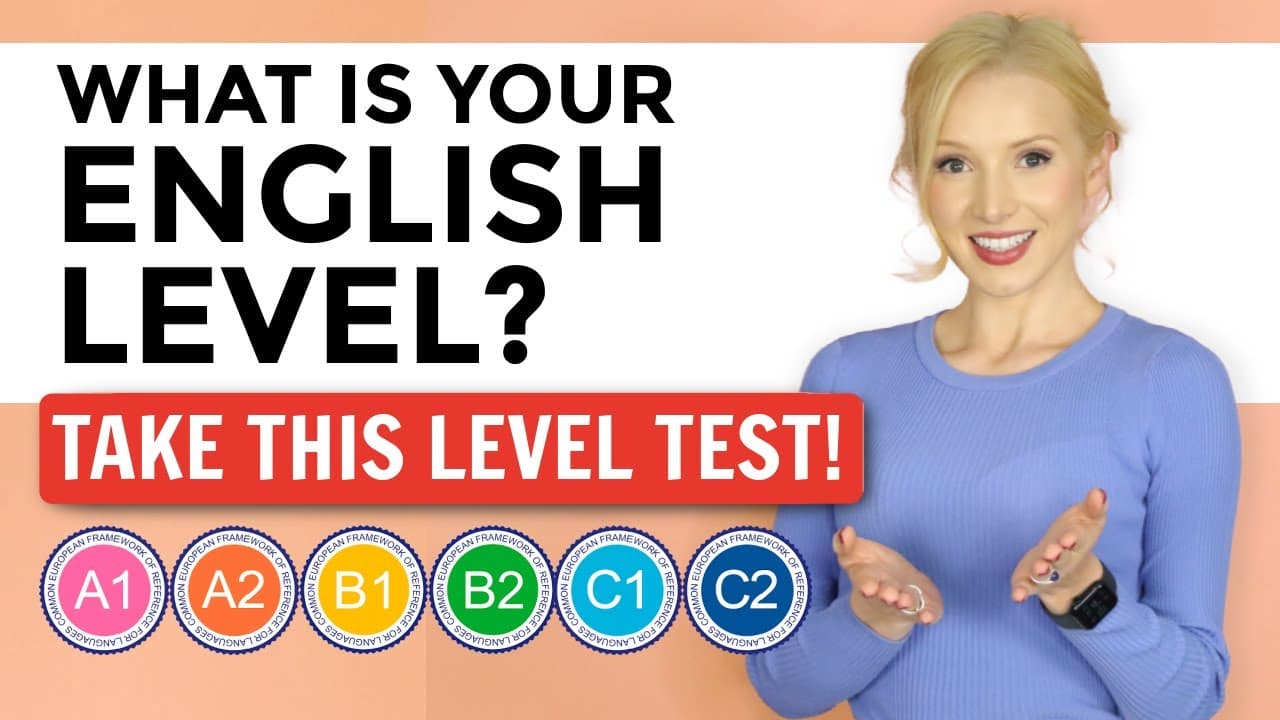
Your likely English level is the highest CEFR stage at which you answer all three sample questions correctly, progressing from A1 through C2. The test checks grammar, vocabulary, sentence structure, reported speech, relative clauses, conditionals, idioms, and passive forms, but the free in-depth online test provides a more accurate assessment.
Transcript
- Hello, lovely students, and welcome back to English with Lucy. Today is an incredibly important lesson. We are finally going to work out what your English level is, A1, A2, B1, B2, or even C1, or the top level, C2. It's so important to know and understand your level of English, because it helps you decide how to proceed with your learning journey... Read More
Key Insights
- The CEFR system divides English proficiency into six stages: A1 and A2 are beginner levels, B1 and B2 are intermediate levels, and C1 and C2 are advanced levels. A1 represents an absolute beginner, while C2 represents near-native language ability.
- The test estimates proficiency by starting with A1 questions and progressing through increasingly difficult levels. Answering all three questions correctly at a particular stage indicates that the learner likely possesses that level, although the result is presented as an initial estimate rather than a definitive assessment.
- The A1 section tests foundational grammar and vocabulary through the third-person form "likes," the plural noun "sisters," and the everyday object "glasses." These questions measure whether a learner can recognize basic sentence patterns, common family vocabulary, and familiar objects.
- The A2 section tests comparative adjectives, the first conditional, and verb patterns. Its correct answers include "taller," "will pass," and "They want to go with us," requiring learners to recognize comparison, a likely future consequence, and the infinitive after "want."
- The B1 section tests future continuous grammar, present perfect experience questions, and reported speech. Learners identify "will be arriving," connect "I have never been to Paris" with "Have you ever been to Paris?", and change "tomorrow" to "the following day."
- The B2 section tests a modal perfect, a relative clause, and a complex conditional structure. Correct forms include "shouldn't have said," the clause "who moved to the country three years ago," and "If you had learned the lyrics, you would be singing in the choir."
- The C1 section tests advanced expressions, plural forms, and the passive perfect infinitive. Learners must recognize "on good terms," use "criteria" and "analyses" correctly, and identify "Alejandro should have been informed of these changes" as the correct passive construction.
- The C2 section tests precise vocabulary, idiomatic meaning, pronunciation, and advanced passive grammar. It uses "charisma," the idiom "go back on his word," and "would be dealt with." Reaching this level is difficult enough that many native speakers might not achieve it in an exam.
Install to Summarize YouTube Videos and Get Transcripts
Explore YouTube Video Summarizer or Get YouTube Transcript Extractor
Questions & Answers
Q: How can I estimate my English level from A1 to C2?
Begin with the A1 questions and continue through A2, B1, B2, C1, and C2. If you answer all three questions at a stage correctly, the lesson says you likely have that level. Because each stage contains only a few sample questions, the result is an estimate. The linked free online level test is recommended for a more accurate measurement.
Q: What do the six CEFR English levels mean?
The six CEFR levels are organized into three broad groups. A1 and A2 are beginner levels, with A1 identified as the absolute beginner stage. B1 and B2 are intermediate levels, and C1 and C2 are advanced levels. C2 is the highest stage presented and represents near-native proficiency, although native speakers do not necessarily achieve C2 in an examination.
Q: What grammar and vocabulary are tested at A1?
The A1 questions assess very basic grammar and everyday vocabulary. They require the third-person singular verb in "She likes to read books every day," the plural family word in "I have two sisters and one brother," and the common object in "Have you seen my glasses?" Correctly answering all three suggests that the learner likely has A1 ability.
Q: What English skills are tested at A2?
The A2 section checks comparative adjectives, conditional grammar, and a common verb pattern. The learner must choose "taller" when comparing two people, complete "If you study, you will pass the test," and recognize "They want to go with us" as correct. Success on all three questions suggests likely A2 proficiency, subject to fuller testing.
Q: What language structures appear in the B1 test?
The B1 questions cover the future continuous, a present perfect question about life experience, and reported speech. The answers are "will be arriving," "Have you ever been to Paris?", and "He said he had to work the following day." These tasks require learners to understand tense choice, question-response relationships, and changes made when reporting another person's statement.
Q: Why is the B2 section more challenging than B1?
The B2 section introduces more complex relationships between time, meaning, and sentence structure. It tests "shouldn't have said" for criticism of a past action, asks learners to identify a relative clause, and uses "If you had learned the lyrics, you would be singing in the choir." These forms demand more than recognition of basic tense patterns.
Q: What advanced language is assessed at C1?
The C1 questions assess an established expression, accurate plural vocabulary, and a passive perfect infinitive. Learners complete "we separated on good terms," select "criteria" and "analyses," and recognize "Alejandro should have been informed of these changes." Answering all three correctly suggests C1 proficiency, while the longer online assessment can provide a more confident result.
Q: What must a learner know to pass the C2 section?
The C2 section requires sophisticated vocabulary, idiomatic understanding, pronunciation awareness, and advanced passive grammar. Correct answers include "charisma," pronounced as demonstrated in the lesson, "go back on his word," meaning not to fulfil a promise, and "would be dealt with." Getting every item right suggests C2 proficiency or native-level ability, but many native speakers might not achieve C2 in an exam.
Summary & Key Takeaways
-
The CEFR divides English ability into six levels. A1 and A2 represent beginner ability, B1 and B2 represent intermediate ability, and C1 and C2 represent advanced ability. C2 is described as near-native proficiency, although even many native speakers might not achieve that result under examination conditions.
-
The assessment moves from basic vocabulary and grammar to increasingly complex language. Early questions cover third-person verbs, plural nouns, common objects, comparisons, first conditionals, and infinitive patterns. Intermediate questions introduce future continuous forms, present perfect questions, reported speech, modal perfect constructions, relative clauses, and mixed conditional structures.
-
Advanced questions assess precise expressions, irregular plurals, passive perfect infinitives, sophisticated vocabulary, idioms, and passive constructions in reported contexts. Correctly answering all three questions at a stage suggests that level, but the short exercise is only an indication. The linked free online test is recommended for greater accuracy and confidence.
Read in Other Languages (beta)
Share This Summary 📚
Summarize YouTube Videos and Get Video Transcripts with 1-Click
Try YouTube Summary with ChatGPT & Claude or YouTube Transcript Generator
Explore More Summaries from English with Lucy 📚




Summarize YouTube Videos and Get Video Transcripts with 1-Click
Try YouTube Summary with ChatGPT & Claude or YouTube Transcript Generator