How Can You Learn All 16 English Tenses in Under 30 Minutes? Present, Past, Future, and Conditional
TL;DR
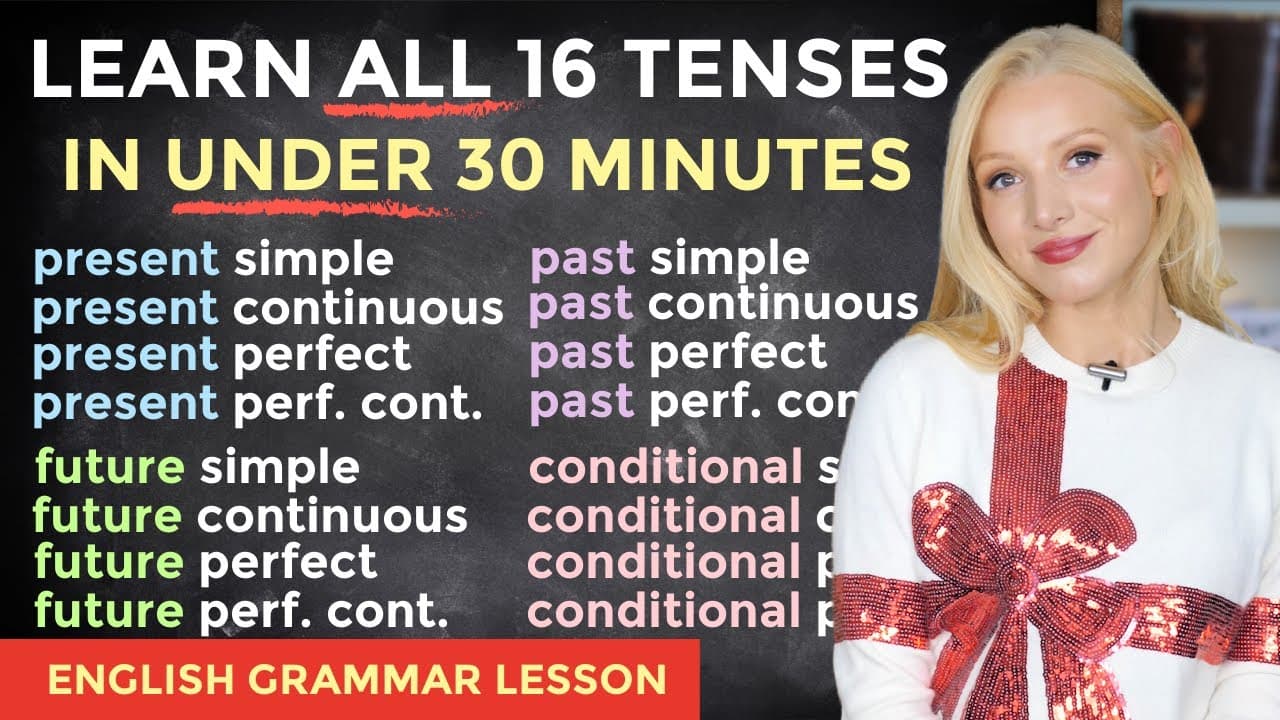
You can understand all 16 English tenses by organizing them into present, past, future, and conditional groups, then comparing each group’s simple, continuous, perfect, and perfect continuous forms. The lesson explains their structures and uses with examples such as “I eat,” “I am eating,” “I have eaten,” and “I have been eating.” Read on to see how the repeated patterns simplify the full tense system.
Transcript
Hello, lovely students. And welcome back to English with Lucy. I have an amazing video for you today if I do say so myself. I'm going to teach you all of the English tenses. So many of you have been requesting a tenses video. I say, go big or go home. That's a great saying. It means either put in all your effort or do nothing at all. Go big, or... Read More
Key Insights
- The lesson organizes English into 16 forms across four groups: present, past, future, and conditional. Each group contains a simple, continuous, perfect, and perfect continuous form, revealing repeated structures that make the full system easier to compare and remember.
- The present simple is used for general statements, facts, habits, and scheduled events. Its structure is a subject plus the base verb, but third-person singular subjects normally require an added s, as in “she works” or “he cleans.”
- The verb be has distinct present-simple forms instead of following the ordinary base-verb pattern. The forms presented are “I am,” “you are,” “he, she, or it is,” “we are,” and “they are,” so learners must remember them separately.
- The present continuous is formed with a subject, a form of be, and a verb ending in -ing. It primarily describes something happening at the moment of speaking, as illustrated by “I am teaching English” and “They are baking cookies.”
- The contrast between present simple and present continuous can signal permanence versus temporary circumstances. “James lives in Manchester” presents the situation as relatively permanent, while “James is living in Manchester” suggests that the situation may change after a short period.
- State verbs are generally avoided in the present continuous, but informal usage can treat a state as temporary. Expressions such as “I’m loving my Christmas jumper right now” and “I’m hating that song right now” emphasize a current, temporary reaction.
- The present perfect is formed with has or have plus a past participle. It describes unfinished situations continuing into the present, experiences without a specified past time, and completed past events that produce consequences in the present.
- The present perfect continuous is formed with has or have, been, and a verb ending in -ing. It describes an uninterrupted, unfinished activity that began in the past and continues now, with particular emphasis on how long the activity has lasted.
Install to Summarize YouTube Videos and Get Transcripts
Explore YouTube Video Summarizer or Get YouTube Transcript Extractor
Questions & Answers
Q: How are all 16 English tenses organized?
The lesson divides the 16 tenses into four groups: present, past, future, and conditional. Each group has simple, continuous, perfect, and perfect continuous forms. Comparing these repeated patterns makes the full system easier to understand and remember.
Q: What are the four present tenses in English?
The four present forms are present simple, present continuous, present perfect, and present perfect continuous. The lesson illustrates them with “I eat chocolate,” “I am eating chocolate,” “I have eaten chocolate,” and “I have been eating chocolate.”
Q: When should you use the present simple tense?
Use the present simple for general statements, facts, habits, and scheduled events. “Mary meets her friends on Friday evenings” describes a habit, while “The train to London leaves at 8:00 PM” describes a scheduled future event.
Q: How do you form the present simple tense correctly?
Use the subject followed by the verb’s base form, but add s for a third-person singular subject. Examples include “she works,” “he cleans,” and “it smells.” The verb be is an exception, with the forms am, are, and is.
Q: When should you use the present continuous tense?
Use the present continuous for an action happening now, a temporary situation, or a future arrangement involving another person or business. It is formed with a subject, a form of be, and a verb ending in -ing, as in “I am teaching English.”
Q: What is the difference between present simple and present continuous?
The present simple can present a situation as relatively permanent, while the present continuous can show that it is temporary. “James lives in Manchester” sounds relatively permanent, whereas “James is living in Manchester” suggests that the situation may change.
Q: When should you use the present perfect tense?
Use the present perfect for unfinished situations continuing into the present, experiences without a specified past time, and past events with present consequences. It is formed with has or have plus a past participle. For example, “Mike has lost his keys” describes a past event that creates a current problem.
Q: What is the difference between present perfect and present perfect continuous?
Both forms can connect the past with the present, but the present perfect continuous emphasizes an uninterrupted, unfinished activity and its duration. The present perfect uses has or have plus a past participle, while the continuous form uses has or have, been, and a verb ending in -ing. An example is “I’ve been watching that TV show for weeks.”
Summary & Key Takeaways
-
English has 16 forms in the lesson’s framework, divided into present, past, future, and conditional groups. Each group contains simple, continuous, perfect, and perfect continuous patterns. Studying these repeated patterns together makes their structural similarities visible and can help learners understand and remember how the forms relate to one another.
-
The four present forms serve different purposes. Present simple describes facts, habits, general statements, and scheduled events. Present continuous covers current or temporary activity and future arrangements. Present perfect connects earlier events with the present, while present perfect continuous emphasizes an unfinished activity’s duration from the past until now.
-
Correct tense formation depends on recognizing auxiliary verbs and verb forms. Present simple generally uses the base verb, with an added s in the third-person singular. Present continuous uses be plus verb-ing, present perfect uses has or have plus a past participle, and present perfect continuous adds been before verb-ing.
Read in Other Languages (beta)
Share This Summary 📚
Summarize YouTube Videos and Get Video Transcripts with 1-Click
Try YouTube Summary with ChatGPT & Claude or YouTube Transcript Generator
Explore More Summaries from English with Lucy 📚
Summarize YouTube Videos and Get Video Transcripts with 1-Click
Try YouTube Summary with ChatGPT & Claude or YouTube Transcript Generator