How to Use Get Correctly in Everyday English
TL;DR
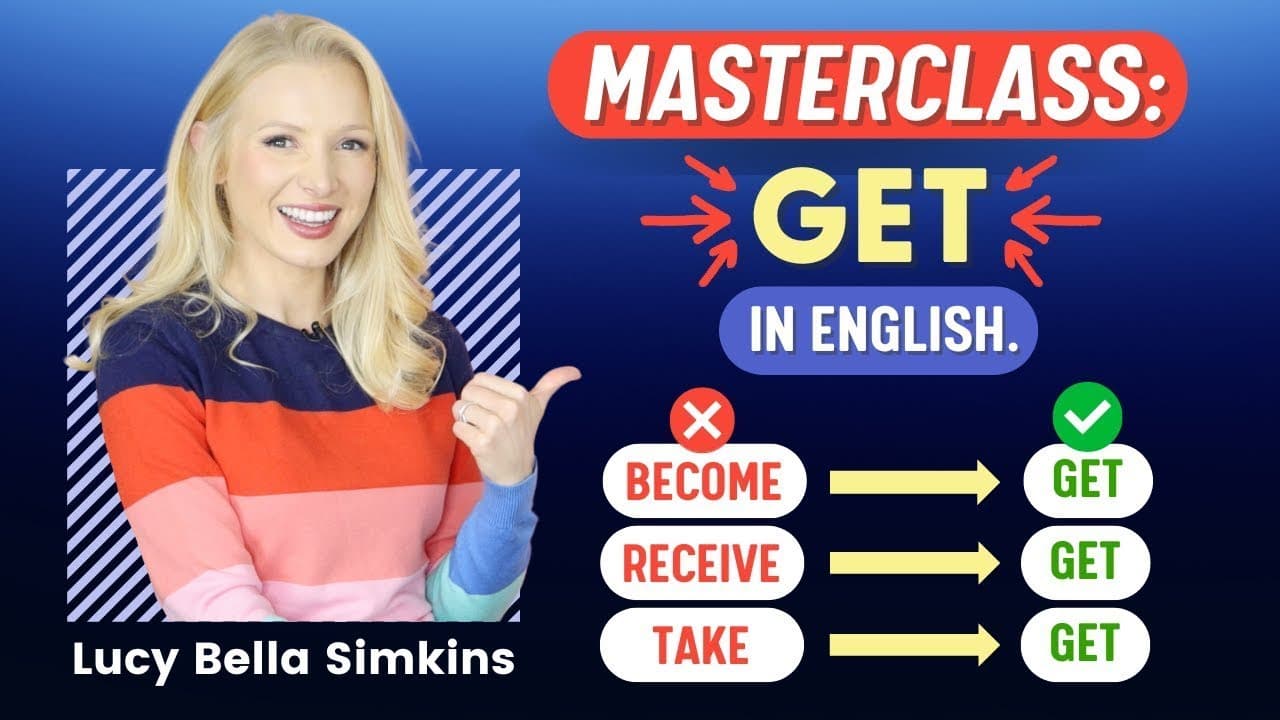
Get can express change and can mean receive, take transport, arrive, buy, obtain, develop, bring, reach, or understand, depending on its grammatical context. It also appears with adjectives, noun phrases, -ing forms, infinitives, passive and causative structures, phrasal verbs, collocations, and the common spoken constructions have got and have got to.
Transcript
Get has so many meanings. I honestly think it's one of the most confusing words in the English language. Get can mean to understand. Do you get it? It can mean obtain. I got a new job. It can mean to receive. Did you get my message? It can mean to buy. Where did you get your bag? It can mean to take. Shall we get a taxi? There are so many meanings,... Read More
Key Insights
- Get is an irregular verb with got as its past simple form. British English typically uses got as the past participle, while American English and some regional varieties also use gotten, although the lesson consistently uses got.
- Get followed by an adjective usually describes becoming or changing. Sentences such as "I'm getting tired," "It's getting dark," and "Your dinner's getting cold" can be understood by replacing get with become while preserving the central meaning.
- Get followed by a noun or noun phrase can mean receive, buy, obtain, or develop. Its intended meaning emerges from context, as shown by getting a birthday dress, getting a new coat, getting a job, or getting a headache.
- Get can describe movement and transport in different ways. Getting a bus means taking that form of transport, while getting to Rome means arriving there. Get commonly takes to before destinations, but the fixed expression get home does not use to.
- Get plus an -ing verb often indicates that an activity started or happened. Adding an object can instead mean causing something to begin functioning, as in trying to get a car going when its battery may be flat.
- Get plus a to-infinitive can express managing, permission, or opportunity. "I didn't get to see him" and "We got to ride the roller coaster twice" may carry different nuances, so the surrounding context or clarification identifies the intended meaning.
- Have got can replace have for possessions, relationships, characteristics, and illnesses. It is less formal, especially common in spoken British English, and frequently appears in contractions such as I've got, she's got, haven't got, and hasn't got.
- Get is used in informal passive and causative structures. Someone can get promoted, persuade another person by getting them to do something, arrange a service by getting something done, or experience an unplanned event such as getting a van broken into.
Install to Summarize YouTube Videos and Get Transcripts
Explore YouTube Video Summarizer or Get YouTube Transcript Extractor
Questions & Answers
Q: What are the main meanings of get in English?
Get can mean receive, take a form of transport, arrive, buy, obtain, develop, bring, reach, or understand. For example, someone can get a birthday present, get a bus, get to a restaurant, get a new coat, get a job, get a headache, get another person a phone, get to a particular age, or get a joke.
Q: How is get used with adjectives in English?
Get followed by an adjective describes a change or the process of becoming something. "I'm getting tired" means "I'm becoming tired," while "It's getting dark" describes increasing darkness. The pattern also works with comparative adjectives and expressions such as get warmer, get married, and get used to waking up early. An object may be included, as in getting the dog ready.
Q: What are the past forms of the verb get?
Get is an irregular verb. Its past simple form is got, and its past participle can be got or gotten. British English typically uses got as the past participle, whereas gotten is common in American English and also occurs in some regional varieties. The lesson chooses got as its consistent past participle form.
Q: What is the difference between get to a place and get home?
Get can mean arrive, and it is often followed by the preposition to before a destination. For example, "We got to Rome at 5 PM" means that the travelers arrived in Rome then, and "I got to the restaurant early" means I arrived early. Get home is a common exception because it does not take the preposition to.
Q: How do get plus -ing and get plus a to-infinitive differ?
Get followed by an -ing verb often means that an activity started or happened, as in "I got talking to Jessica." With an object, it can mean making something start, as in "I can't get the car going." Get followed by a to-infinitive can describe managing, receiving permission, or having an opportunity to do something.
Q: When should have got be used instead of have?
Have got has the same meaning as have when discussing possessions, relationships, characteristics, and illnesses. Examples include having a pen, having a headache, and having siblings. Have got is less formal and more common in spoken British English. More formal language and American English tend to favor have, using forms such as "Do you have a pen?"
Q: How does get work in passive and causative structures?
Get can replace be in an informal passive sentence, as in "Kathy got promoted yesterday." In an active causative, get plus a person plus a to-infinitive means persuading that person to act. In a passive causative, get plus an object plus a past participle can describe arranging a service, such as getting teeth whitened, or experiencing an unplanned event.
Q: What common phrasal verbs are formed with get?
Get away can mean go on holiday, get over someone or something can mean recover emotionally, and get back means return to a place. Get on means have a good relationship, often appearing as get on well with someone. Get together means meet, frequently to discuss or plan something, while a get-together is an informal meeting or party.
Summary & Key Takeaways
-
Get is an irregular verb whose past simple is got. Its past participle is usually got in British English, while gotten is common in American English and some regional varieties. When get precedes an adjective, it commonly describes a change of state, as in getting tired, dark, cold, warmer, married, or used to something.
-
When get precedes a noun or noun phrase, its meaning depends on context. It can mean receive, take transport, arrive, buy, obtain, develop, bring, reach, or understand. Examples include getting a birthday present, getting a bus, getting to Rome, getting a job, getting a headache, and getting a joke.
-
Get also forms broader grammatical patterns. Get plus an -ing verb can mean starting an activity, while get plus a to-infinitive can express managing, being allowed, or having an opportunity. It appears in have got, informal passives, causatives, and expressions such as get away, get over, get back, get on, and get together.
Read in Other Languages (beta)
Share This Summary 📚
Summarize YouTube Videos and Get Video Transcripts with 1-Click
Try YouTube Summary with ChatGPT & Claude or YouTube Transcript Generator
Explore More Summaries from English with Lucy 📚



Summarize YouTube Videos and Get Video Transcripts with 1-Click
Try YouTube Summary with ChatGPT & Claude or YouTube Transcript Generator