How Does Tuberculosis Develop and Spread?
TL;DR
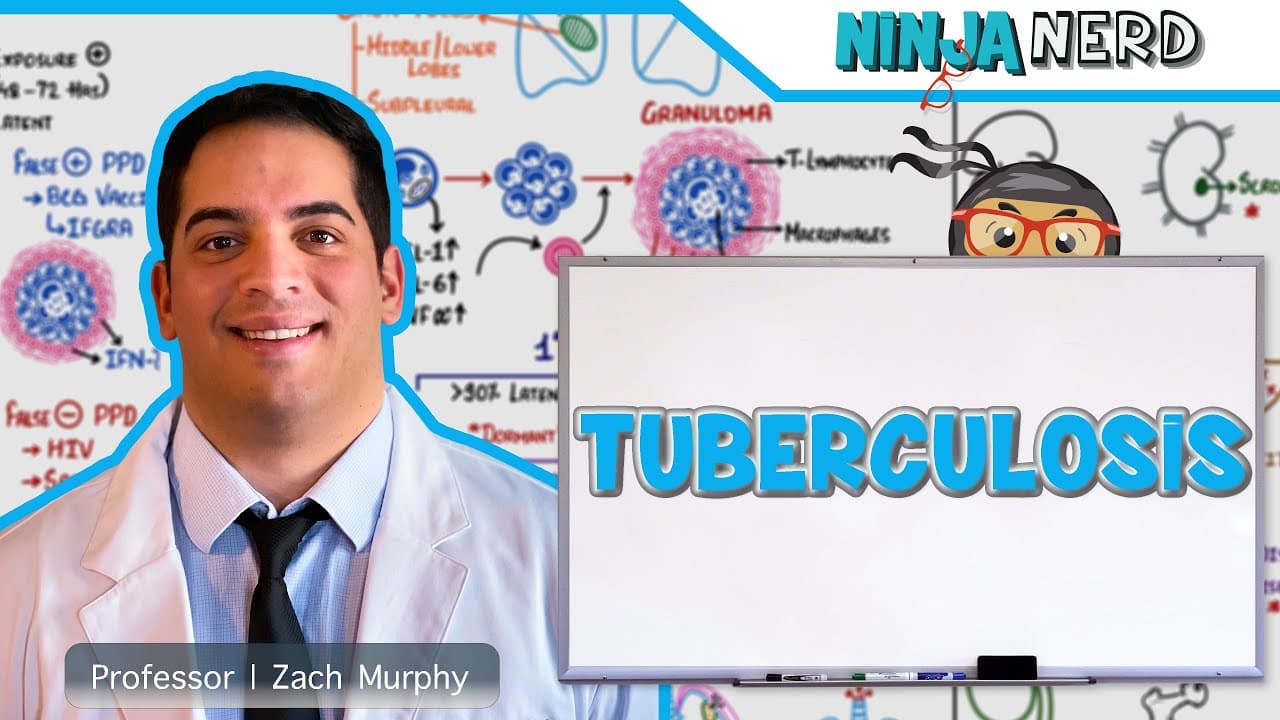
Tuberculosis begins when airborne Mycobacterium tuberculosis enters the respiratory tract and survives inside macrophages by inhibiting phagolysosome activity. The immune response recruits macrophages and T lymphocytes to form caseating granulomas, while most primary infections enter a latent phase and fewer than 10 percent progress as primary progressive tuberculosis.
Transcript
foreign what's up Ninja nerds in this video today we're going to be talking about tuberculosis we're going to first go over the pathophysiology we're not going to go too crazy we're going to try to understand how tuberculosis actually occurs and what type of populations who are at high risk of exposure high risk of reactivation infection then what ... Read More
Key Insights
- Mycobacterium tuberculosis is an airborne pathogen that is inhaled into the respiratory tract, moves through the bronchial system, and commonly establishes the initial pulmonary immune reaction in subpleural tissue of the middle or lower lung lobes.
- Tuberculosis survives inside macrophages by inhibiting the phagolysosome process, which normally allows lysosome-containing vesicles to combine with a phagosome and break down an engulfed pathogen. This inhibition enables the bacteria to multiply within multiple macrophages.
- The immune response to tuberculosis is driven by cytokines such as interleukin-1, interleukin-6, and tumor necrosis factor alpha. These signals recruit additional macrophages and lymphocytes to the infected area in an effort to contain the organism.
- A caseating granuloma is an organized immune structure containing central caseous necrosis, surrounding macrophages, and T lymphocytes. It forms because macrophages cannot completely destroy the bacteria, so recruited immune cells attempt to wall off the infection.
- A Ghon focus is a caseating granuloma that forms in subpleural lung tissue, generally within the middle or lower lobes. It represents the localized pulmonary lesion associated with primary tuberculosis after exposure to Mycobacterium tuberculosis.
- A Ghon complex is the combination of a pulmonary Ghon focus and hilar lymphadenopathy caused by granuloma formation in nearby lymph nodes. This pattern is described as being consistent with primary tuberculosis.
- Interferon gamma is released by T lymphocytes during the immune response to tuberculosis. Its role in the described process is to recruit more macrophages, strengthening the cellular structure that walls off Mycobacterium tuberculosis within granulomas.
- Latent tuberculosis develops in at least 90 percent of primary cases described in the lecture, with fibrocalcification helping keep the infection dormant. Fewer than 10 percent progress to primary progressive tuberculosis, and latent infection may later reactivate as secondary tuberculosis.
Install to Summarize YouTube Videos and Get Transcripts
Explore YouTube Video Summarizer or Get YouTube Transcript Extractor
Questions & Answers
Q: How does tuberculosis infection begin in the lungs?
Tuberculosis infection begins when airborne Mycobacterium tuberculosis is inhaled into the respiratory tract. The organism travels through the bronchial system and reaches lung tissue, where the initial reaction commonly occurs in subpleural areas of the middle or lower lobes. Macrophages then encounter and engulf the bacteria, beginning the immune response that can produce a caseating granuloma.
Q: How does Mycobacterium tuberculosis survive inside macrophages?
Mycobacterium tuberculosis survives by inhibiting the phagolysosome process. Normally, a macrophage engulfs a pathogen inside a phagosome, which then combines with lysosome-containing vesicles so the organism can be broken down. Tuberculosis interferes with this process, remains inside the macrophage, and multiplies. The infected and damaged macrophages consequently stimulate recruitment of more immune cells.
Q: What is a caseating granuloma in tuberculosis?
A caseating granuloma is an immune structure formed when macrophages cannot completely eliminate Mycobacterium tuberculosis. The center contains caseous necrosis created as infected macrophages are destroyed. More macrophages surround this central region, and T lymphocytes gather around them. Together, these cells attempt to wall off the pathogen and limit its spread through the surrounding tissue.
Q: What is the difference between a Ghon focus and a Ghon complex?
A Ghon focus is the initial caseating granuloma located in the lung, generally in a subpleural area of the middle or lower lobes. A Ghon complex includes both that pulmonary focus and involvement of nearby lymph nodes. Granuloma formation in those nodes produces hilar lymphadenopathy, so the combined lung lesion and lymph node reaction constitute the complex.
Q: Which populations have a high risk of tuberculosis exposure?
Populations identified as having a high risk of tuberculosis exposure include people in prisons, healthcare workers, people experiencing homelessness, immigrants arriving from populations where tuberculosis is highly prevalent, and people who use intravenous drugs. These settings or circumstances increase the opportunity for exposure to the airborne pathogen, although exposure alone does not guarantee development of active tuberculosis disease.
Q: What role do cytokines play in tuberculosis infection?
Cytokines recruit immune cells to the area infected by Mycobacterium tuberculosis. Infected macrophages release interleukin-1, interleukin-6, and tumor necrosis factor alpha, which encourage more macrophages and lymphocytes to arrive. T lymphocytes also release interferon gamma to recruit additional macrophages. This coordinated response helps build the granuloma that attempts to contain the pathogen.
Q: What happens after primary tuberculosis develops?
After primary tuberculosis develops, several outcomes are possible. The immune system may completely clear the infection, or the bacteria may remain dormant during a latent phase. At least 90 percent of cases described enter latency, where fibrocalcification helps contain the infection. Fewer than 10 percent progress to primary progressive tuberculosis, which can continue damaging lung tissue.
Q: How does latent tuberculosis differ from progressive tuberculosis?
Latent tuberculosis is a dormant state in which the immune response contains the organism, with fibrocalcification forming around affected areas. The person has been infected, but the bacteria are being held in a shut-down state. Progressive tuberculosis occurs when the infection continues rather than remaining contained. Latent infection may also reactivate and develop into secondary tuberculosis.
Summary & Key Takeaways
-
Mycobacterium tuberculosis is an airborne pathogen that enters the respiratory tract and reaches lung tissue. Macrophages engulf the bacteria, but the organism inhibits the phagolysosome process and multiplies inside these immune cells. Cytokine release recruits additional macrophages and lymphocytes, producing an organized attempt to contain the infection within a granuloma.
-
Primary tuberculosis commonly produces a subpleural Ghon focus in the middle or lower lung lobes. The focus contains a caseating granuloma with central necrosis. When granulomas also involve nearby lymph nodes and cause hilar lymphadenopathy, the combination of the pulmonary Ghon focus and lymph node involvement is called a Ghon complex.
-
At least 90 percent of primary tuberculosis cases enter a latent phase, although some infections may be cleared completely. During latency, fibrocalcification develops around affected areas and helps keep the bacteria dormant. Fewer than 10 percent of cases progress to primary progressive tuberculosis, while latent infection can potentially reactivate as secondary tuberculosis.
Read in Other Languages (beta)
Share This Summary 📚
Summarize YouTube Videos and Get Video Transcripts with 1-Click
Try YouTube Summary with ChatGPT & Claude or YouTube Transcript Generator
Explore More Summaries from Ninja Nerd 📚






Summarize YouTube Videos and Get Video Transcripts with 1-Click
Try YouTube Summary with ChatGPT & Claude or YouTube Transcript Generator