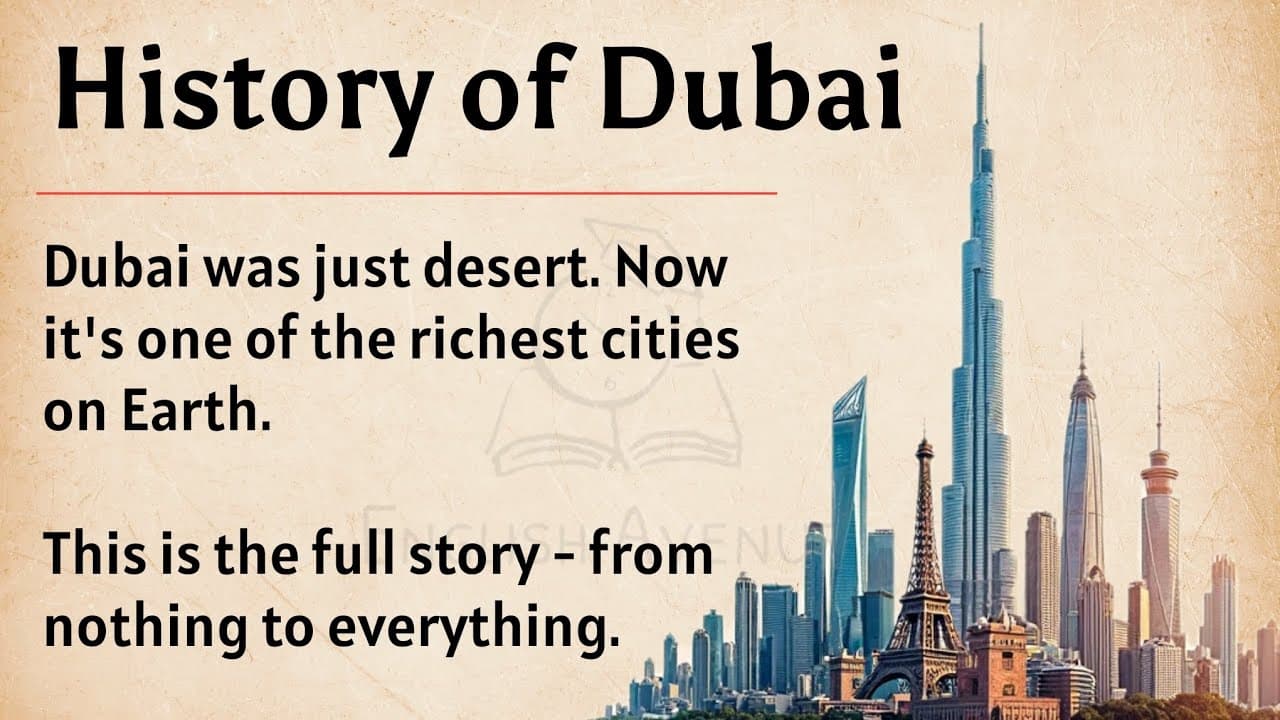
How did Dubai rise from desert to luxury powerhouse?
TL;DR
Dubai transformed through visionary leadership and strategic use of limited oil money to fund infrastructure, trade, and a non oil economy. Key moves included dredging Dubai Creek, building Port Rashid, creating free zones, and launching Emirates Airlines to connect the city to the world. This story frames Dubai as a deliberate, long term development project.
Transcript
Welcome to this video. Look around your room right now. You have electricity. Maybe you're holding a phone. Maybe you're sitting under a fan or in an airond conditioned place. Now imagine this. Just 70 years ago, in one corner of the Arabian desert, there was a land with no electricity, no water, no roads, no buildings, nothing but sand, camels, he... Read More
Key Insights
- Dubai started as a small fishing village with no oil yet a creek that enabled trade.
- Shik Rashid built infrastructure and educated citizens, planning for the future even before oil arrived.
- Oil money funded critical projects like Port Rashid and airports, not luxury palaces.
- The Deeper Dubai Creek and the port opened global trade routes and attracted merchants.
- Dubai pivoted from pearl trade decline to a non oil economy through diversification.
- Jebel Ali port and free zones created a vast logistics and business ecosystem.
- JAFCA free zones allowed 100 percent foreign ownership and tax benefits, attracting multinationals.
- Emirates Airlines began with two aircraft and grew into a global carrier, linking Dubai to the world.
- More videos from this channel:
- More from this channel: English Avenue
Install to Summarize YouTube Videos and Get Transcripts
Explore YouTube Video Summarizer or Get YouTube Transcript Extractor
Questions & Answers
Q: What sparked Dubai's transformation from a desert village to a global city?
Dubai’s transformation was sparked by a combination of visionary leadership and strategic use of the limited oil wealth to fund non oil development. Leaders focused on infrastructure such as dredging the Dubai Creek, building a modern port, and creating a free trade zone network. This laid the groundwork for a diversified economy and global connectivity.
Q: How did Shik Rashid contribute to Dubai’s early development?
Shik Rashid believed in building the future even without oil. He strengthened trade, dredged the Creek to allow larger ships, built roads, schools, hospitals, and utilities, and invited foreign engineers. He planned with the future in mind, creating essential infrastructure that allowed Dubai to attract merchants and investment and set the city on a path to modernization.
Q: What role did the Dubai Creek play in early Dubai’s growth?
Dubai Creek served as a natural economic lifeline that enabled initial trade. By deepening and widening the Creek, Dubai could accommodate larger cargo ships, bringing merchants from India, Africa, and Iran. This shift transformed Dubai into a trading hub, enabling economic activity beyond pearl diving and laying the foundation for maritime commerce.
Q: Why was oil discovery described as a twist in the Dubai story?
Oil discovery in 1966 provided revenue that could be reinvested, but Dubai deliberately used the funds for long term vision rather than luxury. The leadership invested in infrastructure, port development, and non oil industries, ensuring that Dubai would survive when oil declined in the future. This strategic use of oil revenue catalyzed growth in trade and tourism.
Q: What was the significance of Jebel Ali port and free zones?
Jebel Ali port, built far from central Dubai, became the world’s largest man made harbor and connected to an industrial zone with tax free operations. The free zones, starting with JAFZA, allowed 100 percent foreign ownership and tax exemptions, attracting thousands of global companies and creating a robust logistics and business ecosystem.
Q: How did the UAE federation influence Dubai’s development?
The UAE federation unified seven emirates under one flag, allowing Dubai to focus on non oil growth while Abu Dhabi leveraged oil wealth for national development. This partnership enabled highways, shared resources, openness to the world, and a framework in which Dubai could expand into logistics, tourism, and global business.
Q: What role did Emirates Airlines play in Dubai’s story?
Emirates Airlines began with two aircraft and grew into a symbol of Dubai’s global connectivity. By linking Dubai to international destinations, it supported tourism, trade, and business travel, reinforcing Dubai as a gateway to the Middle East and a hub for global commerce and culture.
Q: What is the overarching lesson of Dubai’s rise according to the video?
The overarching lesson is that visionary leadership combined with strategic investment in infrastructure and non oil diversification can transform a resource constrained region into a global powerhouse. Dubai shows how long term planning, openness to trade, and world class logistics create sustainable prosperity beyond natural resources.
Summary & Key Takeaways
-
Dubai shifted from a palm hut village to a modern city by investing oil revenue into infrastructure, ports, and housing while planning for long term growth.
-
A pivotal shift came with transforming the creek into a trading hub and building a modern airport, enabling global commerce and tourism.
-
The creation of free zones and Emirates Airlines cemented Dubai as a logistics and travel gateway of the region.
Read in Other Languages (beta)
Share This Summary 📚
Summarize YouTube Videos and Get Video Transcripts with 1-Click
Try YouTube Summary with ChatGPT & Claude or YouTube Transcript Generator
Explore More Summaries from English Avenue 📚





Summarize YouTube Videos and Get Video Transcripts with 1-Click
Try YouTube Summary with ChatGPT & Claude or YouTube Transcript Generator