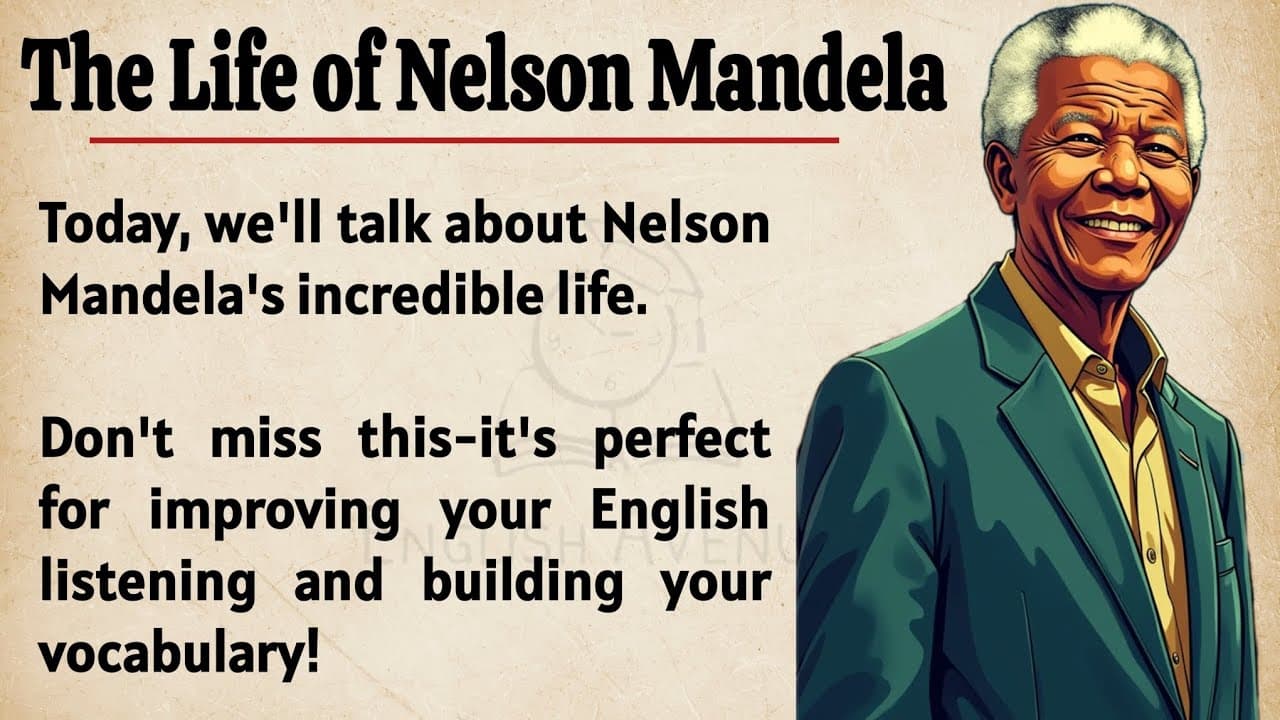
How did Nelson Mandela fight apartheid and lead change?
TL;DR
Mandela pursued education and law to resist apartheid and organize the movement. He joined the ANC Youth League, helped found a black law firm, and adopted nonviolent resistance before endorsing armed struggle when peaceful protests failed. He was imprisoned, became a global symbol, and helped guide a transition to equality.
Transcript
hello dear Learners welcome back to our Channel where English learning becomes an unforgettable Adventure today we begin the incredible life story of one of the greatest leaders in history Nelson Mandela this is not just a story it's a journey of Hope courage and determination listening to this story will help you improve your English vocabulary pr... Read More
Key Insights
- Mandela is introduced as a life story of a leader who inspires through hope, courage, and determination.
- Mandela was born in 1918 in a village in the Eastern Cape and given an English name in school.
- Mandela pursued education, studying geography, history, and English literature, and later law at the University of Witwatersrand.
- Mandela joined the African National Congress and helped form the ANC Youth League to mobilize young people.
- Mandela practiced law with Oliver Tambo, providing free or low-cost help to Black South Africans.
- The Sharpeville massacre and apartheid laws pushed Mandela toward more determined resistance, including underground activity.
- Mandela was banished to Robben Island and faced harsh prison conditions but remained hopeful and educated.
- Mandela advocated education as a powerful weapon and used his speeches to inspire a broader struggle for justice.
- More videos from this channel:
- More from this channel: English Avenue
Install to Summarize YouTube Videos and Get Transcripts
Explore YouTube Video Summarizer or Get YouTube Transcript Extractor
Questions & Answers
Q: How did Nelson Mandela’s early life influence his leadership style?
Mandela grew up in a mud and straw hut with a strong sense of community, learning leadership from elders and his family. He saw fairness and responsibility modeled in his early life, which shaped a leadership style rooted in service and duty to his people. This foundation contributed to his lifelong focus on justice, equality, and creating inclusive structures for participation in society.
Q: What role did education play in Mandela’s fight against apartheid?
Education was a central theme for Mandela. He valued education as the most powerful weapon to change the world and pursued studies in English, geography, and history before studying law. His education enabled him to understand the legal system, articulate arguments against apartheid, and build a career that supported both his personal growth and political activism.
Q: Why did Mandela join the ANC Youth League, and what did it aim to achieve?
Mandela joined the ANC Youth League to mobilize younger people in the struggle for justice and equality. The Youth League provided a platform for energetic, bold leadership and the adoption of more dynamic tactics to resist apartheid. This group helped reframe the movement with a clearer call for action and broader youth involvement.
Q: How did the Sharpeville massacre affect Mandela’s strategy?
The Sharpeville massacre demonstrated that peaceful protests alone might not be enough to end apartheid, pushing Mandela and colleagues toward more assertive actions. It led to the government banning the ANC, forcing activists underground and ultimately contributing to the formation of the armed struggle program for strategic resistance.
Q: What was Mandela’s contribution to the legal profession in South Africa?
Mandela co-founded a black law firm with Oliver Tambo, providing free or low-cost legal assistance to Black South Africans who were victims of apartheid. This work helped document abuses, defend those oppressed by unjust laws, and empower Black communities by delivering concrete legal aid and education about their rights.
Q: How did Mandela’s imprisonment influence his global stature and strategy?
Imprisonment on Robben Island turned Mandela into a global symbol of resistance and endurance. He used his time to study languages, teach younger prisoners, and refine his leadership philosophy. His steadfastness and humanity resonated worldwide, sustaining international pressure for ending apartheid and shaping negotiations for a transition to democracy.
Q: What was Mandela’s guiding vision for South Africa after apartheid?
Mandela envisioned a democratic and free society where all persons live together in harmony with equal opportunities. He believed in a country where children could play together regardless of race and where justice prevailed. This vision guided his political and personal work, emphasizing reconciliation, reconciliation, and national unity.
Q: How did Mandela balance personal life with his political mission?
Mandela balanced marriage, fatherhood, and leadership by prioritizing his mission while remaining committed to his family. He understood the strain of activism on personal life and spoke about not settling for less than one is capable of living. His approach combined responsibility to family with dedication to a broader struggle for justice.
Summary & Key Takeaways
-
Mandela grew up in a village setting in the Eastern Cape and learned leadership early from elders and family. He adopted education as a key tool for change and later studied law at a university where he faced discrimination but persisted. His work with the ANC and legal defense of black South Africans defined his path.
-
The Sharpeville massacre, his underground period, and the formation of a secret armed wing shifted his tactics. He testified to the world during his trial and used imprisonment to emphasize perseverance and hope for a democratic society with equal opportunities.
-
Ultimately, Mandela’s life embodied resilience, leadership, and reconciliation. He became a global symbol of resistance to oppression and a catalyst for a peaceful transition toward a multiracial democracy, illustrating the power of education, courage, and steadfast commitment to justice.
Read in Other Languages (beta)
Share This Summary 📚
Summarize YouTube Videos and Get Video Transcripts with 1-Click
Try YouTube Summary with ChatGPT & Claude or YouTube Transcript Generator
Explore More Summaries from English Avenue 📚

Summarize YouTube Videos and Get Video Transcripts with 1-Click
Try YouTube Summary with ChatGPT & Claude or YouTube Transcript Generator