How Do Quaternions Represent 4D Multiplication?
TL;DR
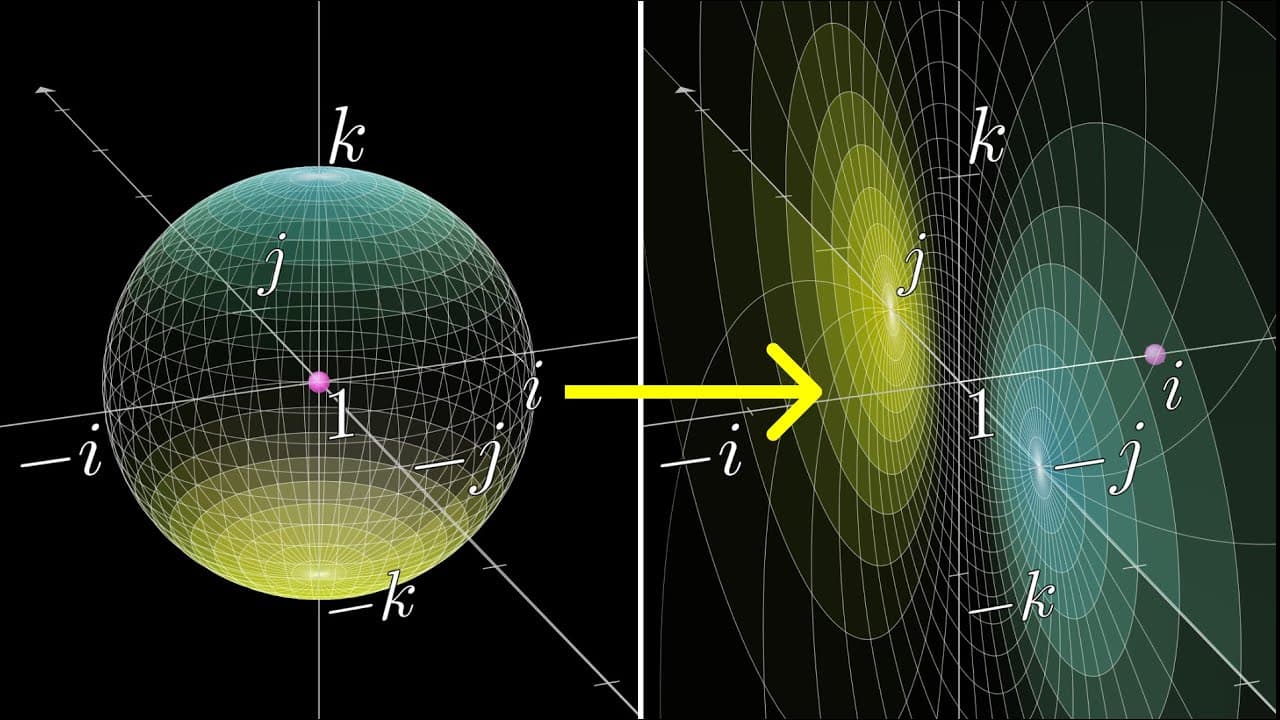
Quaternions extend complex numbers into four dimensions, and multiplication by a unit quaternion can be understood as a transformation involving rotation on a four-dimensional sphere. Stereographic projection makes this geometry visible in three-dimensional space, much as projecting the complex unit circle onto a line lets a one-dimensional observer perceive the effects of complex multiplication.
Transcript
What you're looking at right now is something called quaternion multiplication, or rather you're looking at a certain representation of a specific motion happening on a four-dimensional sphere being represented in our three-dimensional space, one which you'll understand by the end of this video. Quaternions are an absolutely fascinating and often u... Read More
Key Insights
- Quaternions are a four-dimensional extension of complex numbers, consisting conceptually of the real numbers together with three imaginary dimensions. Their multiplication is more difficult to interpret than ordinary or complex multiplication, but a geometric view reveals it as a structured transformation of four-dimensional space.
- Quaternion multiplication is useful for computing orientation and rotation in three-dimensional graphics and robotics. The transcript states that it is computationally more efficient than other methods and avoids many numerical errors that can arise when those alternative methods are used.
- William Rowan Hamilton discovered the crucial quaternion equation on October 16, 1843, while crossing Broom Bridge in Dublin. His decisive insight was that a workable extension required two additional imaginary dimensions beyond complex numbers, rather than only one additional dimension.
- Complex multiplication is an action on the plane: the left factor acts like a function that rotates and stretches the right factor. Looking at how that factor transforms the entire plane provides the conceptual model later used to interpret quaternion multiplication in four dimensions.
- Unit complex numbers produce pure rotations because every number on the unit circle has distance 1 from the origin. Multiplication by i rotates the complex plane by 90 degrees counterclockwise, and applying that multiplication four times returns every point to its original position.
- Stereographic projection maps a circle onto a line by drawing lines from negative 1 through points on the circle. The projected position is where each line intersects the vertical line through the center, allowing one-dimensional space to represent a continuous family of two-dimensional rotations.
- The point negative 1 becomes a point at infinity under the stereographic projection because its tangent line never intersects the projection line. Both directions along the projected line approach this same added point, preserving the continuity of movement around the original unit circle.
- Quaternion multiplication acts through a type of double rotation in four-dimensional space. Projecting a four-dimensional hypersphere into three-dimensional space makes that action visible, providing an intuitive geometric interpretation for multiplication rules that otherwise appear opaque when presented only as algebra.
Install to Summarize YouTube Videos and Get Transcripts
Explore YouTube Video Summarizer or Get YouTube Transcript Extractor
Questions & Answers
Q: What are quaternions in mathematics?
Quaternions are a four-dimensional extension of complex numbers. The construction combines the real numbers with three imaginary dimensions, rather than adding only one new dimension to the complex plane. Their multiplication has an unusual geometric structure, but it can be interpreted as an action that transforms four-dimensional space through a type of double rotation.
Q: Why are quaternions useful for three-dimensional rotations?
Quaternions provide an elegant way to describe and compute orientation and rotation in three-dimensional space. According to the transcript, they are computationally more efficient than other methods and avoid many numerical errors associated with those alternatives. These advantages led to their resurgence among programmers working in computer graphics, robotics, and other fields involving three-dimensional orientation.
Q: How did William Rowan Hamilton discover quaternions?
William Rowan Hamilton spent much of his life looking for a three-dimensional number system analogous to the complex numbers. On October 16, 1843, while crossing Broom Bridge in Dublin, he realized that the solution required three imaginary dimensions alongside the real numbers. He carved the crucial equation describing the imaginary units into the bridge, which later received a commemorative plaque.
Q: How does complex multiplication help explain quaternions?
Complex multiplication supplies a lower-dimensional model for understanding quaternion multiplication. A complex number on the left can be treated as a function acting on the number to its right, rotating and stretching the entire plane. Quaternion multiplication is approached similarly, except that the left quaternion transforms four-dimensional space through a type of double rotation rather than transforming a two-dimensional plane.
Q: What is stereographic projection in this explanation?
Stereographic projection is a method for representing a circle on a line, a sphere on a plane, or a four-dimensional hypersphere in three-dimensional space. For the unit circle, a line is drawn from negative 1 through each circle point. Its intersection with the vertical line through the center determines the projected location, translating circular geometry into one dimension.
Q: Why does negative 1 map to infinity in stereographic projection?
Negative 1 has no ordinary projected position because the tangent line at that point never crosses the vertical projection line. It is therefore assigned a special point at infinity. Traveling indefinitely far in either direction along the projected line approaches that same point, corresponding to approaching negative 1 from either direction around the original unit circle.
Q: What does multiplying a complex number by i do geometrically?
Multiplying by i rotates the complex plane by 90 degrees counterclockwise. On the projected unit circle, 1 moves to i, i moves to the point at infinity representing negative 1, that point moves to negative i, and negative i moves to 1. Repeating the operation four times returns to the starting configuration, expressing i to the fourth equals 1.
Q: How can quaternion multiplication be visualized in three dimensions?
Quaternion multiplication can be visualized by restricting attention to a four-dimensional sphere and mapping that hypersphere into three-dimensional space with stereographic projection. The resulting motion is a three-dimensional representation of a transformation occurring in four dimensions. Following how reference points move under multiplication reveals the structure of the underlying double rotation without requiring direct four-dimensional perception.
Summary & Key Takeaways
-
Quaternions form a four-dimensional number system with one real dimension and three imaginary dimensions. William Rowan Hamilton discovered their crucial structure in 1843 after unsuccessfully seeking a three-dimensional analogue of complex numbers. Their unusual multiplication later became valuable for describing orientation, graphics, robotics, and mathematical models of two-state quantum systems.
-
The geometric explanation begins with complex multiplication. A complex number acting from the left can rotate and stretch the entire complex plane. Unit complex numbers produce pure rotations. By projecting the unit circle onto a line, a one-dimensional observer can witness these rotations as continuous but unfamiliar movements involving a point at infinity.
-
The same strategy extends through dimensions. Three-dimensional rotations are presented to a two-dimensional observer, then a four-dimensional hypersphere is projected into ordinary three-dimensional space. This progression builds an intuition for quaternion multiplication as a spatial transformation, preparing the viewer to interpret otherwise opaque algebraic formulas through the geometry of double rotation.
Read in Other Languages (beta)
Share This Summary 📚
Summarize YouTube Videos and Get Video Transcripts with 1-Click
Try YouTube Summary with ChatGPT & Claude or YouTube Transcript Generator
Explore More Summaries from 3Blue1Brown 📚

Summarize YouTube Videos and Get Video Transcripts with 1-Click
Try YouTube Summary with ChatGPT & Claude or YouTube Transcript Generator