How do frequency ratios create harmony in music?
TL;DR
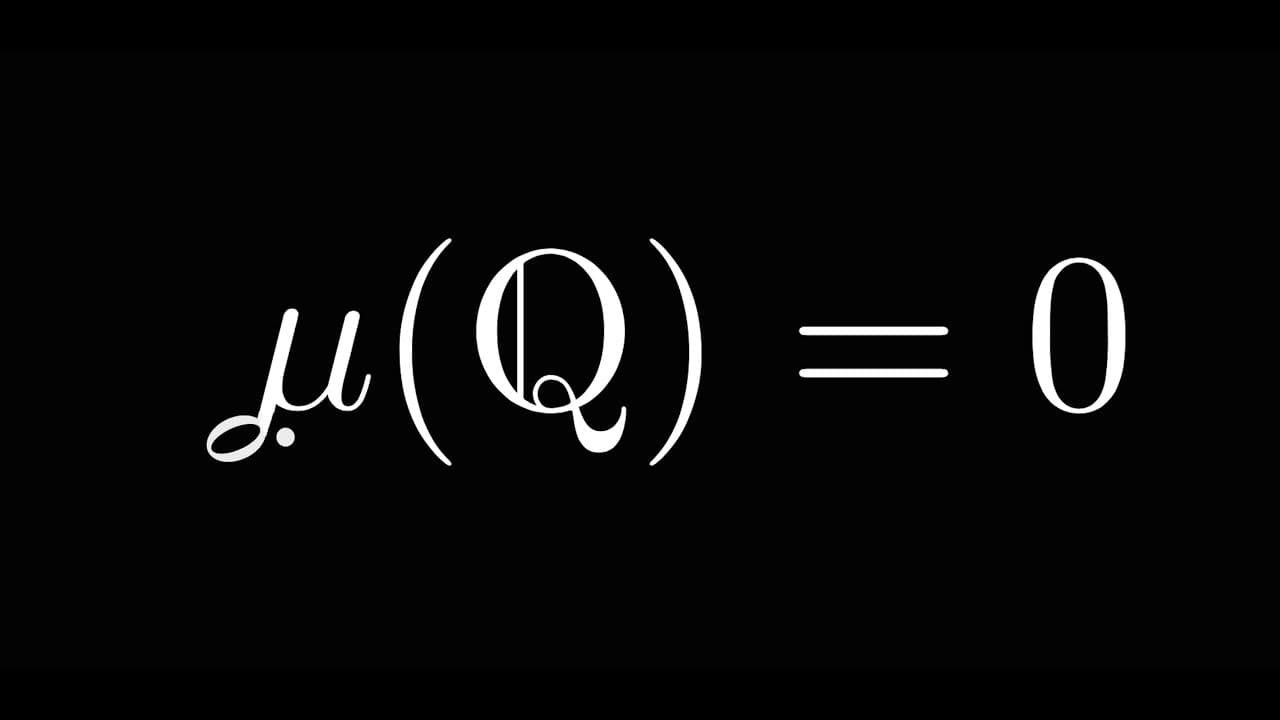
A ratio is harmonious when it aligns with simple rational numbers and close irrational approximations, making beating patterns detectable as a rhythm. The video explains that harmony depends on how small the denominator is and how closely an irrational can imitate a simple ratio, and it presents a counterintuitive method to cover all rationals in an interval with arbitrarily small total length using open intervals.
Transcript
I have two seemingly unrelated challenges for you. The first relates to music, and the second gives a foundational result in measure theory, which is the formal underpinning for how mathematicians define integration and probability. The second challenge, which I'll get to about halfway through the video, has to do with covering numbers with open se... Read More
Key Insights
- Music harmony emerges when frequency ratios approximate simple rationals or close irrationals, creating recognizable beat patterns.
- Pianos and equal temperament use irrational powers of the 12th root of 2, which approximate simple ratios and maintain close harmonic relationships.
- A simple measure of complexity is the denominator size in reduced fractions, affecting perceived harmony.
- Rational numbers can be densely packed yet can be covered by intervals whose total length is arbitrarily small.
- The covering construction enumerates rationals by increasing denominator and assigns a shrinking interval to each.
- The method shows that most numbers near a harmonious target remain audible as pleasant due to near rational approximations.
- The contrast between analytic enumeration and geometric intuition illustrates a counterintuitive result known in covering lemmas.
- A mathematical savant might find harmony in rationals but not in all irrationals, depending on interval coverage.
Install to Summarize YouTube Videos and Get Transcripts
Explore YouTube Video Summarizer or Get YouTube Transcript Extractor
Questions & Answers
Q: How to determine if a frequency ratio is harmonious based on the transcript?
Harmony is determined by how closely a ratio resembles simple rational numbers and how small the denominator is when written in reduced form. The ear detects patterns in beats when a frequency ratio is rational, but even irrational numbers can sound harmonious if they approximate a simple ratio closely enough. The discussion emphasizes the role of perceptual discrimination and tonal training in identifying harmony.
Q: What role does the 12th root of 2 play in musical tuning according to the video?
The 12th root of 2 is used to tune the chromatic scale so each half step multiplies the frequency by this irrational factor. Although these powers are irrational, they stay very close to simple rational numbers, which is why the tuned scale sounds coherent. The video notes that this closeness is why a piano can imitate harmony despite using irrational ratios.
Q: Why can irrational powers still approximate rational intervals in music?
Powers of the 12th root of 2 tend to stay within a small margin of error around simple rational numbers, which makes intervals like a fifth or a fourth sound harmonious even though their exact ratios are irrational. This approximation underpins why equal temperament works well across the chromatic scale.
Q: What is the second challenge about covering rationals with open intervals?
The challenge asks to cover all rational numbers between 0 and 1 using open intervals whose total length is strictly less than 1, allowing infinitely many intervals. The construction enumerates rationals by denominator and assigns shrinking intervals to each, showing that a positive total length can be made arbitrarily small while still covering every rational.
Q: How does the enumeration of rationals help in the covering problem?
Rationals are listed in a specific order by increasing denominators, with each rational assigned a unique interval. This structured listing ensures that every rational has a designated interval, and because the interval lengths can be scaled down by a convergent positive series, the sum of lengths can be kept below 1 even though the rationals are dense.
Q: What counterintuitive point does the video make about covering intervals?
Even though the rationals are dense, it is possible to cover all of them within a fixed interval with total length less than that interval, by carefully shrinking the assigned intervals according to a convergent series. This defies geometric intuition by showing that density does not force a large total measure for a covering.
Q: What does the speaker mean by a musical savant finding harmony in all rationals?
The savant is imagined as someone who perceives harmonious patterns in all rational ratios. The question then asks whether such a person would also find all real numbers between 1 and 2 harmonious, which leads to considering how well any real number can be approximated by rationals and how the covering construction might extend to irrationals.
Q: How does the video relate the two challenges to a broader mathematical idea?
The link lies in how a perceptual question about harmony connects to a theoretical covering problem in measure theory. Both explore how a complex, dense set can be understood through simple, structured representations: harmonious ratios via rational approximations and covering rationals with shrinking open intervals, illustrating counterintuitive results in analysis and geometry.
Summary & Key Takeaways
-
A connection is drawn between musical harmony and measure theory, showing how simple ratios relate to pleasant sounds and how irrational approximations influence perception.
-
The second challenge uses open intervals to cover all rational numbers between 0 and 1 with total length less than 1, despite density of rationals.
-
The discussion highlights that intuition from geometry can clash with analytic constructions in covering problems.
Read in Other Languages (beta)
Share This Summary 📚
Summarize YouTube Videos and Get Video Transcripts with 1-Click
Try YouTube Summary with ChatGPT & Claude or YouTube Transcript Generator
Explore More Summaries from 3Blue1Brown 📚

Summarize YouTube Videos and Get Video Transcripts with 1-Click
Try YouTube Summary with ChatGPT & Claude or YouTube Transcript Generator