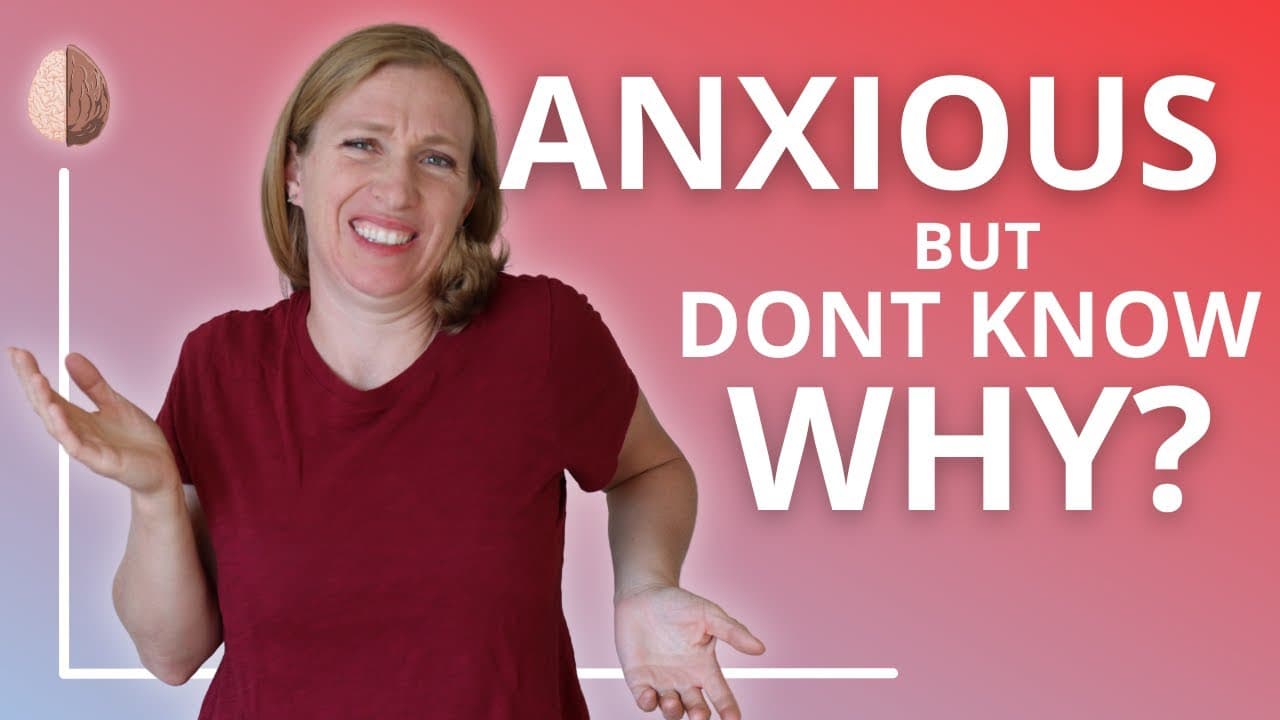
Why Am I Anxious for No Reason? 4 Hidden Causes
TL;DR
Anxiety with no obvious cause often traces to four things: distorted thinking patterns like catastrophizing and mind reading, old trauma surfacing because your brain now feels ready to process it, physical factors such as caffeine, poor sleep or nutrient deficiencies, and living out of step with your own values. Most anxiety is learned and habitual, which means it is treatable and the brain can be rewired.
Transcript
Hello everyone let's talk about general anxiety disorder. I'm Emma McAdam and welcome to part 4 of rewiring the anxious brain. In part 3 we talked about how micro threats in your environment and how habitual distraction actually keeps stress stored up in your system and that can lead you to feeling anxious when you don't know why. So if you haven't... Read More
Key Insights
- General anxiety disorder is feeling anxious much of the time without the feeling being tied to any specific event or situation, which makes the problem hard to solve because the cause is not visible to the person experiencing it.
- Most anxiety develops as something learned and habitually done rather than a permanent character trait, according to licensed Marriage and Family Therapist Emma McAdam, which is why it is treatable and the brain can be rewired to be less anxious.
- Rumination is a warning sign of distorted thinking: if thinking or writing about anxiety makes it spiral bigger and worse over and over rather than better, habitual thinking patterns are likely exacerbating the anxiety.
- Cognitive distortions that fuel anxiety include black and white thinking, mind reading, jumping to conclusions, mental filtering, and catastrophizing. Most people never notice these internal dialogues because thoughts happen automatically without awareness.
- Mental filtering means noticing only mistakes and what is going wrong while filtering out skills and successes, producing thoughts like "I never do anything right" or "I always mess everything up."
- Work triggers outsized anxiety because the brain treats a job as the source of food and shelter, so job loss registers as a survival threat and switches on ancient responses like adrenaline surges and muscle tension that are useless in a meeting.
- Changing thoughts requires making silent inward thoughts outward by writing them down, saying them aloud, or sharing them with an honest friend or therapist who can point out when the thinking is driving anxiety.
- Anxiety that signals you are not living your values is not general anxiety disorder but anxiety working correctly. Values offer a choice to make one small change to be better, while depression and anxiety disorders push you to shrink, hide, and avoid.
Install to Summarize YouTube Videos and Get Transcripts
Explore YouTube Video Summarizer or Get YouTube Transcript Extractor
Questions & Answers
Q: What is general anxiety disorder?
General anxiety disorder is when you feel anxious much of the time but that feeling is not tied to any specific event or situation. Because there is no identifiable trigger, it becomes hard to solve the problem, since you cannot address a cause you cannot see. Licensed Marriage and Family Therapist Emma McAdam frames it as something most people learn and habitually do rather than a fixed character trait, which is why it responds to treatment and skill building.
Q: Why do I feel anxious when I don't know why?
Four causes are covered in this part of the series. First, distorted thinking patterns run automatically and amplify anxiety without your noticing. Second, old trauma or anxiety surfacing can be your brain signaling that you are finally ready to process it. Third, physical factors such as caffeine, drugs, alcohol, lack of sleep, lack of exercise, or poor diet undermine your ability to regulate emotions. Fourth, you may not be living your values. An earlier part of the series covers constant distraction and avoidance as another cause.
Q: What are the cognitive distortions that make anxiety worse?
The distortions named are black and white thinking, mind reading, jumping to conclusions, mental filtering, and catastrophizing. Black and white thinking turns not knowing an answer into "I'm a complete failure." Mind reading assumes "everyone must think I'm so dumb." Mental filtering notices only mistakes while ignoring skills and successes. Catastrophizing imagines the worst possible scenario, such as "I'm gonna get fired, I can't handle this." Most people do not notice these thoughts and simply believe them.
Q: How do I change anxious thinking patterns?
Take silent inward thoughts and make them outward. Write them down, say them out loud, or share them with someone such as an honest friend or a therapist who can point out when your thinking is leading you to be anxious. This is why talk therapy, and cognitive behavioral therapy specifically, is effective for anxiety: it rewires the brain to respond to problems with different thoughts. Changing how you think changes how you feel.
Q: What are examples of reframing anxious thoughts?
Instead of "I'm so stupid," think "I didn't know that answer, but that just means I need to do some research." Instead of "everyone on my team hates me," think "I can check in with my team to see if I'm working well with them." Instead of remembering only every bad thing you have done, note the many things you do contribute to the team. Instead of catastrophizing, say "let's make the best of today, who knows how it will go, but I'm just gonna try my best."
Q: Why does work cause so much anxiety?
Anxiety stems from the fight flight freeze response, which evolved for escaping physical threats and ensuring survival. Your brain knows that your job is your source of food and shelter, so it treats not having a job as a survival threat. When you tell yourself after a mistake that you are a complete failure and everyone hates you and they are going to fire you, that message tells the brain survival is at stake, triggering ancient survival techniques like an adrenaline surge and muscle tension that are not helpful in a work meeting.
Q: Why is old trauma coming up now when I feel safe?
When painful or anxiety provoking memories surface, it can be your brain signaling that you are now ready to work through the trauma. Earlier you may not have been ready because you were still in survival mode or not in a safe place. Seen this way, resurfacing trauma is a sign of growth and healing. The recommended response is to slow things down, examine what is going on, listen to your body, sensations, emotions and thoughts, write things down, and work with a professional who specializes in trauma treatment.
Q: How does physical health affect anxiety?
Anxiety is a bodily response to the perception of danger, combining the fight flight freeze response with worry. Heavy caffeine use, drugs, alcohol, poor sleep, no exercise, or eating badly all make it harder for the body to regulate emotions, because the brain is a physical organ in the body. If the full list feels overwhelming, pick one small improvement for a week, such as going to bed earlier or taking a five minute walk daily. A doctor visit and blood work can rule out physical conditions or reveal deficiencies in iron, magnesium, or vitamin D.
Q: How can I tell the difference between a cognitive distortion and a real values signal?
Values give you the choice to make one small change, to take one small action to be better. Depression and anxiety disorders instead encourage you to shrink down, to hide, and to avoid your problems. Anxiety that comes from treating people poorly, stealing from an employer, or cheating on tests is not general anxiety disorder, it is anxiety functioning the way it should, acting as a warning sign that things are not as they ought to be. If that is the source, positive thinking or supplements will not fix it.
Q: Can you rewire your brain to be less anxious?
Yes. The core claim is that most anxiety develops as something we learn and something we habitually do, so it is not a permanent character trait and it is treatable. Because the habit of thinking a certain way was learned, the brain can be rewired to think differently, and different thoughts produce different feelings. The method is learning skills to get better at feeling, which includes noticing distorted thinking, externalizing thoughts through writing or talking, processing old trauma with a professional, and managing whole body health.
Summary & Key Takeaways
-
Part 4 of the Rewiring the Anxious Brain series covers reasons three through six for feeling anxious without knowing why. Parts 1 and 3 cover the anxiety cycle, the fight flight freeze response, and how habitual distraction keeps stress stored in the system. The premise throughout is that anxiety is learned behavior, so it can be unlearned through skills for getting better at feeling.
-
Reason three is how we think. Cognitive distortions including black and white thinking, mind reading, jumping to conclusions, mental filtering, and catastrophizing run automatically below awareness and amplify anxiety. Cognitive behavioral therapy works by replacing these responses: instead of "I'm so stupid," the reframe is "I didn't know that answer, so I need to do some research."
-
Reason four is that painful memories resurfacing can mean the brain judges you ready to process old trauma now that you are out of survival mode. Reason five is the body: caffeine, drugs, alcohol, poor sleep, no exercise, and bad food impair emotional regulation, and a doctor visit may reveal an iron, magnesium, or vitamin D deficiency. Reason six is not living your values.
Read in Other Languages (beta)
Share This Summary 📚
Summarize YouTube Videos and Get Video Transcripts with 1-Click
Try YouTube Summary with ChatGPT & Claude or YouTube Transcript Generator
Explore More Summaries from Therapy in a Nutshell 📚




Summarize YouTube Videos and Get Video Transcripts with 1-Click
Try YouTube Summary with ChatGPT & Claude or YouTube Transcript Generator