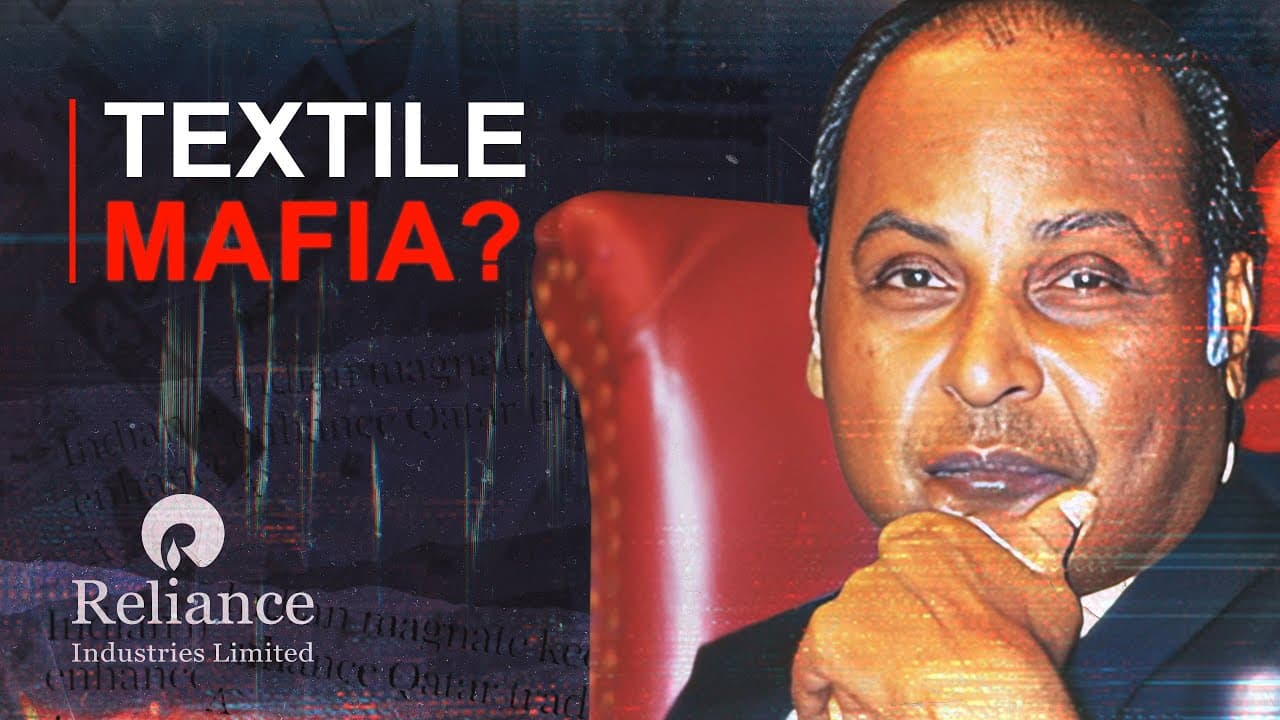
How Did Dhirubhai Ambani Build Reliance?
TL;DR
Dhirubhai Ambani built Reliance by studying markets closely, cultivating relationships, adapting to government incentives, and recognizing the potential of synthetic fibers before many competing traders. He accepted losses on selected exports because the resulting import credits allowed him to import scarce polyester and nylon, sell them at a premium in India, and create stronger overall profits.
Transcript
hi everybody we all know that huai was one of the greatest businessmen in the history of India this has been my father's favorite saying that if we can dream it we can do it it took up a 500 ft space on rent at the wholesale Market District at Masjid Bund and set up his first office in India Reliance commercial Corporation s Amani represented your ... Read More
Key Insights
- Dhirubhai Ambani's market education came from direct observation in Yemen, where he explored local streets, studied trading activity, learned Arabic fluently, and built relationships instead of limiting himself to his assigned work as a petrol pump clerk.
- Reliance Commercial Corporation began in a rented 500-square-foot office in Mumbai's Masjid Bunder wholesale market. Ambani used his relationships in Yemen to export Indian cardamom, cloves, turmeric, and ginger to West Asian countries, generating cash flow for later opportunities.
- Government incentives influenced Ambani's move from spices into textiles. After India encouraged cotton-cloth exports to African countries, he began trading yarns such as cotton, nylon, and viscose while targeting markets including Ethiopia, Somalia, and Kenya.
- India's export promotion scheme tied importing capacity to prior exports of equal value. An exporter who earned import credits could use them directly or import products for traders who lacked credits, collecting commissions for providing access to scarce foreign goods.
- Ambani's established export network became a strategic advantage under India's restrictive trade rules. While importers could be paralyzed by the credit requirement, his ongoing exports of spices, cotton, and nylon supplied the credits needed to bring textile goods into India.
- Synthetic fibers offered several commercial advantages over cotton and silk. The transcript identifies lower production costs, greater durability, resistance to creasing, faster drying, and uses across clothing, upholstery, and industrial materials as reasons Ambani expected demand to grow.
- Ambani deliberately accepted losses on some exports because export credits unlocked imports of nylon and polyester. His calculation focused on the combined transaction, not the profitability of each stage, since scarce synthetic fibers could be sold at a premium in India.
- Reliance's reported revenue rose from 4.9 crore rupees in 1970 to 240 crore rupees in 1980. The transcript describes this as 48-fold growth over ten years, with revenue repeatedly approaching or achieving a doubling every two years.
Install to Summarize YouTube Videos and Get Transcripts
Explore YouTube Video Summarizer or Get YouTube Transcript Extractor
Questions & Answers
Q: How did Dhirubhai Ambani start his trading business?
Dhirubhai Ambani started after working as a petrol pump clerk and performing menial jobs for a trading company in Yemen. He observed that spices and rice sold there came from India, spoke with local traders, and identified spice trading as a low-risk, high-margin opportunity. He then moved to Mumbai, opened Reliance Commercial Corporation, and exported Indian spices to West Asian countries.
Q: Why did Dhirubhai Ambani learn Arabic in Yemen?
Dhirubhai Ambani learned Arabic while working in Yemen so he could communicate fluently and build strong relationships with local people. His curiosity took him beyond the routine duties of a petrol pump employee. By exploring markets and speaking with traders, he learned that Indian spices and rice were already reaching Yemen, which helped him identify an export opportunity he could pursue from India.
Q: Why did Dhirubhai Ambani shift from spices to textiles?
Dhirubhai Ambani shifted attention toward textiles after the Indian government announced that cotton clothes were in strong demand in African countries and offered incentives to exporters serving those markets. He began buying and selling yarns such as cotton, nylon, and viscose, targeting Ethiopia, Somalia, and Kenya. The move also positioned him to benefit from the later export promotion scheme.
Q: How did India's export promotion scheme work?
India's export promotion scheme required a trader to export goods before importing goods of the same value. An export worth 1,000 rupees generated import credit worth 1,000 rupees. Importers without sufficient credits had to work through exporters who possessed them and pay commissions. The policy was intended to balance imports and exports, but it made importing difficult for businesses without export operations.
Q: Why were export credits valuable to Dhirubhai Ambani?
Export credits were valuable because Dhirubhai Ambani already had networks for exporting spices, cotton, and nylon. Those transactions gave him authorization to import goods of corresponding value under the government's rules. Importers without credits could also place orders through him and pay commissions. His established export activity therefore provided both direct importing capacity and a service he could offer to constrained traders.
Q: Why did Dhirubhai Ambani focus on synthetic fibers?
Dhirubhai Ambani focused on synthetic fibers because he expected them to become increasingly attractive in India. According to the transcript, they resisted creasing, lasted longer, dried quickly, and cost less to produce than traditional alternatives. They could also be used for clothing, upholstery, and industrial materials. Restricted imports created scarcity, allowing imported synthetic fibers to command premium prices in the domestic market.
Q: Why did Dhirubhai Ambani export some goods at a loss?
Dhirubhai Ambani exported some goods at a deliberate loss because the exports generated credits needed to import nylon and polyester. Rather than requiring both sides of the trade to be profitable independently, he evaluated the combined result. A small export loss could be justified if it unlocked scarce synthetic fibers that could be imported and sold at a sufficiently high premium in India.
Q: How quickly did Reliance grow between 1970 and 1980?
Reliance's revenue reportedly increased from 4.9 crore rupees in 1970 to 12.7 crore in 1972, 30.2 crore in 1974, 62.8 crore in 1976, 120 crore in 1978, and 240 crore in 1980. The transcript characterizes this as 48-fold growth in ten years, showing how rapidly the company expanded despite India's difficult business and import environment.
Summary & Key Takeaways
-
Dhirubhai Ambani began as a petrol pump clerk in Yemen, where he learned Arabic, studied local markets, and developed relationships with traders. After noticing that Indian spices and rice were sold there, he moved to Mumbai, established Reliance Commercial Corporation, and exported cardamom, cloves, turmeric, and ginger to West Asian countries.
-
Government incentives for textile exports led Ambani to shift from spices toward cotton, nylon, viscose, and other yarns sold in African markets such as Ethiopia, Somalia, and Kenya. This export network became especially valuable when India required businesses to earn export credits before importing goods of an equivalent value.
-
Ambani recognized that synthetic fibers were durable, inexpensive, quick-drying, crease-resistant, and suitable for clothing, upholstery, and industrial materials. He sometimes exported goods at a deliberate loss to obtain import credits, which enabled him to bring scarce polyester and nylon into India and pursue greater profits from their domestic sale.
Read in Other Languages (beta)
Share This Summary 📚
Summarize YouTube Videos and Get Video Transcripts with 1-Click
Try YouTube Summary with ChatGPT & Claude or YouTube Transcript Generator
Explore More Summaries from Think School 📚



Summarize YouTube Videos and Get Video Transcripts with 1-Click
Try YouTube Summary with ChatGPT & Claude or YouTube Transcript Generator