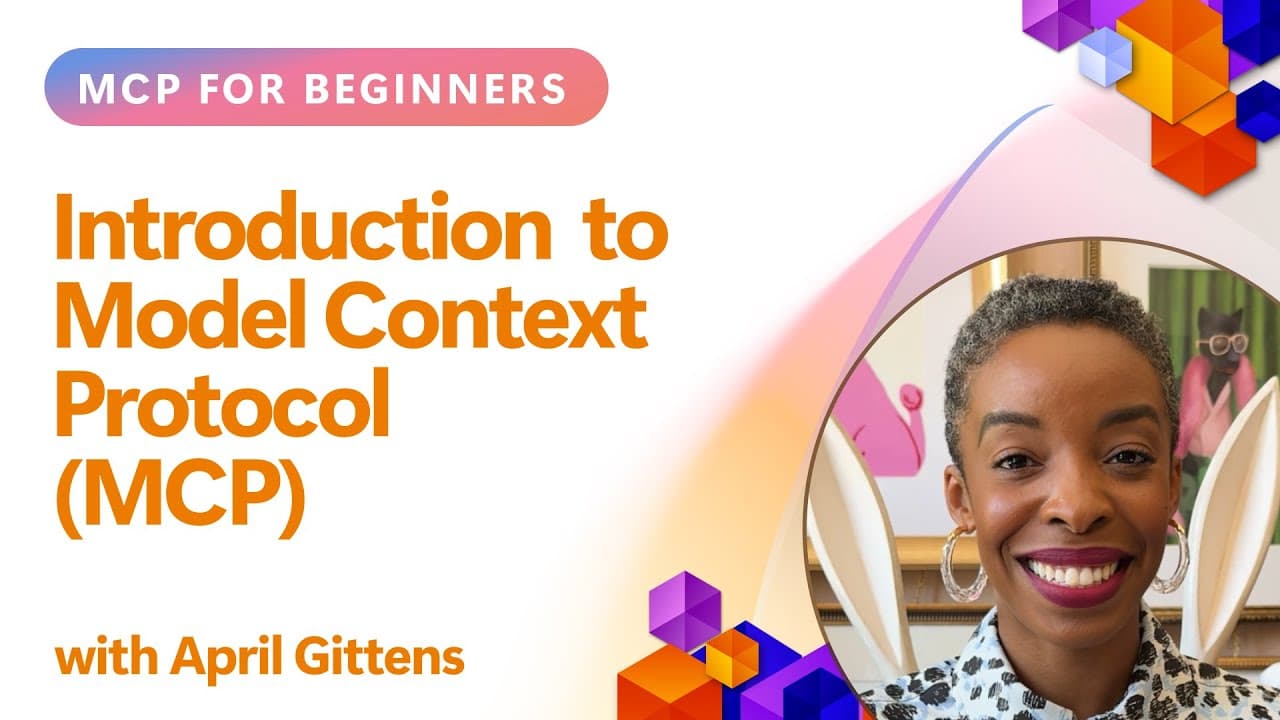
How to use MCP to connect AI tools and data
TL;DR
MCP provides a standard client server interface that lets AI models request tools and data through a unified protocol. It enables scalability, reuse, and consistency across tools and models, reducing brittle integrations and enabling smarter agentic applications. You can run MCP servers in multiple languages and connect tools without custom wiring, paving the way for real time data access and extensible architectures.
Transcript
Hey everyone, welcome. In this video, we're kicking off your journey into model context protocol or MCP for short. If you've ever tried building a generative AI app that does more than just chat, you've probably run into some challenges. How do you connect it to real-time data? How do you call tools like a calculator or search engines? And how do y... Read More
Key Insights
- MCP is a standard interface that lets AI models access tools and data.
- The client server model in MCP consists of an MCP host, an MTP client, and an MTP server.
- MCP servers run in Java, JavaScript, Python, and C for easy adoption.
- MCP enables interoperability across vendors and platforms.
- MCP provides consistency so models behave the same with any tool.
- MCP promotes reusability by letting tools be built once and reused widely.
- MCP accelerates development by eliminating repetitive wiring for new integrations.
- MCP helps grounding models in real data to reduce hallucinations and enable secure data handling.
- More videos from this channel:
- More from this channel: Microsoft Developer
Install to Summarize YouTube Videos and Get Transcripts
Explore YouTube Video Summarizer or Get YouTube Transcript Extractor
Questions & Answers
Q: How does MCP enable a model to call external tools
MCP acts as a universal layer that standardizes how a model requests external help from tools or data sources. When the model identifies a need — such as a calculation or a web search — it sends a request through the MCP client to the MCP server, which executes the tool and returns the result for the model to use in its response.
Q: What are the main components of an MCP setup
An MCP setup includes three core parts: an MCP host that runs the AI model, an MTP client (usually your app) that sends requests, and an MTP server that provides tools, resources, and context. The server manages tool registries, authentication, and response formatting so the model can understand and use the results.
Q: Why is MCP compared to a universal charger for AI tools
MCP is described as a universal connector because, once a tool or server speaks MCP, a model can use it without custom wiring or per tool instructions. This unifies access across different tools and servers, enabling a single model to scale with many available capabilities without rewriting code for each new integration.
Q: How does MCP improve scalability
MCP improves scalability by centralizing tool access through a standard interface. You can add new servers or tools without breaking existing connections, and an agent can automatically discover available capabilities. This reduces the effort required to expand functionalities as the application grows and new requirements emerge.
Q: Can MCP support real time data access
Yes, MCP supports real time data access by grounding models in live data sources via its standard interface. This enables more up to date responses and reduces latency between the model's decision processes and the tools or data it relies on, leading to more accurate outputs.
Q: What languages can MCP servers run in
MCP servers are available in multiple languages, including Java, JavaScript, Python, and C. This allows developers to start building MCP-enabled tools in a language they are already comfortable with, speeding up adoption and integration into existing stacks.
Q: How does MCP contribute to safer AI you build
MCP contributes to safer AI by structuring access to tools and data through a controlled, standard interface. This makes it easier to manage authentication, tool permissions, and data formatting, helping to keep sensitive information secure and enabling more reliable grounding of generated responses in real data.
Q: What future benefits does MCP promise for developers
For developers, MCP promises easier extensibility, consistency across models and tools, and faster development cycles. By reducing bespoke integrations, teams can reuse tools across projects, plug in new capabilities more quickly, and scale a single model across multiple servers with minimal rewiring.
Summary & Key Takeaways
-
MCP standardizes how AI models talk to tools, data sources, and APIs to create scalable, maintainable integrations.
-
The protocol uses a client server model with an MCP host, a client app, and an MCP server that hosts tools and context.
-
Adopting MCP enables tool reuse across models and projects, and supports slower or faster development cycles as needs grow.
Read in Other Languages (beta)
Share This Summary 📚
Summarize YouTube Videos and Get Video Transcripts with 1-Click
Try YouTube Summary with ChatGPT & Claude or YouTube Transcript Generator
Explore More Summaries from Microsoft Developer 📚



Summarize YouTube Videos and Get Video Transcripts with 1-Click
Try YouTube Summary with ChatGPT & Claude or YouTube Transcript Generator