What Is MCP OAuth and Why Separate Auth Server
TL;DR
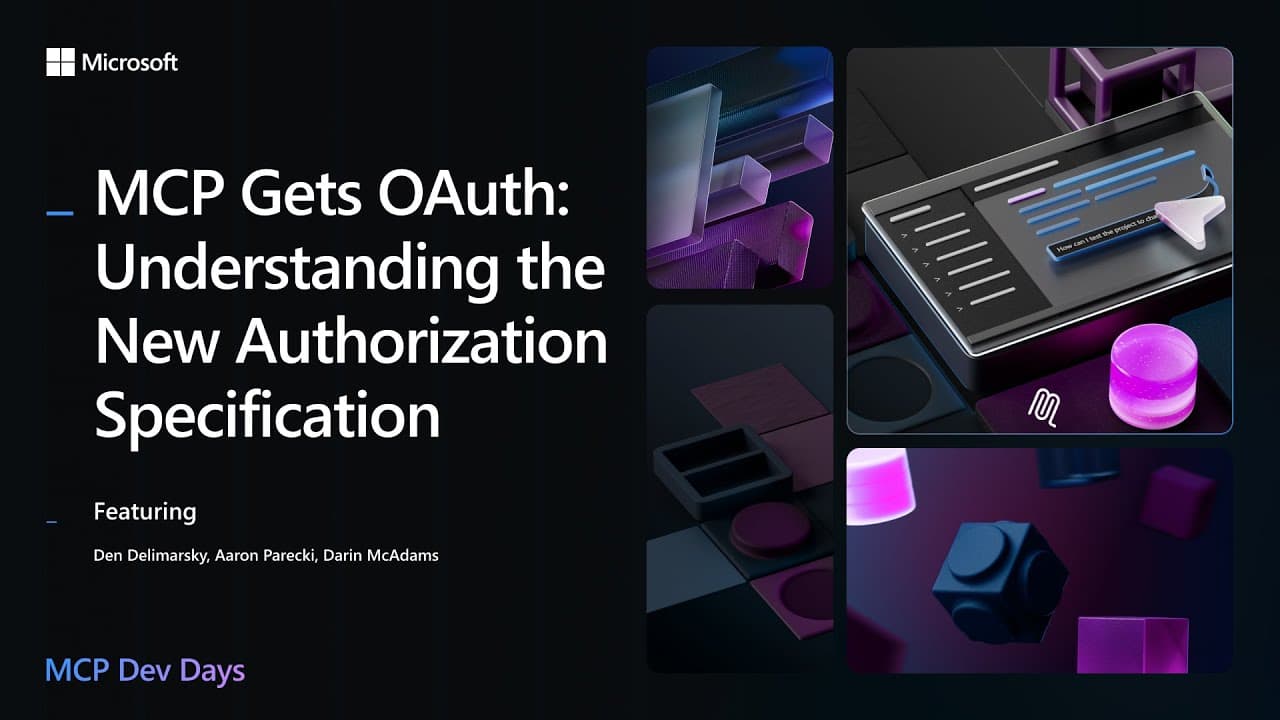
MCP uses OAuth 2.1 style authorization to connect clients with resource servers, enabling a separate authorization server. This setup supports dynamic client registration and the concept of protected resource metadata, simplifying developer experience and integration with existing authorization systems for enterprise MCP use.
Transcript
Hello folks, I'm Dan Delmarski and we are bringing you some amazing guests today to talk about MCP a and security and we have Aaron Darren. Uh Aaron, why don't you kick us off and maybe tell us what are you doing and then we'll hand it off to Darren. Great. Yeah. Hi, Aaron Perki, director of identity standards at Octa. Excited to be here today. tha... Read More
Key Insights
- MCP now fully leverages OAuth 2.1 conventions to align with established authorization patterns.
- The separation between authorization server and MCP server is a deliberate design choice to enable flexible deployments.
- Dynamic client registration enables software to connect to MCP servers without pre registered credentials.
- Protected Resource Metadata conventions provide a standardized way to describe resources and access rules.
- Using off the shelf authorization services reduces risk and simplifies MCP integration.
- The MCP ecosystem aims for a plug and play experience with common clients and servers.
- Browser based app considerations are included to guide token management and storage choices.
- MCP brings enterprise readiness by formalizing authorization flows and best practices for security.
Install to Summarize YouTube Videos and Get Transcripts
Explore YouTube Video Summarizer or Get YouTube Transcript Extractor
Questions & Answers
Q: A real search query question about the video (e.g. 'How to...', 'What is...', 'Why does...', 'When should...'). Question 1
MCP uses OAuth 2.1 conventions to enable mature authorization patterns in AI agent ecosystems, and the separation between authorization server and MCP server is a deliberate design to allow flexible deployments. This structure supports both dedicated authorization services and existing deployment scenarios, reducing the need to roll your own security solutions and improving enterprise adoption.
Q: Question 2
Dynamic client registration is introduced to allow users to bring their own servers to clients that may not have pre registered credentials. It enables a software component to connect to an MCP server with minimal upfront configuration while maintaining secure access controls and consistent client management across environments.
Q: Question 3
Protected Resource Metadata conventions provide standardized descriptions of resources and access rules within MCP. This helps clients and servers understand what resources are protected, how to request access, and what metadata governs permissions, enabling smoother interoperability between diverse MCP implementations and authorization servers.
Q: Question 4
Why is the separation of authorization and MCP servers important for MCP adoption in enterprises? It reduces deployment constraints by letting organizations choose an authorization server that fits their existing security posture, while the MCP server handles data access, enabling scalable and flexible architectures rather than forcing a single monolithic solution.
Q: Question 5
What is the role of OAuth 2.1 within MCP? It provides a modern, vetted framework for access control, token handling, and secure authorization flows that align with current security best practices, ensuring MCP can work with widely used identity and access management tools and libraries.
Q: Question 6
How does MCP aim to avoid insecure practices like copy and paste credentials? By embracing established authorization flows and encouraging the use of off the shelf authorization servers and token validation libraries, MCP reduces the risk of misconfigurations and weak security associated with custom, ad hoc authentication methods.
Q: Question 7
What is the impact for developers building MCP clients and servers? The impact is a simplified developer experience through standard OAuth flows, dynamic client registration, and metadata conventions, which lowers integration barriers and accelerates the ability to deploy MCP with confidence in secure authorization patterns.
Q: Question 8
What practical guidance is given for implementing MCP securely? The guidance emphasizes using existing authorization services rather than building from scratch, validating inputs against trusted providers, and following best practices from the OUTH community to ensure robust, maintainable, and interoperable MCP deployments.
Summary & Key Takeaways
-
The MCP protocol now embraces OAuth 2.1 conventions, bringing mature authorization patterns to AI agent ecosystems. It favors separating the authorization server from the MCP server to enable flexible deployments and enterprise readiness.
-
Dynamic client registration and protected resource metadata are introduced to support user brought servers and flexible client networking, improving deployment options and overall interoperability.
-
The session emphasizes using off the shelf authorization solutions and following established security practices to avoid roll your own implementations while enabling easier MCP adoption across diverse environments.
Read in Other Languages (beta)
Share This Summary 📚
Summarize YouTube Videos and Get Video Transcripts with 1-Click
Try YouTube Summary with ChatGPT & Claude or YouTube Transcript Generator
Explore More Summaries from Microsoft Developer 📚





Summarize YouTube Videos and Get Video Transcripts with 1-Click
Try YouTube Summary with ChatGPT & Claude or YouTube Transcript Generator