How MCP Enables AI Assistants to Take Action
TL;DR
MCP enables general-purpose AI assistants to use many services through one shared communication standard, reducing the need for separate, hand-built integrations. By connecting compatible clients and servers, it can help assistants gather context, perform external actions, respond through natural language, and move closer to the useful, widely available experience represented by Jarvis.
Transcript
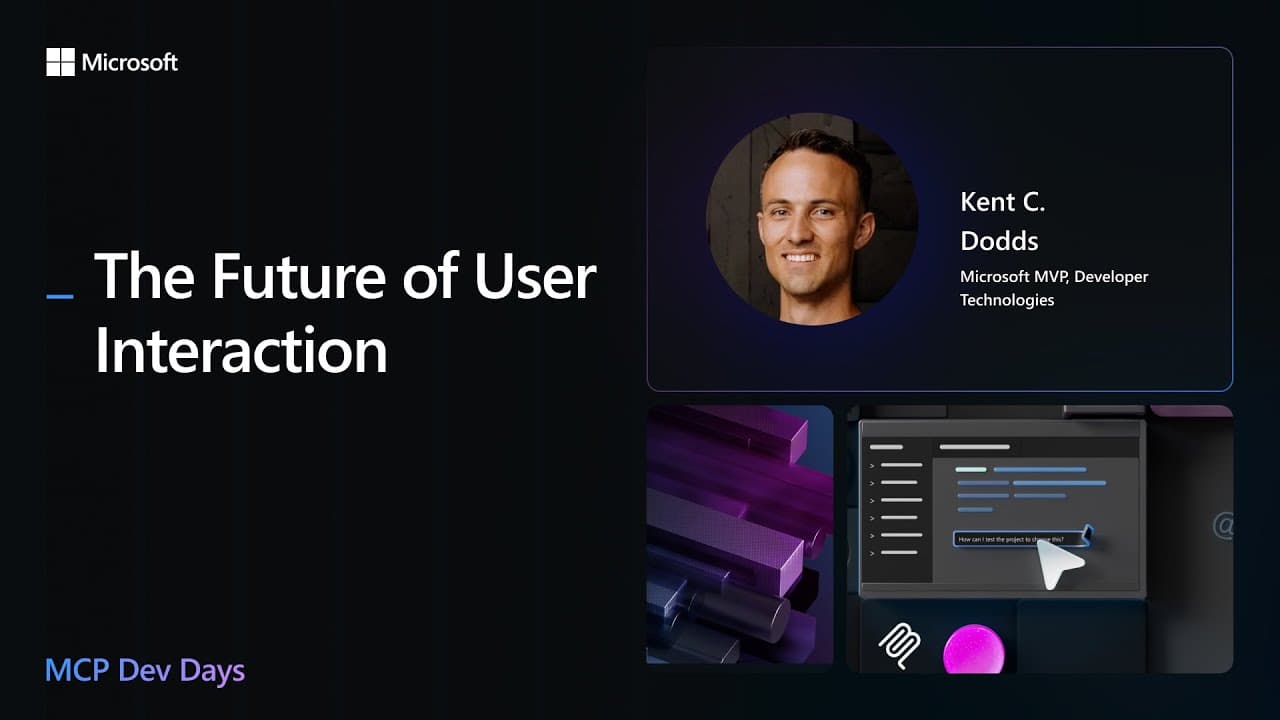
Hey everybody, my name is Kent Cods. I am a full-time independent educator and I teach people how to build excellent user experiences and the future of user interaction is in MCP. And so that's why I'm here at Microsoft to talk with you all about this at MCP day. So, thank you so much for having me. I want to talk with you about how the future of u... Read More
Key Insights
- MCP is a shared communication standard that allows compatible AI clients and independently created servers to connect without requiring their teams to negotiate a unique integration for every pairing.
- A Jarvis-like assistant is useful because it can accept natural language, text, or gestures, respond immediately, monitor events proactively, operate across devices, and complete tasks without making the user configure every required tool.
- The primary barrier to broadly useful digital assistants is fragmented integration, because the number of possible connections among assistant platforms, companies, public services, websites, and specialized tools becomes too large to manage through individual partnerships.
- Hand-built integrations work for common services such as calendars and email, but they do not scale well to specialized needs such as booking a dentist appointment or reserving a municipal pavilion for a birthday party.
- Accessible chat applications made LLMs valuable to non-technical users by removing the need to set up their own computing infrastructure, although early versions primarily answered questions using training data and user-provided text.
- Tool-enabled host applications expanded AI capabilities by allowing an LLM to request extra context or perform changes in external systems, but every host still needed separate integrations with each supported tool.
- MCP removes part of the integration ceiling by allowing people to build servers that can connect with any compatible client or host application, provided that each side follows the same communication standard.
- Software developers have a central role in the emerging assistant model because useful assistants still need tools that expose real services and actions through MCP servers before they can complete practical tasks for users.
Install to Summarize YouTube Videos and Get Transcripts
Explore YouTube Video Summarizer or Get YouTube Transcript Extractor
Questions & Answers
Q: What is MCP and how does it support AI assistants?
MCP, described as Model Context Protocol, is a standard for communication between AI-facing clients and servers that provide tools or services. A developer can build an MCP server, while compatible host applications can create clients that communicate with it. This shared structure reduces the need to create a unique connection for every combination of assistant, application, and external service.
Q: Why do current digital assistants struggle with specialized tasks?
Current assistants depend heavily on integrations created for particular services. Common connections involving calendars, email, or other widely used systems may already exist, but specialized tasks often do not. Scheduling with a particular dentist or reserving a local municipal pavilion would require connections that platform companies cannot realistically negotiate and build separately for every organization, city, and service.
Q: How could MCP create a Jarvis-like user experience?
MCP could help create a Jarvis-like experience by giving a general-purpose assistant standardized access to many independently developed tools. The user could express a goal through natural language while the assistant selects suitable capabilities, gathers context, and performs external actions. The intended experience is responsive, proactive, available across devices, and less dependent on users manually configuring every underlying service.
Q: How did accessible LLM chat applications change user interaction?
Accessible chat applications placed an LLM behind an interface that ordinary, non-technical people could use without setting up their own computing cluster. Users could ask questions and receive responses directly, which made existing LLM technology broadly useful and visible. However, these applications initially relied on training data or text supplied in the conversation and could not independently complete external tasks.
Q: What limitations remained after AI applications gained tools?
Tools allowed a host application to retrieve additional context, modify external systems, and perform actions requested by an LLM. The remaining limitation was that each host still needed its own connections to every tool. Integrations made for ChatGPT, VS Code, Gemini, or another environment did not automatically provide universal compatibility, so the number of supported actions continued to have a practical ceiling.
Q: How is MCP similar to the relationship between browsers and websites?
MCP is compared with the web because a browser can communicate with many independently created websites when both follow shared standards. Similarly, an MCP-compatible client can communicate with independently built MCP servers through a standardized protocol. Developers do not need the team behind every client to coordinate directly with the team behind every server before their software can work together.
Q: What qualities define the Jarvis interaction model?
The Jarvis interaction model includes communication through natural language, text, and gestures, along with immediate responses even when a requested task takes longer to finish. It also includes proactive monitoring, minimal configuration by the user, and availability across environments such as a car, suit, house, or phone. Together, these qualities make the assistant continuously accessible and practically useful.
Q: What role do software developers have in an MCP-based future?
Software developers must give AI assistants the tools needed to perform useful tasks. They can expose services and actions through MCP servers that follow the shared communication standard, allowing compatible clients to discover and use those capabilities. This work expands what general-purpose assistants can accomplish without requiring separate agreements and custom integrations between every client provider and every service owner.
Summary & Key Takeaways
-
Kent C. Dodds envisions a general-purpose AI assistant that resembles Jarvis, accepting natural-language requests, responding immediately, working across devices, monitoring relevant events, and completing tasks without extensive user configuration. He argues that most necessary technology already exists, while fragmented integrations remain the central obstacle preventing this experience from becoming broadly available.
-
Earlier assistants could handle common services such as calendars and email because companies created specific integrations for them. They struggled with specialized tasks, such as scheduling a dentist appointment or reserving a municipal pavilion, because every assistant provider and service owner would otherwise need to coordinate and maintain a separate technical connection.
-
The evolution described moves from accessible LLM chat applications, to host applications equipped with proprietary tools, and finally to MCP clients and servers. MCP standardizes communication so independently created servers can work with compatible clients, resembling how websites follow shared standards that allow them to operate through different web browsers.
Read in Other Languages (beta)
Share This Summary 📚
Summarize YouTube Videos and Get Video Transcripts with 1-Click
Try YouTube Summary with ChatGPT & Claude or YouTube Transcript Generator
Explore More Summaries from Microsoft Developer 📚
![What are Conditional Statements in Bash? [15 of 20] | Bash for Beginners thumbnail](/_next/image?url=https%3A%2F%2Fi.ytimg.com%2Fvi%2Fgg9LzZ4d9cI%2Fhqdefault.jpg&w=750&q=75)
Summarize YouTube Videos and Get Video Transcripts with 1-Click
Try YouTube Summary with ChatGPT & Claude or YouTube Transcript Generator