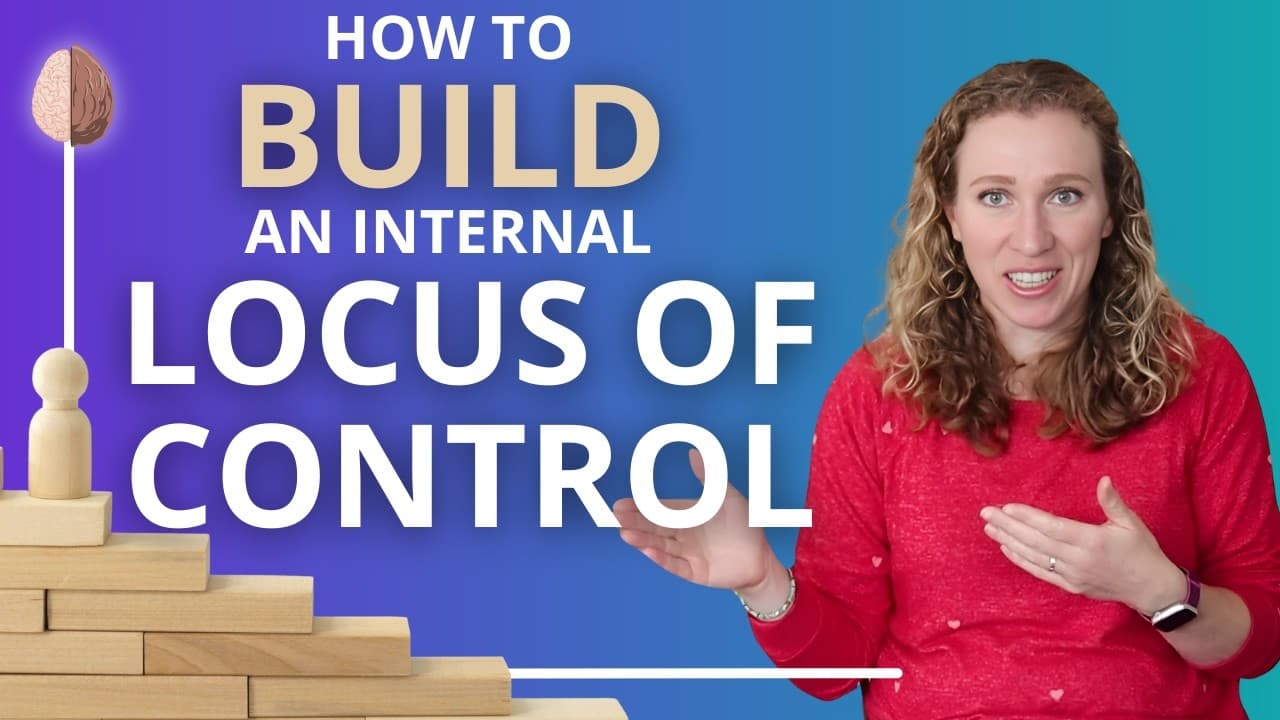
How to Build an Internal Locus of Control
TL;DR
Locus of control is how much you believe you can influence what happens in your life, and it is a thinking pattern anyone can adopt rather than a fixed trait. An internal locus, acknowledging what you cannot change and directing energy toward what you can, is linked with better physical health, mental health, relationships, and success, while an external locus tracks with depression, stress, and anxiety.
Transcript
If you were struggling with a relationship issue, this skill would come up in therapy. If you were struggling with depression, this skill would come up in therapy. If you were struggling with anxiety, boundry, school, work, politics, existential dread; this skill would probably come up in therapy because it's just such an important skill. It is... Read More
Key Insights
- Locus of control refers to how much a person believes they can influence what happens in their life, and it is described as the difference between people who solve problems and succeed and those who feel frustrated and helpless.
- An internal locus of control has been linked with improved physical health, better mental health, better relationships, and more success, because the person acknowledges what cannot be changed and concentrates energy on what can be.
- An external locus of control means believing luck, fate, or other people's actions are responsible for how life turns out, and people holding it tend to feel more depressed, stressed, and anxious than those with an internal locus.
- Locus of control is not a trait you are born with. The therapist calls it a choice and a thinking pattern that anyone can adopt, which means shifting from an external to an internal locus is a learnable skill.
- The helplessness wobble describes alternating between two forms of powerlessness: feeling powerless in a broken world, and feeling personally broken, defective, stupid, lazy, or too depressed, anxious, or ADHD to succeed.
- Externalizing shows up as blame, where the problem is anyone or any reason except me, such as blaming a boss, office politics, the business system, one's background, or who you know for a missed promotion.
- Victim identity differs from having been victimized. Being mistreated is something that happened to you, while victim identity is a lens you view all of life through, and it feels vindicating but blocks the actions that could improve your life.
- A balanced reframe replaces 'that accident ruined my day' with 'that fender bender made my day hard, so I made sure to take extra time for self-care later', which keeps the focus on what can be changed rather than what cannot.
- Sonia Carson modeled an internal locus by observing the wealthy families she cleaned for, noticing their children read books instead of watching much TV, and requiring her two sons to read two library books a week and write reports she reviewed despite barely being able to read.
Install to Summarize YouTube Videos and Get Transcripts
Explore YouTube Video Summarizer or Get YouTube Transcript Extractor
Questions & Answers
Q: What is locus of control?
Locus of control refers to how much you believe you can influence what happens in your life. People who focus on what they can change have an internal locus of control: they believe their efforts make a difference, they acknowledge what they cannot change, and they direct their energy and attention toward what they can change. People with an external locus of control believe external factors such as luck, fate, or other people's actions are responsible for how their life turns out. The therapist describes it as the difference between people who solve problems and succeed and those who do not.
Q: How do I build an internal locus of control?
Start by recognizing the signs of an external locus in your own thinking, then deliberately shift attention. A healthy locus of control means acknowledging the things you cannot change and focusing all your energy on the things you can. Practically, that involves replacing blame statements with balanced ones, for example changing 'that accident ruined my day' to 'that fender bender made my day hard, so I made sure to take some extra time to do self-care later'. The therapist says there are practical ways to do this and that it only takes a few minutes, and that it is a thinking pattern anyone can adopt rather than a fixed trait.
Q: What are the signs of an external locus of control?
The video lists several. Externalizing through blame, where the problem is anyone or any reason except me, such as blaming a boss, politics, the business system, your background, or who you know. Saying other people made you feel depressed, angry, or victimized, or that one bad event ruined your entire day or week. Believing everything is awful, that the world is going downhill, that it is too late to change, or that the economy ruined your choices. Taking on victim identity as a lens. And believing success or failure depends on luck, fate, or a deity.
Q: Why does an external locus of control make people feel worse?
People with an external locus of control believe outcomes are determined by luck, fate, or other people, so they tend to feel more depressed, stressed, and anxious. The therapist notes that beliefs like blaming the world or adopting a victim identity feel vindicating, because what happened was not your fault, but they disempower you from taking any action that could make your life better. When energy is consumed by what cannot be controlled, it perpetuates feelings of helplessness, and externalizers often end up feeling angry, bitter, victimized, or hopeless.
Q: What is the helplessness wobble?
The helplessness wobble is the therapist's term for going back and forth between two forms of powerlessness. On one side, people feel powerless in a broken world and say things like 'what's the point, it never works out' or 'other people have great lives but that's not in the cards for me'. On the other side, they feel broken or defective and conclude they are too stupid, lazy, depressed, anxious, or ADHD to succeed, that relationship conflict proves they are unlovable, or that work struggles prove they are not as smart as a colleague. At its root is believing there is not much you can do, which leaves people angry and depressed.
Q: How did Sonia Carson teach her sons an internal locus of control?
Sonia Carson worked two jobs as a cleaner and carefully observed the wealthy families she worked for. She noticed they did not allow their kids to watch much TV and had them read books instead. So she required Ben and his brother Curtis to read two library books a week and write book reports on them, and even though she could barely read herself, she reviewed their reports, which pushed them to take reading seriously. She constantly encouraged them to keep working and to trust in God, and when Ben faced racial discrimination at his private school she told him to ignore the ignorance and focus on his schoolwork.
Q: What did Ben Carson achieve after struggling in school?
Ben Carson grew up poor in inner-city Detroit, was abandoned by his father at eight, sat at the bottom of his class, and was called dummy by other kids. After his mother's reading requirement, he improved little by little and rose to the top of his class. He was accepted into a private school and graduated near the top of his class despite daily racial discrimination, then graduated near the top of his class at Johns Hopkins Medical School. He became one of the youngest chief pediatric neurosurgeons in the United States, leading the department at Johns Hopkins Hospital at age 33, gained fame for pioneering complex procedures including the separation of conjoined twins, received the Presidential Medal of Freedom, and became Secretary of Housing and Urban Development.
Q: Is locus of control something you are born with?
No. The therapist states directly that your locus of control is not a trait and not something you were born with. It is a choice and a thinking pattern that everyone, including you, can adopt, which means you can learn how to shift from an external to an internal locus of control. This is why she teaches it in almost every therapy session and describes it as one of the most important skills a person can develop, one that would come up in therapy for relationship issues, depression, anxiety, boundaries, school, work, politics, or existential dread.
Q: Does focusing on what you can control ignore discrimination and systemic problems?
The therapist addresses this directly and says she approaches the topic with care and humility, and is not trying to tell marginalized groups what they should do. She acknowledges the world is messed up, that there are bad people, discrimination, and many things that make life harder. Her point is that focusing on what is within our control can foster empowerment even in the face of systemic challenges: when energy is consumed by what cannot be controlled, helplessness is perpetuated, but channeling effort into areas where you do have agency builds power and resilience. She also notes learned helplessness can be passed down through family or cultural experiences shaped by systemic injustice, abuse, and historical trauma.
Q: What is the difference between being victimized and having a victim identity?
The therapist draws a clear distinction. Having been mistreated or victimized is something that happened to you, an event. Victim identity is something different: it is an identity you take upon yourself and the lens through which you see everything in life. When you believe you are a victim, you feel a little vindicated because what happened to you was not your fault, but that belief disempowers you from taking any action you could take to make your life better. The event is real; the problem is letting it become the frame for everything.
Summary & Key Takeaways
-
Locus of control refers to how much you believe you can influence what happens in your life. People with an internal locus believe their efforts make a difference: they acknowledge what they cannot change and focus attention and energy on what they can. This orientation has been linked with improved physical health, better mental health, better relationships, and more success.
-
An external locus of control means believing that luck, fate, or other people's actions determine how life turns out, and it correlates with feeling more depressed, stressed, and anxious. The therapist describes a helplessness wobble: alternating between feeling powerless in a broken world and feeling personally broken, defective, stupid, lazy, or too depressed to succeed.
-
Ben Carson's story illustrates the shift. Raised poor in inner-city Detroit, abandoned by his father at eight, and called dummy at the bottom of his class, he was pushed by his mother Sonia to read two library books a week and write reports on them. He rose to the top of his class and became a chief pediatric neurosurgeon at 33.
-
Signs of an external locus include blame (any reason except me), saying other people made you feel a certain way, insisting everything is awful, adopting victim identity as a lens on life, and attributing outcomes entirely to luck, fate, or God's will. These beliefs feel vindicating but leave you helpless and unable to act.
-
The therapist frames the skill with care rather than prescription, noting she is not telling marginalized groups what to do. Discrimination, poverty, abuse, and historical trauma are real, and learned helplessness can pass through families and cultures. The point is that channeling effort into areas where you do have agency builds power and resilience even amid systemic challenges.
Read in Other Languages (beta)
Share This Summary 📚
Summarize YouTube Videos and Get Video Transcripts with 1-Click
Try YouTube Summary with ChatGPT & Claude or YouTube Transcript Generator
Explore More Summaries from Therapy in a Nutshell 📚



Summarize YouTube Videos and Get Video Transcripts with 1-Click
Try YouTube Summary with ChatGPT & Claude or YouTube Transcript Generator