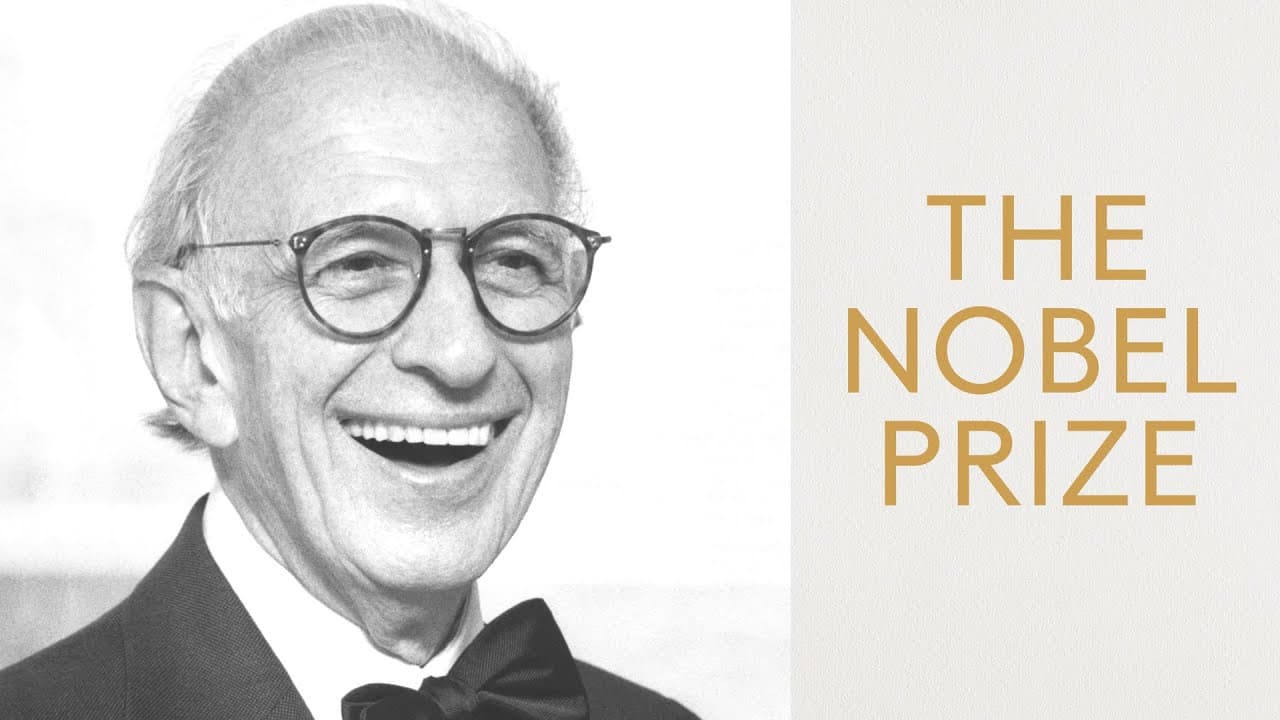
Eric Kandel, Nobel Prize in Physiology or Medicine 2000: Nobel Prize lecture
TL;DR
Learning and memory can be studied in molecular terms by choosing the simplest possible behavior in the simplest possible animal, rather than the most complex. Using a marine snail's gill-withdrawal reflex, memory mechanisms proved evolutionarily conserved, and long-term memory differs fundamentally from short-term memory because it requires the synthesis of new proteins.
Transcript
thank you sten for those marvelous comments i also want to thank the nobel assembly for honoring me in this marvelous way and for giving me the opportunity to share this honor with paul and with abit whose work i enormously admire i've been told that the opportunity of giving a nobel lecture is one of the high points of the visit to stockholm as pa... Read More
Key Insights
- A reductionist approach to learning and memory means studying not the most complex case but the simplest form of memory storage in the simplest, most technically tractable nervous system available for analysis.
- Learning is the process by which we acquire new knowledge about the world, and memory is the process by which we retain that knowledge over time, making us who we are through what we learn.
- Learning is the mental process most accessible to molecular analysis because, unlike thought, language, and consciousness, its elementary forms are the most clearly delineated and easily controlled of any mental process.
- Memory storage mechanisms are likely evolutionarily conserved, so a molecular analysis of learning in even a very simple animal is likely to reveal mechanisms of general relevance to more complex organisms.
- The marine snail was chosen because a simple behavioral act modifiable by learning is controlled by a small number of large, accessible nerve cells, letting researchers relate overt behavior to molecular events.
- The gill-withdrawal reflex, a simple defensive response like pulling a hand from a hot object, can be modified by habituation, sensitization, and classical conditioning, resembling more complex forms of learning in higher animals.
- Long-term memory differs fundamentally from short-term memory by requiring the synthesis of new proteins, a distinction previously characterized only for complex forms of learning in mammals.
- Sensitization is a form of learned fear in which an animal recognizes an aversive stimulus and learns to enhance its reflex responses, so a previously weak stimulus later produces a more powerful withdrawal.
Install to Summarize YouTube Videos and Get Transcripts
Explore YouTube Video Summarizer or Get YouTube Transcript Extractor
Questions & Answers
Q: What is a reductionist approach to studying learning and memory?
A reductionist approach means studying not the most complex and interesting case of memory but the simplest case, in the simplest and technically most tractable system available. Kandel sought an experimental system where a simple behavioral act, modifiable by learning, is controlled by a small number of large and accessible nerve cells, so an animal's overt behavior could be related directly to molecular events occurring in the nerve cells that control that behavior. This tradition of selecting technically congenial systems is common in biology.
Q: Why did Kandel choose a marine snail instead of the mammalian brain?
Kandel and Alden Spencer began by studying the hippocampus, the part of the mammalian brain most involved in complex memory, but found it a formidable challenge because the mammalian brain has an enormous number of neurons and interconnections. It seemed unlikely one could trace how sensory information reached the hippocampus or how its processing influenced behavior. He therefore turned to a marine snail with a far simpler nervous system, whose nerve cells are few, large, and accessible, making molecular analysis feasible.
Q: How does the gill-withdrawal reflex work?
The animal has a respiratory organ called the gill, normally covered by a sheet of skin called the mantle shelf that ends in a fleshy spout called the siphon. When a weak tactile stimulus is applied to the siphon, the animal produces a brisk withdrawal of the gill. This simple defensive reflex is comparable to withdrawing a hand from a hot object, and it can be modified by several different learning processes, making it an ideal elementary behavior to study.
Q: What is the difference between short-term and long-term memory?
For each form of learning studied, there was a short-term memory that lasted minutes and a long-term memory that lasted days, weeks, or longer. Crucially, long-term memory differs fundamentally from short-term memory by requiring the synthesis of new proteins, a property that had already been characterized for complex forms of learning in mammals. Repetition, or practice, transfers information from short-term to long-term storage, so identifying the proteins involved in this switch could reveal proteins of general importance.
Q: What is sensitization in the context of this research?
Sensitization is a form of learned fear in which the animal learns about the properties of an aversive stimulus. When a noxious stimulus is given to the animal's tail, it recognizes the stimulus as unpleasant and aversive and learns to enhance its reflex responses. As a result, a weak tactile stimulus that previously produced only a modest withdrawal will, after the noxious stimulus, produce a more powerful withdrawal. Kandel focused on sensitization because defining its critical proteins could illuminate learning generally.
Q: Why is learning considered the mental process most accessible to molecular analysis?
Kandel argues that unlike thought, language, and consciousness, learning is the mental process most accessible to molecular analysis. Elementary forms of learning and memory have been well characterized by classical psychology since the first half of the twentieth century, and they represent the most clearly delineated and, for the experimenter, the most easily controlled of any mental process. This accessibility and controllability made learning the natural target for translating psychological questions into the empirical language of biology.
Q: What four criteria guided Kandel's approach to learning and memory?
Kandel identified four criteria for an intellectually satisfying approach. First, delineate a behavior in a simple organism that can be modified by learning, through extensive behavioral analysis. Second, define in cellular detail the neural circuit that mediates the behavior being modified. Third, locate within that circuit the critical sites that are changed by learning. Fourth, having located those sites, bring the tools of modern cell and molecular biology to bear on analyzing the mechanisms that mediate learning and store the memory.
Q: How did Kandel's view of memory shift over his career?
Kandel first became interested in memory as an undergraduate, motivated by a long-standing interest in psychoanalysis. As he became immersed in biology during medical training, he found the psychoanalytic approach limiting because it treated the brain, the organ that generates behavior, as a black box. He came to believe that black box could be opened and demystified with modern biology, so his interest shifted from a psychoanalytic to a biological approach, aiming for a synthesis rather than a replacement of psychological thinking.
Summary
In this video, the speaker discusses their research on learning and memory, focusing on the reductionist approach they have taken. They explain their interest in understanding the underlying mechanisms of learning and memory in molecular terms. They describe the use of the sea slug, Aplysia, as a model organism for studying the simplest forms of learning and memory. They discuss the neural circuitry involved in these processes and the role of specific neurotransmitters and proteins. They also highlight the importance of transcriptional mechanisms in long-term memory storage and how they interact with synaptic connections.
Questions & Answers
Q: What is the speaker's research focus?
The speaker's research focuses on understanding the molecular mechanisms of learning and memory.
Q: Why did the speaker choose Aplysia as a model organism?
Aplysia is a simple organism with a tractable nervous system, making it ideal for studying the basic mechanisms of learning and memory.
Q: What are some examples of diseases that affect memory?
Down syndrome, age-related memory weakening, and Alzheimer's disease are some examples of diseases that affect memory.
Q: What is the advantage of studying learning and memory compared to other mental processes?
Learning and memory are the mental processes most accessible to molecular analysis, making them ideal for studying the underlying mechanisms.
Q: How did the speaker shift their research focus from a psychoanalytic to a biological approach?
While in medical school, the speaker realized that the exclusive focus on psychoanalytic explanations limited their understanding of memory storage. They recognized the potential for biology to provide a more comprehensive understanding.
Q: What was the aim of the speaker's research?
The aim was to develop a reductionist approach to study learning and memory at the molecular level, focusing on simple behavioral acts controlled by a small number of large and accessible nerve cells.
Q: How did the speaker study the neural circuitry involved in learning and memory?
They used the sea slug Aplysia as a model organism and identified specific sensory and motor neurons involved in the behavioral act they were studying. By mapping connections between these cells and studying their activity, they determined the neural circuitry involved.
Q: How does learning modify synaptic connections?
Learning alters the strength of pre-existing synaptic connections. In some forms of learning, the connections are enhanced, while in others, they are decreased in strength. The persistence of these changes contributes to memory storage.
Q: What is the role of cyclic AMP (cAMP) and protein kinase A (PKA) in learning and memory?
Cyclic AMP, activated by serotonin or other modulatory pathways, leads to the activation of protein kinase A (PKA). PKA then phosphorylates substrates involved in synaptic transmission, enhancing or inhibiting the release of neurotransmitters, and thereby modulating the strength of synaptic connections.
Q: How is short-term memory converted into long-term memory?
The conversion of short-term memory to long-term memory involves the activation of transcriptional mechanisms in the nucleus. This leads to the synthesis of new proteins that play a role in the growth of new synaptic connections and the stabilization of the memory.
Takeaways
The speaker's research on learning and memory in Aplysia has provided valuable insights into the molecular mechanisms underlying these processes. Their reductionist approach has allowed them to study the simplest forms of memory storage and identify key signaling pathways and proteins involved. They have demonstrated the role of transcriptional mechanisms in long-term memory storage and the importance of synaptic connections in memory formation and stabilization. These findings have broader implications for understanding memory disorders and the potential for therapeutic interventions.
Summary & Key Takeaways
-
Kandel set out to develop a reductionist, molecular approach to learning and memory, shifting from a psychoanalytic view that treated the brain as a black box toward biology. His goal was a new synthesis honoring both the psychology of memory storage and the molecular biology of neuronal signaling.
-
Because the mammalian brain has an immense number of neurons and interconnections, tracing how the hippocampus mediates behavior proved a formidable challenge. Kandel instead sought the simplest behavior, controlled by few large nerve cells, in a marine snail whose nervous system is small enough to analyze cell by cell.
-
Four criteria guided the work: define a behavior modifiable by learning, map its neural circuit, locate the sites changed by learning, then apply molecular tools. The gill-withdrawal reflex could be modified by habituation, sensitization, and conditioning, with long-term memory uniquely requiring new protein synthesis.
Read in Other Languages (beta)
Share This Summary 📚
Summarize YouTube Videos and Get Video Transcripts with 1-Click
Try YouTube Summary with ChatGPT & Claude or YouTube Transcript Generator
Explore More Summaries from Nobel Prize 📚


!["Being a novelist has been a good second choice [career]." Kazuo Ishiguro, Nobel Prize in Literature thumbnail](/_next/image?url=https%3A%2F%2Fi.ytimg.com%2Fvi%2FYqDUstHYx4Q%2Fhqdefault.jpg&w=750&q=75)


Summarize YouTube Videos and Get Video Transcripts with 1-Click
Try YouTube Summary with ChatGPT & Claude or YouTube Transcript Generator