Ray Kurzweil: The Future of Intelligence - Nobel Week Dialogue 2015

TL;DR
Information technology advances through predictable exponential gains in price-performance and capacity, enabling increasingly powerful computing, communications, biology, medicine, energy, and manufacturing applications. Kurzweil argues that computers may eventually become small enough to circulate in the bloodstream, support immune function, create virtual reality within the nervous system, and connect the brain directly to cloud computing.
Transcript
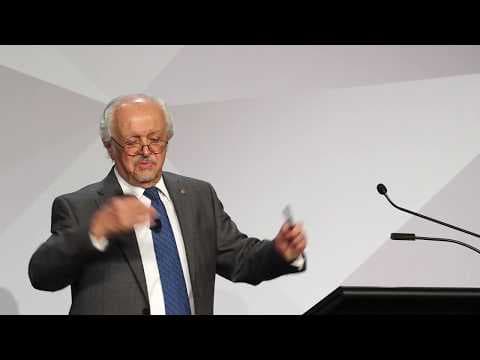
it's a pleasure to be here in this beautiful city and part of this prestigious proceeding uh I'm going to talk about the future of intelligence where we're going to enhance our natural biological intelligence which we've been doing through education through artificial intelligence and first I want to share a surprising discovery I made in 1981 I wa... Read More
Key Insights
- Information technology follows a predictable exponential trajectory in price-performance and capacity. Kurzweil says his 1981 projection of computing power through 2050 remained on its expected path in 2015, with performance roughly doubling during fixed periods rather than advancing at a constant linear rate.
- Human intuition is primarily linear because the brain evolved to predict relatively stable physical trajectories. After 30 steps, a linear sequence reaches 30 while an exponential sequence reaches about a billion, illustrating why the later effects of repeated technological doubling can appear sudden and surprising.
- Computing progress extends beyond Moore's law because Moore's law describes only the chip era within a longer sequence of paradigms. When shrinking vacuum tubes became impractical, another paradigm took over, and Kurzweil expected three-dimensional computing to continue the broader exponential trend after conventional chip scaling reached its limits.
- Information technology creates an economics of abundance through rapid reductions in cost. A transistor cost about a dollar in 1968, while the same amount could buy about 10 billion transistors by 2015, and their smaller size also increased operating speed by reducing the distance traveled by electrons.
- The Human Genome Project demonstrated how linear expectations can misread exponential progress. After seven years, only 1 percent had been sequenced, but Kurzweil viewed that milestone as seven doublings from completion, and the project finished seven years later as sequencing capability continued doubling.
- Falling information technology prices do not necessarily shrink consumption or economic activity. Kurzweil says consumption has more than doubled across forms of information technology because improved price-performance enables innovative applications that were previously impractical, causing new demand to emerge when capabilities reach useful thresholds.
- Artificial intelligence requires advances in both hardware and software. Multiple estimates placed the computational capacity needed for a functional human-brain simulation at 10 to the 14th calculations per second, a level supercomputers had already exceeded and personal computers were projected to reach in the early 2020s.
- Microscopic computers could extend human intelligence and health by operating inside the body. Kurzweil envisions blood-cell-sized devices that augment the immune system, generate virtual reality from within the nervous system, and create direct links between the brain and cloud computing resources.
Install to Summarize YouTube Videos and Get Transcripts
Explore YouTube Video Summarizer or Get YouTube Transcript Extractor
Questions & Answers
Q: Why does exponential technological growth seem sudden?
Exponential growth begins slowly and becomes conspicuous near what Kurzweil calls the knee of the curve. Human intuition usually expects linear change, such as a sequence progressing from one to two to three. Repeated doubling instead reaches about a billion by step 30 and about a trillion by step 40, so mature information technologies can appear to arrive unexpectedly despite following a long, measurable trajectory.
Q: How is information technology progress predictable?
Kurzweil identifies price-performance and capacity as aspects of information technology that follow smooth exponential curves. In 1981, he plotted calculations per second per constant dollar from the 1890 American census through 1980 and projected the curve to 2050. By 2015, he reported that computing performance remained exactly where the projection indicated, despite wars, recessions, and technological transitions.
Q: Why is Moore's law not the whole story of computing growth?
Moore's law describes the period of progress based on shrinking components on computer chips, but Kurzweil's historical curve began decades before Gordon Moore was born. Earlier engineers improved computing by shrinking vacuum tubes until that method reached a practical limit. New paradigms then sustained the broader trend, with three-dimensional computing presented as the next approach after conventional chip scaling.
Q: How did exponential growth affect the Human Genome Project?
The Human Genome Project had sequenced only 1 percent of the genome after seven years, leading critics using linear projections to predict that completion would take far longer. Kurzweil interpreted 1 percent as being only seven doublings away from 100 percent. Sequencing capability kept doubling, and the project finished seven years later, while sequencing costs continued falling afterward.
Q: Why can falling technology prices increase consumption?
Falling prices allow people and organizations to purchase more computing, communication, memory, and genetic sequencing capacity, but increased quantity alone is not Kurzweil's full explanation. As price-performance reaches new thresholds, innovators create applications that were previously impossible or uneconomical. These new uses expand demand enough that consumption has more than doubled across forms of information technology over the period he describes.
Q: How could artificial intelligence reach human-brain computing capacity?
Artificial intelligence depends on both sufficient hardware and effective software. Kurzweil says several independent methods estimated that functionally simulating the human brain would require 10 to the 14th calculations per second. Supercomputers had exceeded that level about ten years before the 2015 talk, and he projected that personal computers would reach the same computational capacity in the early 2020s.
Q: How could computers connect human brains to the cloud?
Kurzweil predicts that computers and robotic devices could eventually become as small as blood cells. Devices operating inside the bloodstream and nervous system could provide a direct connection from the brain to computing resources outside it, including the cloud. He supports the general plausibility of brain-connected computers by noting that Parkinson's patients already had neural implants connected to their brains and externally accessible systems.
Q: Which industries could become information technologies?
Kurzweil argues that industries are progressively transformed when their core processes become digital, measurable, modelable, and programmable. Biology was undergoing this transition through genome sequencing, simulation, and reprogramming. He also identifies medicine, solar collection and energy storage, communications, and three-dimensional printing as areas where information-based methods could drive accelerating improvements in capability, cost, or production.
Summary
In this video, the speaker discusses the future of intelligence and how it is being enhanced through the use of artificial intelligence. He shares a surprising discovery he made regarding the predictability of information technology's price performance and capacity. He explains that information technology progresses in an exponential manner, which is different from our linear intuition. The speaker also talks about various areas, such as biology, computing, and energy, where information technology is transforming industries. He highlights the exponential growth of supercomputers, the advancements in nanotechnology, and the potential of 3D printing. The speaker concludes by discussing the future of artificial intelligence and how it will connect with our biological brains, enabling us to access vast amounts of information wirelessly.
Questions & Answers
Q: What discovery did the speaker make in 1981 regarding the predictability of the future?
In 1981, the speaker discovered that the price performance and capacity of information technology, specifically computing calculations per second per constant dollar, followed a remarkably predictable trajectory. By plotting and visualizing a lot of data, the speaker found that information technology's progress follows an exponential pattern.
Q: How does information technology's growth differ from our linear intuition?
Our intuition is based on linear projections, where we expect things to progress steadily in a constant trajectory. However, information technology progresses exponentially, meaning it doubles every fixed period of time. This exponential growth is much faster than our linear intuition, with each step representing a significantly larger leap in progress. For example, by step 30, exponential growth surpasses a billion times, while linear growth only reaches 30.
Q: What is the significance of Moore's Law regarding information technology?
Moore's Law refers to the observation that the number of transistors on a computer chip doubles approximately every two years, leading to increased computing power. While Moore's Law became popular in relation to computer chips, the exponential growth of information technology started decades before Gordon Moore's time. Information technology encompasses various paradigms and technologies, such as computing, communication, and genetic sequencing, all of which follow similar exponential growth trajectories.
Q: How has biology transformed into an information technology?
The speaker explains that biology is currently undergoing a grand transformation due to the advancements in information technology. This transformation was made possible by the genome project, which enabled us to understand and manipulate the genetic code. The cost of sequencing a genome has drastically reduced from a billion dollars to a few thousand dollars, making it more accessible. Additionally, our ability to model, simulate, and reprogram biological processes is also accelerating exponentially, contributing to biology becoming an information technology.
Q: How has the field of medicine been revolutionized by information technology?
The field of medicine has experienced a significant revolution due to the advancements in information technology. Traditionally, health and medicine were linear processes, but now, they are being treated as an information technology. Our ability to understand the software of life, model it, simulate it, and reprogram it has improved exponentially. This has led to more effective treatments, overcoming diseases, and slowing down the aging process. The field of medicine is currently leveraging the power of information technology to transform health care.
Q: How are supercomputers and artificial intelligence advancing?
Supercomputers are rapidly advancing in capacity and performance due to the exponential growth of information technology. Hans Moravec and other researchers estimate that a functional simulation of the human brain requires 10^14 calculations per second. Supercomputers today have already surpassed this mark, with personal computers projected to achieve this level by the early 2020s. In addition, the speaker mentions that his group at Google is creating functional simulations of the neocortex, the main thinking region of the brain. These simulations, as our knowledge about the brain improves, will contribute to the advancement of artificial intelligence.
Q: How will artificial intelligence be connected to our brains in the future?
The speaker envisions a future where artificial intelligence will be connected to our biological brains. This connection will be achieved through the use of nanobots that will enter our bloodstream, augment our immune system, and provide a direct connection between our brain and the cloud. These nanobots will wirelessly access the computing power and knowledge available in the cloud, effectively increasing our cognitive abilities. Just as we can currently upgrade neural implants for Parkinson's patients, future advancements in technology will enable us to wirelessly upgrade our own brains, creating a hybrid of biological and non-biological thinking.
Q: How has our ability to recognize language improved through artificial intelligence?
Artificial intelligence has made significant advancements in the field of language recognition. Systems like Watson, created by IBM, are now capable of understanding and responding to language queries with a high degree of accuracy. For example, Watson correctly identified the answer to a rhyming category question that even the best human contestants did not. These systems acquire knowledge through reading vast amounts of information, such as Wikipedia, and use that knowledge to process language. The speaker also mentions that Google is working on a similar project to understand and interpret language.
Q: How has the Internet and data traffic grown over the years?
The growth of the Internet and data traffic has followed an exponential trajectory. The speaker shares a graph illustrating the exponential increase in data traffic, which has multiplied by trillions in the last century. From its early beginnings as the ARPANET connecting a few thousand scientists, the Internet has now expanded to connect hundreds of millions of people worldwide. Initially, this growth was not apparent on a linear scale, but if viewed logarithmically, the exponential progression becomes clear.
Q: How will three-dimensional printing revolutionize the creation of physical objects?
The speaker believes that three-dimensional printing, also known as additive manufacturing, will revolutionize the creation of physical objects. While it may currently be in the hype phase, true advancements are expected to occur in the 2020s when submicron resolutions are achieved. This will greatly expand our ability to create physical objects using information technology. Three-dimensional printing will allow us to transform designs into physical products with incredibly precise and intricate details. Ultimately, this technology will enable us to computerize devices and create objects at the size of blood cells.
Q: How is our understanding of the brain improving, and how does it relate to artificial intelligence?
Our understanding of the brain is improving through the efforts of reverse engineering projects and advancements in non-invasive brain scanning. The spatial resolution of brain scanning is doubling every year, allowing for more detailed functional models of the neocortex. The neocortex, responsible for higher-order functions like thinking, is organized in modular structures comprised of about a hundred neurons each. By studying these modular structures, researchers gain insights into how the neocortex recognizes patterns. This knowledge benefits the development of artificial intelligence, as it helps create simulations and models that mimic the brain's functionality and contribute to advancements in intelligent systems.
Takeaways
The speaker makes a compelling case for the exponential growth and transformative power of information technology. He highlights how various industries, such as computing, biology, energy, and 3D printing, are being revolutionized through the use of information technology. The exponential progression of Moore's Law, the advancements in nanotechnology, and the potential of artificial intelligence are among the key drivers of this transformation. Furthermore, the speaker emphasizes the future integration of artificial intelligence with our biological brains, enabling us to access vast amounts of information wirelessly. Overall, this exponential growth presents both promises and perils for society, and it is crucial to carefully navigate this transformative era.
Summary & Key Takeaways
-
Kurzweil argues that the price-performance and capacity of information technologies follow predictable exponential trajectories. Human intuition tends to project change linearly, causing people to underestimate repeated doublings. Historical computing data, including calculations per second per constant dollar, showed a smooth progression from the 1890 American census through the period discussed in 2015.
-
Successive computing paradigms have maintained exponential progress even when individual technologies reached practical limits. The progression continued through vacuum tubes, chips, and emerging three-dimensional computing. Kurzweil emphasizes that wars, recessions, and other major disruptions did not visibly break the long-term curve, suggesting that the broader process extends beyond Moore's law.
-
As biology, medicine, energy, and physical manufacturing become information technologies, their capabilities can advance exponentially. Genome sequencing illustrates the pattern, while solar energy, artificial intelligence, and three-dimensional printing offer additional examples. Kurzweil expects microscopic computerized devices eventually to enhance immunity, provide internally generated virtual reality, and connect human brains with cloud resources.
Read in Other Languages (beta)
Share This Summary 📚
Summarize YouTube Videos and Get Video Transcripts with 1-Click
Try YouTube Summary with ChatGPT & Claude or YouTube Transcript Generator
Explore More Summaries from Nobel Prize 📚




Summarize YouTube Videos and Get Video Transcripts with 1-Click
Try YouTube Summary with ChatGPT & Claude or YouTube Transcript Generator