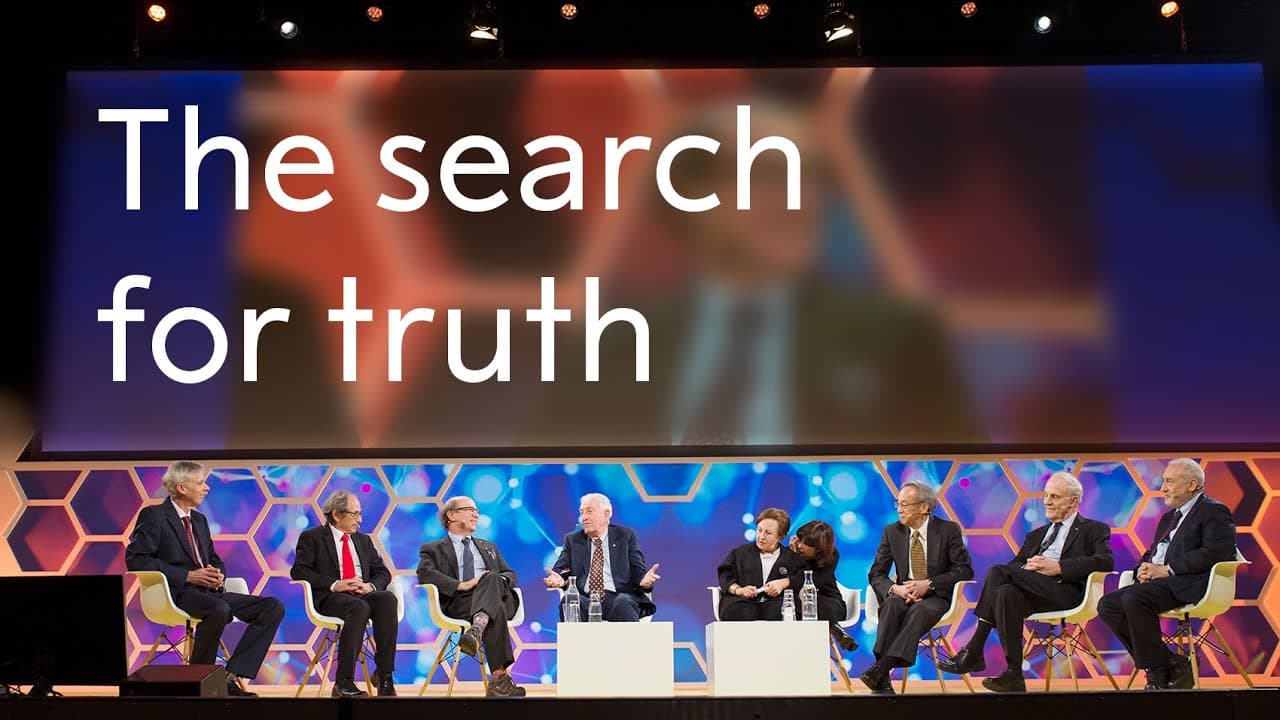
Seven Nobel Laureates discuss: The search for truth
Transcript
so we've called this session the search for truth I shan't introduce everybody I think you've met everybody already but just to name them Michael Levitt Frank will check Peter Doherty sharing a body Steven Chu David gross and Joseph Stiglitz we've called it the search for truth because in a way in their own disciplines that is what unites them thei... Read More
Install to Summarize YouTube Videos and Get Transcripts
Explore YouTube Video Summarizer or Get YouTube Transcript Extractor
Summary
In this video, a group of Nobel laureates discuss the topic of creativity and its role in their respective disciplines. They explore the elusive nature of creativity and the various factors that contribute to it. The panelists also reflect on their personal experiences with creativity and the conditions that foster it. Towards the end, they offer their perspectives on the future of truth, with some expressing hope while others highlight the need for vigilance.
Questions & Answers
Q: What is creativity and where does it come from?
According to Michael Levitt, creativity is a mysterious thing that often stems from activities unrelated to one's field of study, such as walking the dog or taking showers. David Gross adds that creativity originates from a place that is not conscious and surprises the conscious self. He believes that different modules in the brain, specifically in neuroscience, are responsible for creativity.
Q: What conditions promote creativity?
The panelists agree that concentration and immersion in a subject or problem are crucial for creativity. Michael Levitt emphasizes the importance of focusing on a problem, which encourages the unconscious mind to come up with new ideas. Frank Wilczek and Joseph Stiglitz both mention the role of different parts of the brain working together and communicating, often referred to as intuition or pattern recognition.
Q: How does exposure to new ideas contribute to creativity?
Steven Chu and Peter Doherty discuss the significance of being exposed to ideas that are different and contrasting. This exposure allows for a creative melting pot where these ideas can interact with a problem or question. By questioning and challenging existing knowledge or the standard wisdom, new and innovative ideas can emerge.
Q: Should creativity be taught? Can it be taught?
David Gross believes that while creativity cannot be taught directly, there are ways to encourage it. He suggests that encouraging students to explore new fields, ask unconventional questions, and expose themselves to diverse sources of ideas can foster creativity. Peter Doherty adds that creativity often arises when individuals come into a field from outside perspectives, free from the preconceived notions of the discipline.
Q: How does hard work relate to creativity?
The panelists acknowledge the importance of hard work in achieving creative breakthroughs. However, they also highlight the significance of working smart, finding innovative approaches, and questioning existing knowledge. They emphasize that creativity often comes from discovering new ways to approach a problem, rather than just putting in long hours.
Q: Do the panelists feel hopeful for the future of truth?
The panelists have mixed views on the future of truth. While Michael Levitt and Frank Wilczek express optimism, highlighting the spread of ideals like capitalism and the accumulation of truth over time, Joseph Stiglitz and Sharon Ebadi raise concerns about the political climate and the need for vigilance to ensure the preservation of truth. Steven Chu acknowledges the challenges but remains optimistic, stating that truth will ultimately prevail.
Takeaways
The discussion on creativity reveals that it is a mysterious and elusive concept, often arising from unrelated activities and the unconscious mind. Concentration and immersion in a subject, as well as exposure to diverse ideas, play significant roles in fostering creativity. While creativity cannot be directly taught, encouraging exploration, questioning existing knowledge, and seeking alternate perspectives can enhance creative thinking. The panelists emphasize that hard work is important but should be accompanied by innovative approaches. Regarding the future of truth, some panelists express hope, highlighting the accumulation of truth over time, while others raise concerns about the political climate and the need for vigilance.
Read in Other Languages (beta)
Share This Summary 📚
Summarize YouTube Videos and Get Video Transcripts with 1-Click
Try YouTube Summary with ChatGPT & Claude or YouTube Transcript Generator
Explore More Summaries from Nobel Prize 📚

Summarize YouTube Videos and Get Video Transcripts with 1-Click
Try YouTube Summary with ChatGPT & Claude or YouTube Transcript Generator