Why Is America's $36 Trillion Debt a Risk?
TL;DR
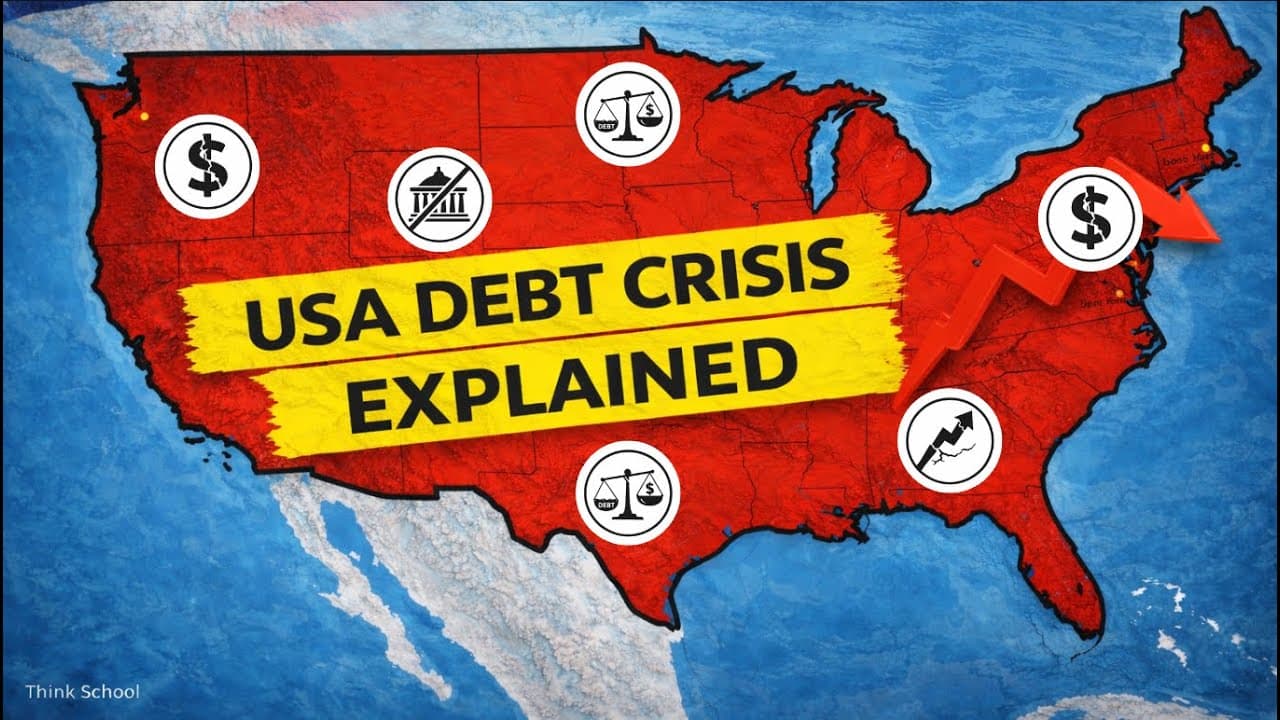
America's national debt has exceeded $36 trillion because recurring federal deficits require continual borrowing, while rising interest payments further widen the gap between spending and revenue. The danger grows when demand for Treasury bonds weakens, yields rise, and major foreign holders reduce their positions, making future borrowing more expensive and placing additional pressure on the federal budget.
Transcript
America deserves to hear the truth. Our national debt is too high. 36 36 36 trillion. That's the debt. 36 trillion. 120% of GDP and rising debt service costs. The International Monetary Fund has officially raised the red flag. You know, America has made a lot of bombs. nuclear bombs, hydrogen bombs, even neutron bombs. But this time they made a bom... Read More
Key Insights
- America's national debt has crossed $36 trillion and reached 122.5% of GDP, according to the figures presented. The transcript says this debt exceeds the combined GDP of China, Germany, the United Kingdom, Japan, and India, illustrating the extraordinary scale of federal borrowing.
- Persistent federal deficits are a central cause of rising debt because the United States spends more than it earns in both favorable and unfavorable economic periods. Defense, Social Security, Medicare, interest payments, and mandatory programs together account for 70% of the federal budget.
- Federal spending pressures are increasing because an aging population raises program costs, while COVID stimulus, military aid, infrastructure programs, and roughly $800 billion in annual defense spending add to expenditures. The transcript says America spends more on defense than the next 10 countries combined.
- Tax cuts have disproportionately favored wealthy Americans, based on the distribution cited in the transcript. The richest 20% received 65% of the total tax cuts, while the poorest 20% received only 3%, contributing to the widening gap between government spending and tax revenue.
- Trickle-down economics is presented as the theory that lower taxes on wealthy people and large businesses encourage consumption, employment, and wage growth that eventually benefits poorer households. The transcript argues that the policy instead enriched wealthy groups and coincided with increasing income inequality from 1990 to 2023.
- Interest costs are creating a self-reinforcing debt cycle because the government borrows to cover deficits, pays interest on the resulting bonds, and then faces larger future deficits. Annual federal interest payments have approached $1 trillion, exceeding the GDP of 174 countries according to the transcript.
- The debt ceiling has not imposed a lasting limit on federal borrowing because Congress has crossed and extended it more than 70 times since 1960. The transcript therefore describes the ceiling as ineffective at preventing the national debt from rising over successive budget cycles.
- Demand for US Treasury bonds is showing signs of pressure because major foreign holders have reduced their positions. China's holdings fell from $1.3 trillion in 2012 to $759 billion, while Japan's declined from $1.84 trillion to $1.06 trillion, alongside rising Treasury yields.
Install to Summarize YouTube Videos and Get Transcripts
Explore YouTube Video Summarizer or Get YouTube Transcript Extractor
Questions & Answers
Q: Why has America's national debt exceeded $36 trillion?
America's national debt exceeded $36 trillion because the federal government repeatedly spends more than it receives in revenue and borrows to cover the difference. Defense, Social Security, Medicare, interest payments, and other mandatory programs make up 70% of the federal budget. An aging population, COVID stimulus, military aid, and infrastructure programs have added further spending pressure, while tax revenue has failed to keep pace.
Q: How do interest payments make the US debt problem worse?
Interest payments make the debt problem worse by creating a repeating cycle. When federal spending exceeds revenue, the government issues bonds to finance the deficit. Those bonds require interest payments, which add to future spending and widen subsequent deficits. The government must then borrow again. The transcript says annual interest costs have approached $1 trillion, so debt service itself has become a major source of fiscal pressure.
Q: What percentage of GDP does the US national debt represent?
The transcript states that US national debt stands at 122.5% of GDP and has already crossed the broader threshold of 120%. It also says this level is worse than the levels reached during World War II. If current policies continue, the debt-to-GDP ratio is projected in the transcript to exceed 140% by 2032, indicating that debt could continue growing faster than the economy.
Q: Why are falling foreign purchases of US Treasury bonds concerning?
Falling foreign purchases are concerning because the United States depends on buyers for the Treasury bonds it issues to finance deficits. The transcript says China's holdings declined from $1.3 trillion in 2012 to $759 billion, while Japan's fell from $1.84 trillion to $1.06 trillion. Weaker demand, combined with greater bond supply, can correspond with higher yields and more expensive government borrowing.
Q: How did US tax cuts contribute to the debt problem?
US tax cuts contributed by limiting government revenue while spending continued to rise. According to the distribution presented, the poorest 20% received 3% of the total tax cuts, the next poorest 20% received 7%, and the richest 20% received 65%. The transcript argues that these cuts disproportionately benefited wealthy Americans without broadly empowering poorer groups, leaving revenue increasingly unable to match expenditures.
Q: What is trickle-down economics according to the case study?
Trickle-down economics is described as the theory that reducing taxes on wealthy individuals and large businesses will encourage them to consume more, hire additional workers, and increase wages, allowing benefits to reach poorer households. The approach is associated with Ronald Reagan and Reaganomics, which emphasized lower taxes, reduced regulation, and lower government spending. The transcript argues that the promised broad distribution of benefits did not occur.
Q: Why has the US debt ceiling failed to control borrowing?
The debt ceiling has failed to provide a durable constraint because it has repeatedly been raised or extended whenever federal borrowing approaches the legal limit. The transcript says the United States has crossed and extended the ceiling more than 70 times since 1960. Consequently, the ceiling has not prevented persistent deficits or stopped the national debt from growing beyond $36 trillion.
Q: How could the US debt situation affect India?
The supplied transcript identifies India's exposure as an important question but does not provide a detailed explanation of specific effects before the text ends. It does establish that global markets are concerned about weakening Treasury demand, rising bond yields, credit-rating warnings, and the possibility of a broader downturn. Any more precise claim about consequences for India would go beyond the information provided in the source.
Summary & Key Takeaways
-
The United States repeatedly spends more than it collects, regardless of whether economic conditions are strong or weak. Defense, Social Security, Medicare, interest payments, and other mandatory programs represent 70% of the federal budget, while an aging population, COVID stimulus, military aid, and infrastructure programs have added further pressure.
-
Federal tax cuts have disproportionately benefited wealthier Americans, according to the figures presented. The richest 20% received 65% of all tax cuts, while the poorest 20% received 3%. The transcript argues that these policies increased inequality without producing the broad benefits promised by trickle-down economics.
-
Annual interest payments have approached $1 trillion, creating a cycle in which deficits require new bonds, new bonds generate additional interest, and higher interest contributes to future deficits. The risk intensifies as China and Japan reduce Treasury holdings, bond yields rise, and current policy projections push debt beyond 140% of GDP by 2032.
Read in Other Languages (beta)
Share This Summary 📚
Summarize YouTube Videos and Get Video Transcripts with 1-Click
Try YouTube Summary with ChatGPT & Claude or YouTube Transcript Generator
Explore More Summaries from Think School 📚






Summarize YouTube Videos and Get Video Transcripts with 1-Click
Try YouTube Summary with ChatGPT & Claude or YouTube Transcript Generator