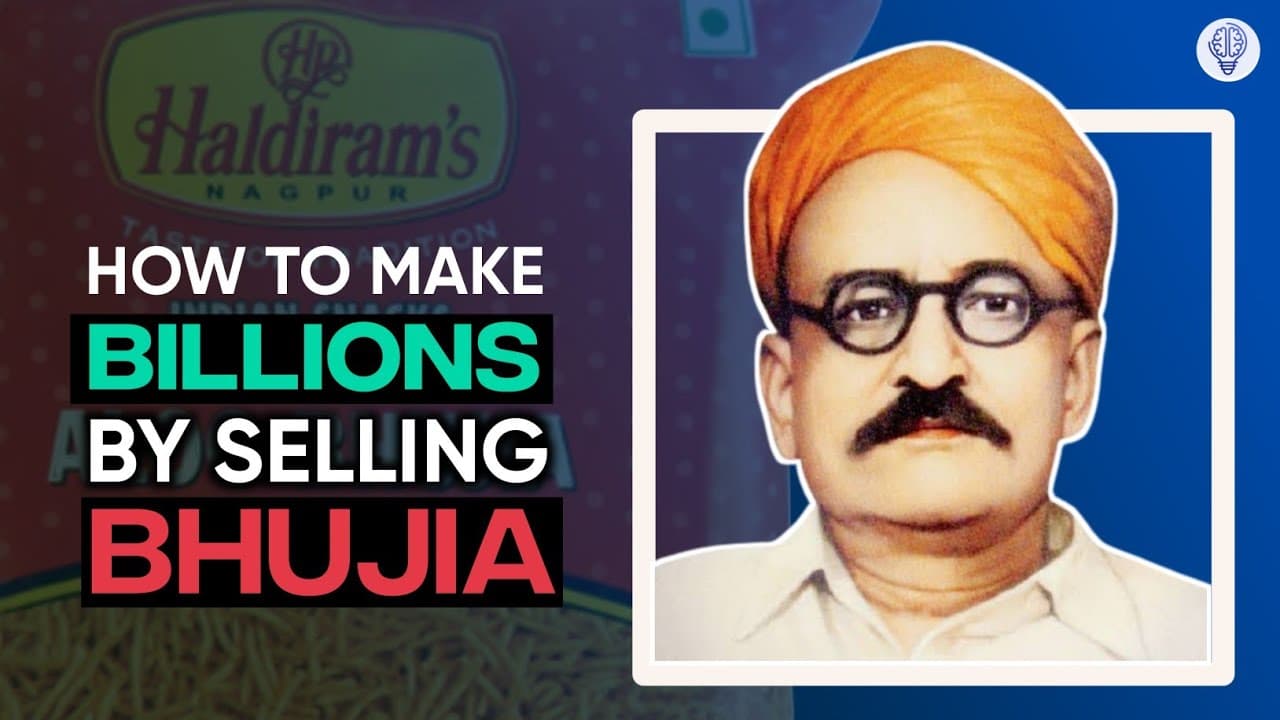
How Did Haldiram Build a Billion-Dollar Brand?
TL;DR
Haldiram escaped commodity competition by improving bhujia, giving it a distinctive name, and charging a premium that the product’s taste justified. Later generations expanded the formula through local market research, free sampling, familiar foods that built customer trust, strategic restaurant offerings, and recognizable packaging that turned each purchase into an advertisement.
Transcript
Hi everybody. Haldiram is one of the most iconic brands in Indian business history. And while most of us are taught about the American icons like Domino's and McDonald's, very few of us know about the world class business strategies developed by the homegrown brands of India. And Haldiram is one such brand that started as a small sweet shop in ... Read More
Key Insights
- Haldiram’s early advantage was product differentiation in a market where hundreds of bhujia sellers competed mainly on price. Improving ingredients and texture gave customers a meaningful reason to choose the product beyond its cost.
- Dungar Sev was made with moth dal instead of besan and prepared as a fine, crispy mixture rather than a soft snack. These changes created a distinctive eating experience and supported its positioning as a delicacy.
- Premium pricing worked because Haldiram combined enhanced perception with genuine product quality. Dungar Sev sold for 5 paise per kilo compared with a market price of 2 paise, representing a 150 percent premium.
- Brand value emerged from the combination of perceived value and tangible delivery. The Dungar name attracted attention and suggested prestige, while the product’s taste validated customers’ expectations after they paid the higher price.
- Shiv Kishan Agarwal’s Nagpur expansion began with direct market research into Maharashtrian food habits. Visits to popular stores revealed limited savory options, strong demand for sweets, and an opportunity to introduce delicacies from other regions.
- Free sampling reduced the risk of trying an unfamiliar sweet. Customers initially bought 100 grams of kaju katli, later increased purchases to 200 grams, and eventually bought 500 grams as acceptance and word of mouth grew.
- Familiar foods created a bridge from customer skepticism to trust. Shiv Kishan attracted people with popular South Indian dishes, then introduced samosas, kachoris, and unfamiliar regional sweets after customers had confidence in the seller.
- Packaging increased Haldiram’s brand recall when competitors paid little attention to presentation. Customers carrying or gifting branded products effectively displayed the name to others, making each package function like a small advertisement for quality and trust.
Install to Summarize YouTube Videos and Get Transcripts
Explore YouTube Video Summarizer or Get YouTube Transcript Extractor
Questions & Answers
Q: How did Haldiram differentiate its bhujia from competitors?
Haldiram differentiated its bhujia through three connected changes. He replaced besan with moth dal, made the snack into a fine and crispy mixture instead of a soft product, and named it Dungar Sev. The name increased perceived value, while the improved ingredients and texture delivered a noticeably different taste. Together, these choices separated the product from hundreds of competing bhujia sellers.
Q: Why could Haldiram charge more than other bhujia sellers?
Haldiram could charge more because the product combined premium positioning with a better eating experience. Dungar Sev was priced at 5 paise per kilo, compared with the prevailing 2 paise per kilo. Its distinctive name encouraged customers to perceive it as a delicacy, and its moth dal recipe and crispy texture justified that perception when they tasted it. The premium therefore represented earned brand value.
Q: What does Haldiram’s story show about building brand value?
Haldiram’s story shows that brand value is created when perception and product performance reinforce each other. The Dungar Sev name made the bhujia sound special and attracted people willing to pay a premium. After purchase, the improved taste confirmed that expectation. Marketing generated initial interest, but tangible quality sustained demand and persuaded both customers and wholesalers that the higher price was worthwhile.
Q: How did Shiv Kishan Agarwal research the Nagpur market?
Shiv Kishan Agarwal returned to direct market observation after struggling to sell bhujia in Nagpur. He repeatedly visited popular stores and studied Maharashtrian food habits. He found that customers had encountered relatively few savory snacks, that popular shops offered a limited selection of sweets, and that local consumers had a strong preference for sweets. These findings shaped his product and market-entry decisions.
Q: How did free samples help Haldiram sell kaju katli?
Free samples helped customers overcome hesitation toward a product they had not previously encountered. Shiv Kishan aggressively encouraged visitors to taste kaju katli, allowing flavor to demonstrate the product’s value before a larger purchase. Word of mouth then expanded demand. According to the account, purchases progressed from 100 grams to 200 grams and eventually reached 500 grams per customer as acceptance increased.
Q: How did Haldiram use familiar foods to introduce new products?
Haldiram used familiar foods to establish trust before asking customers to try less familiar dishes. In Nagpur, Shiv Kishan opened a restaurant featuring popular South Indian foods such as dosa and idli. As customer traffic and confidence grew, he introduced samosas and kachoris. The same principle supported regional sweets: customers were more receptive to unfamiliar offerings when they came from a seller they already trusted.
Q: What results did Haldiram achieve during its Nagpur expansion?
The Nagpur operation expanded by introducing kaju katli, promoting it through tasting, and later offering sweets associated with Bikaner and Calcutta, including malai ladoo, rasgulla, and rasmalai. Within three years, sales increased by 400 percent, rising from 100 rupees per day to 500 rupees per day. The transcript equates the later figure to 12,000 rupees in the present-day comparison it provides.
Q: Why was packaging important to Haldiram’s growth?
Packaging strengthened brand recall because every customer carrying or gifting a Haldiram product displayed the brand to other people. In the 1980s market described in the transcript, competitors generally did not treat packaging as an important strategic tool. Manohar Lal Agarwal used recognizable packaging so that thousands of shipped products also acted as small advertisements, increasing visibility and reinforcing trust among customers and sellers.
Summary & Key Takeaways
-
Haldiram differentiated an ordinary bhujia by replacing besan with moth dal, creating a finer and crispier texture, and naming it Dungar Sev. The premium positioning attracted attention, while the improved taste fulfilled the promise. This combination of perceived value and tangible product quality generated demand in a crowded, price-driven market.
-
Shiv Kishan Agarwal entered Nagpur by studying Maharashtrian food habits and identifying limited varieties of savory snacks and sweets. He introduced kaju katli through free samples, encouraged customers to taste it, and benefited from word of mouth. Within three years, daily sales rose from 100 rupees to 500 rupees.
-
Haldiram reduced customer skepticism by using familiar foods to establish trust before introducing less familiar regional dishes. A South Indian restaurant attracted customers with popular dosa and idli, after which samosas and kachoris were added. Recognizable packaging later strengthened brand recall by turning products carried or gifted by customers into visible advertisements.
Read in Other Languages (beta)
Share This Summary 📚
Summarize YouTube Videos and Get Video Transcripts with 1-Click
Try YouTube Summary with ChatGPT & Claude or YouTube Transcript Generator
Explore More Summaries from Think School 📚



Summarize YouTube Videos and Get Video Transcripts with 1-Click
Try YouTube Summary with ChatGPT & Claude or YouTube Transcript Generator