How to avoid multi-agent traps with context engineering
TL;DR
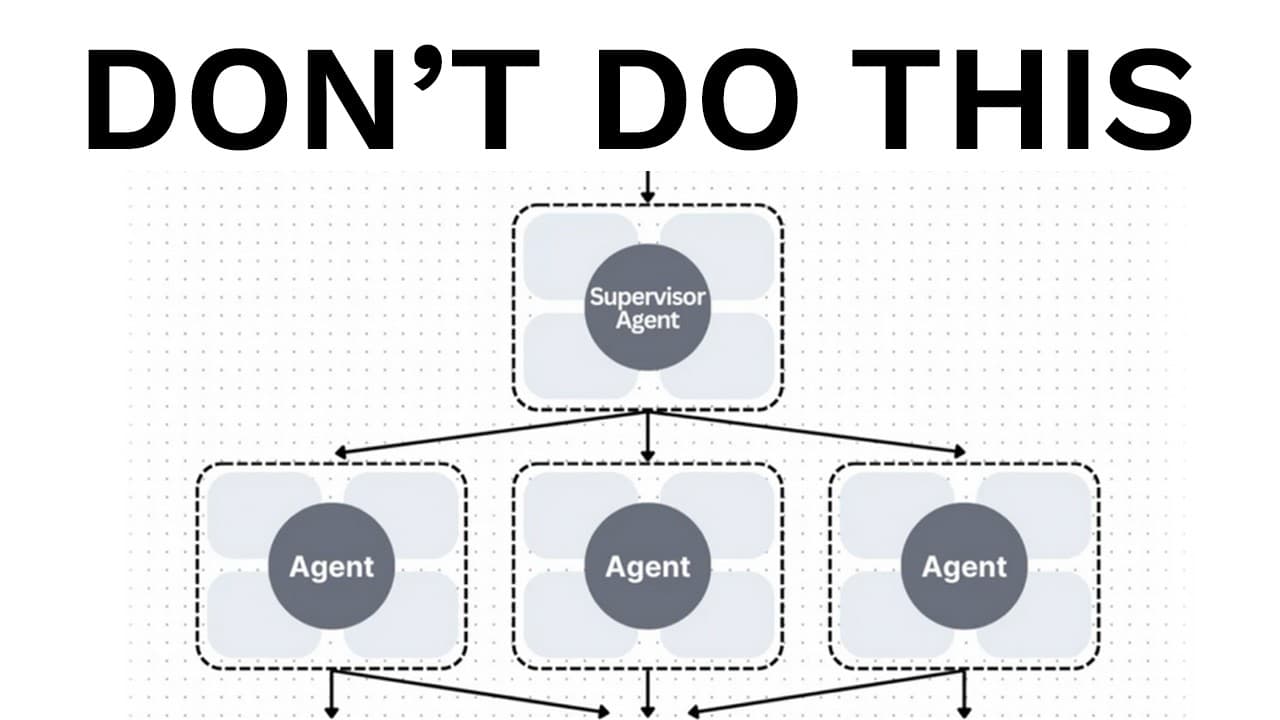
Context engineering is the key to reliable AI agents. It centers on sharing full context among agents and ensuring actions carry implicit decisions, avoiding parallel subagents that diverge. The simplest reliable approach is a single threaded linear agent, which reduces misalignment and errors while preserving task clarity.
Transcript
do not build multi- aent systems and here's why so the multi- aent team is actually a trap openai and microsoft want you to use their frameworks like openai swarm or microsoft autogen to build teams of agents however cognition ai just released an article that explains why building multi- aent systems is a trap and why you shouldn't do it in this vi... Read More
Key Insights
- Context must be shared across all agents to avoid misalignment and broken task coherence.
- Each agent should carry the full reasoning and input context so outputs remain consistent with intent.
- Parallel subagents without cross-communication tend to output conflicting results and styles.
- Implicit decisions in agent actions prevent cascading disagreements when agents operate sequentially.
- Two principles, share context and carry implicit decisions, are highlighted as essential for reliability.
- Complex multi-agent frameworks often increase error rates and reduce reliability in practice.
- A single threaded linear agent is presented as the most reliable architecture for long running tasks.
- Reliability improves when the architecture minimizes inter-agent communication and state divergence.
- More videos from this channel:
- More from this channel: David Ondrej
Install to Summarize YouTube Videos and Get Transcripts
Explore YouTube Video Summarizer or Get YouTube Transcript Extractor
Questions & Answers
Q: What is context engineering in AI agents
Context engineering is the practice of sharing the full context, including inputs, reasoning, and decisions, across all agents involved in a task. It prevents individual agents from acting with incomplete or conflicting information. By ensuring every agent sees the same traces and intents, outputs stay aligned with the overall goal and reduce the risk of inconsistent results.
Q: Why are multi-agent systems considered risky
Multi-agent systems are risky because adding more agents increases complexity and the potential for misalignment. When subagents work in parallel without seeing each other, they can produce conflicting outputs or adopt different styles, which later must be reconciled by a final consolidating agent. This often leads to unreliable results and brittle behavior.
Q: What are the two principles recommended for reliable agents
The two recommended principles are share context and actions carry implicit decisions. Sharing context ensures all components have access to the same information and history, while implicit decisions ensure that each action taken by an agent reflects a clear, predescribed intention. Together, they reduce ambiguity and improve consistency across the system.
Q: What is the simplest architecture that follows the principles
The simplest architecture that follows the principles is a single threaded linear agent. This design minimizes inter-agent communication, keeps reasoning and decision logic in a single thread, and reduces the chances of conflicting outputs. It demonstrates how reliability can be preserved by reducing architectural complexity.
Q: How does sharing context improve reliability
Sharing context improves reliability by ensuring every agent operates with the same inputs, goals, and reasoning traces. When context is shared, subtasks and outputs do not diverge due to isolated perspectives. This alignment prevents the common pitfall of inconsistent task execution and inconsistent visual or functional results.
Q: What happens when subagents do not communicate
When subagents do not communicate, they can independently pursue different interpretations of the task, leading to inconsistent results such as mismatched styles or conflicting decisions. The final assembly step then struggles to fuse these divergent outputs into a coherent whole, undermining reliability and user experience.
Q: Why is a linear agent recommended for 2025
A linear agent is recommended because it offers robustness and simplicity, reducing the risk of errors that compound across multiple agents. In 2025 and beyond, unreliable multi-agent patterns persist in production, so a straightforward approach with clear, single-threaded reasoning provides a more dependable baseline for long running tasks.
Q: What resources are suggested for building effective agents
The video suggests starting from the cognition ai article on not building multi-agent systems and the Enthropic building effective agents article. It also points to OpenAI resources on tool calling, reasoning models, and guardrails and mentions a more concise internal video version that condenses an extensive OpenAI course into a shorter guide for practical use.
Summary & Key Takeaways
-
Context engineering defines the core requirement for reliable agents by sharing complete traces and decisions across subtasks. It reduces fragmentation when dividing tasks and helps maintain consistency across outputs. The recommended architecture in 2025 is a single threaded linear agent to maximize reliability and simplicity.
-
Two core principles are shared context and implicit decisions. Shared context ensures all agents see the same information and intent, while implicit decisions prevent conflicting outcomes when agents operate on the same task. Together they dramatically increase reliability over multi-agent setups.
-
A practical path to reliable agents is to favor linear, single-threaded execution over complex multi-agent hierarchies. This reduces error propagation and misalignment between components. The video demonstrates concrete examples and links to resources that support a simpler, more robust design approach.
Read in Other Languages (beta)
Share This Summary 📚
Summarize YouTube Videos and Get Video Transcripts with 1-Click
Try YouTube Summary with ChatGPT & Claude or YouTube Transcript Generator
Explore More Summaries from David Ondrej 📚




Summarize YouTube Videos and Get Video Transcripts with 1-Click
Try YouTube Summary with ChatGPT & Claude or YouTube Transcript Generator