How to Fine-Tune Huge Open-Source AI Models
TL;DR
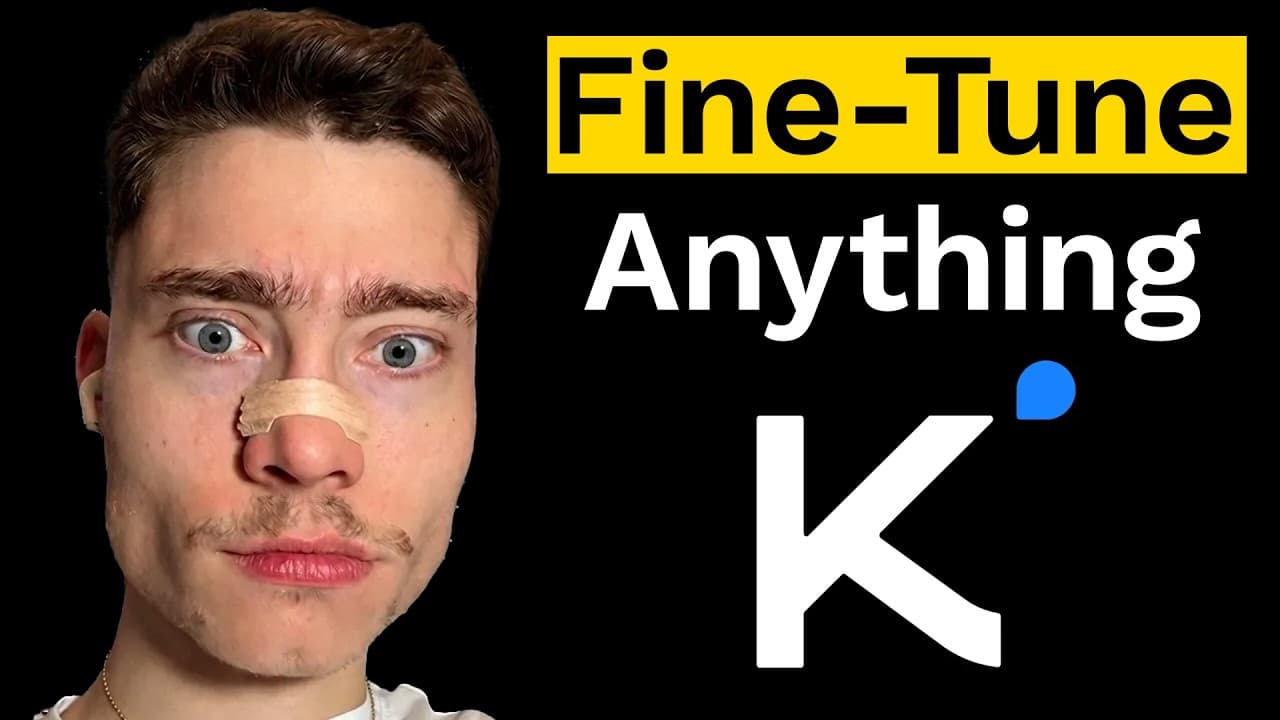
Fine-tune a massive open-source model without owning expensive hardware by using Fireworks AI, supervised fine-tuning, and LoRA adapters that leave the base weights frozen. Choose a high-quality dataset, format it correctly, train only the adapter weights, and then deploy the resulting model through the same platform for public inference or application development.
Transcript
My name is David Andre and here is how to fine-tune Kimmy K2.7 on your own data. So, the future is here. We now can fine-tune massive AI models such as Kim K2.7, which by the way is one of the best models in the world. It's on a similar level as Opus 4.8 or GPD 5.5. And it's reaching the level of Opus for a fraction of the cost, roughly 6 to 8 time... Read More
Key Insights
- Fine-tuning is a method for making an AI model better at one specific task or domain. A specialized fine-tuned model can outperform models with as many as five times more parameters because its training is concentrated on examples relevant to the intended use.
- The three requirements for fine-tuning are an open-source model, GPU compute, and a dataset. The model must be adaptable, the GPUs must support training and deployment, and the dataset must contain high-quality examples in a format suitable for the selected training workflow.
- Open-source models are required for this workflow because their accessible weights can be fine-tuned. Closed-source models from providers such as OpenAI or Anthropic are not presented as candidates for direct fine-tuning through the process demonstrated in the transcript.
- Hardware cost is the main obstacle to locally fine-tuning trillion-parameter models. The transcript estimates that sufficient home compute could cost more than $100,000, while a rack containing at least eight Nvidia B300 Blackwell GPUs could require an upfront investment of roughly $300,000 to $350,000.
- LoRA is an efficient fine-tuning technique that freezes the base model's weights and trains a small collection of adapter weights. For Kimi K2.7, this avoids updating all one trillion parameters, which reduces the expected training time and cost.
- Supervised fine-tuning teaches a model through good examples, while reinforcement learning lets it try different actions and receive rewards. The demonstrated workflow selects supervised fine-tuning because it is simpler and because the chosen dataset contains many examples the model can imitate.
- Dataset quality is one of the most important factors in producing a useful fine-tuned model. Training an already capable model on weak examples, including outputs from an inferior model, may not provide the desired improvement, so dataset provenance and quality require careful evaluation.
- Fireworks AI supports both model fine-tuning and deployment within one platform. After training a LoRA adapter for Kimi K2.7, the resulting customized model can be deployed for fast inference, exposed publicly, or used as the model behind a software application.
- More videos from this channel:
- More from this channel: David Ondrej
Install to Summarize YouTube Videos and Get Transcripts
Explore YouTube Video Summarizer or Get YouTube Transcript Extractor
Questions & Answers
Q: How can I fine-tune a huge open-source model without powerful local hardware?
Use a cloud platform that provides the GPUs needed for both training and deployment. The demonstrated process uses Fireworks AI, selects its LoRA version of Kimi K2.7, uploads or connects a prepared dataset, and performs supervised fine-tuning. LoRA freezes the enormous base model and trains only a small adapter, avoiding the need to purchase expensive data-center hardware for a home computer.
Q: What do I need to fine-tune an open-source AI model?
You need three things: an open-source model, GPU compute, and a suitable dataset. The open-source model provides weights that can be adapted, the GPUs supply the computing capacity for training and later deployment, and the dataset supplies examples of the behavior you want. The transcript emphasizes that weak or incorrectly formatted data can produce a weak customized model.
Q: What is LoRA and why is it useful for fine-tuning Kimi K2.7?
LoRA stands for low-rank adaptation. It is an efficient technique that freezes the original base weights and trains a much smaller group of adapter weights on top of the model. This means the workflow does not update all one trillion parameters in Kimi K2.7. According to the transcript, that approach saves money and avoids the longer training associated with modifying the complete model.
Q: What is the difference between supervised fine-tuning and reinforcement learning?
Supervised fine-tuning trains a model with good examples that demonstrate the desired output, while reinforcement learning gives the model a reward and allows it to try different approaches to find actions that earn better rewards. The demonstrated Kimi K2.7 workflow uses supervised fine-tuning because it is described as simpler and works with a dataset containing many strong examples for the model to follow.
Q: How should I choose a dataset for fine-tuning a large model?
Choose high-quality examples that match the specific capability you want the model to improve. The transcript warns against fine-tuning a strong trillion-parameter model with outputs generated by a weaker model, because those examples may not improve it. You can search Hugging Face by domain, such as frontend design or software engineering, use examples from a stronger model, or create your own dataset.
Q: How can an AI coding agent help download a Hugging Face dataset?
Give the agent the Hugging Face dataset URL and ask it to download the files into a specified folder. In the demonstration, the agent first checks the current directory and whether the Hugging Face CLI is available, then starts the download through that command-line tool. If the CLI is missing, the user can ask the agent to install and configure it before downloading the dataset.
Q: Why use Fireworks AI for fine-tuning and deployment?
Fireworks AI is used because it provides both fine-tuning and model deployment. Its dashboard includes dedicated areas for these tasks, and its model catalog offers a LoRA version of Kimi K2.7. After training the adapter, the customized model can be deployed on the same platform so developers can run inference, make it publicly accessible, or build software on top of it.
Q: Why is local fine-tuning of a trillion-parameter model so expensive?
A model of that size requires powerful data-center GPUs to load and train. The transcript cites Nvidia B300 Blackwell hardware at about $40,000 per GPU and says it is sold in server racks with at least eight units, producing an estimated upfront cost of $300,000 to $350,000. It also estimates that sufficient home compute for this type of fine-tuning would exceed $100,000.
Summary & Key Takeaways
-
Fine-tuning improves a model for a specific task or domain by training it on relevant data. The process requires three core components: an open-source model whose weights can be adapted, suitable GPU compute for training and deployment, and a carefully selected, correctly formatted dataset containing strong examples of the desired behavior.
-
Training a trillion-parameter model at home would require prohibitively expensive hardware. The presented workflow instead uses Fireworks AI for cloud-based fine-tuning and deployment. Its LoRA option freezes Kimi K2.7's base weights and trains a relatively small adapter, reducing the time and expense compared with updating every parameter in the original model.
-
The demonstration uses supervised fine-tuning, in which the model learns from good examples. A dataset can be downloaded from Hugging Face with help from an AI coding agent and the Hugging Face CLI, then prepared using the provided formatting skill. After training, the customized model can be deployed for inference or application development.
Read in Other Languages (beta)
Share This Summary 📚
Summarize YouTube Videos and Get Video Transcripts with 1-Click
Try YouTube Summary with ChatGPT & Claude or YouTube Transcript Generator
Explore More Summaries from David Ondrej 📚
Summarize YouTube Videos and Get Video Transcripts with 1-Click
Try YouTube Summary with ChatGPT & Claude or YouTube Transcript Generator