What Does Demis Hassabis Explain About AlphaFold? Nobel Prize Lecture, Chemistry 2024
TL;DR
AlphaFold addresses the protein folding problem by predicting a protein’s three-dimensional structure from its one-dimensional amino acid sequence. In his Nobel Prize in Chemistry 2024 lecture, Demis Hassabis connects this achievement to self-learning systems such as AlphaGo, which defeated Lee Sedol 4–1 in 2016. Read on to understand the search methods, problem-selection criteria, and scientific challenge behind AlphaFold.
Transcript
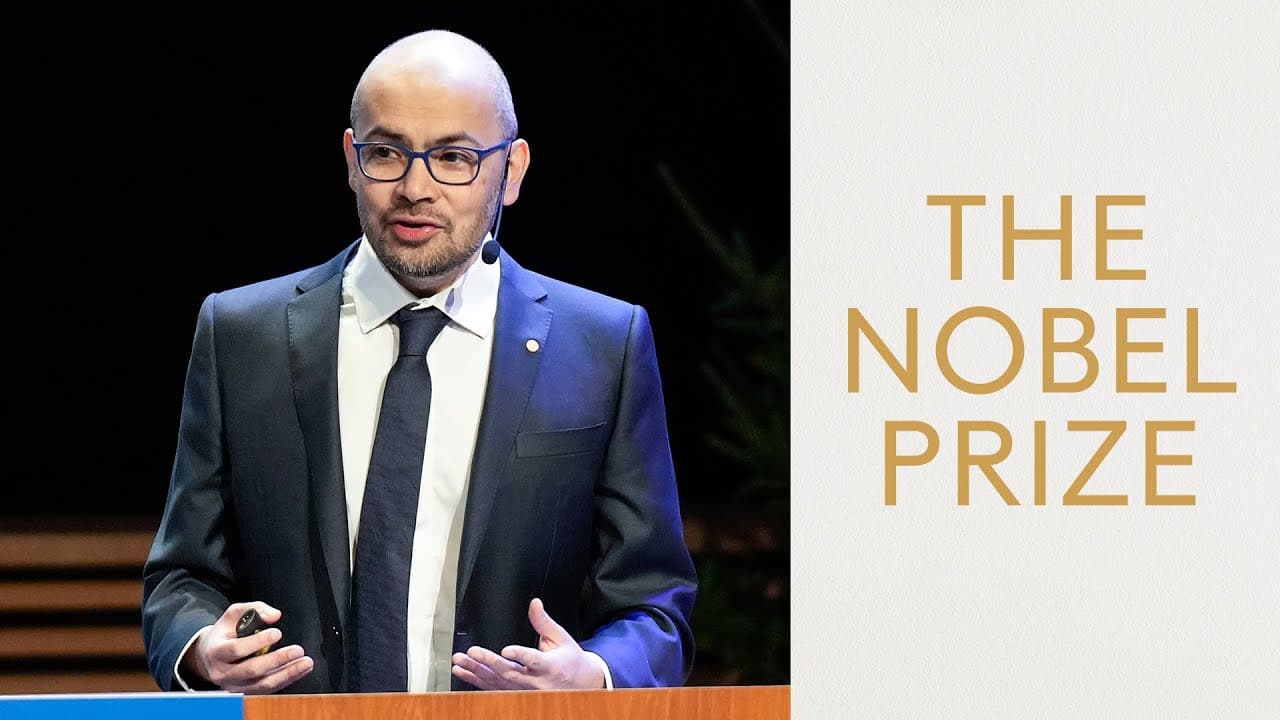
so our next speaker is uh Demis hassabis he was born 1976 in London United Kingdom and he received his PhD in 2009 from University College London and he is presently the CEO of Google Deep Mind also based in London United Kingdom so please Demis we're looking forward to your Nobel lecture and please join me in wel coming Dr hassis well first of all... Read More
Key Insights
- AlphaGo beat South Korean Grandmaster Lee Sedol 4-1 in a 2016 match in Seoul, and importantly invented new creative strategies never seen before, such as the famous move 37 in game two that proved decisive 100 moves later.
- Go is likely the most complex game ever devised, with 10 to the power 170 possible positions, more than there are atoms in the universe, making a brute-force programmed solution impossible.
- Self-learning is how AlphaGo and its more general successor AlphaZero mastered Go and other two-player games, learning strategies for themselves by playing millions of games against themselves and improving from their mistakes rather than being directly programmed with solutions.
- A neural network model lets AlphaGo search efficiently by analyzing only a tiny fraction of possible paths, identifying the most promising moves and estimating each side's probability of winning from a given position before outputting the best line found.
- A problem suits these AI methods if it meets three criteria: it can be couched as finding a path through a massively combinatorial search space, it has a clear objective function to optimize, and there is a lot of data to learn from or an accurate simulator to generate synthetic data.
- Proteins are the building blocks of life, and almost all biological processes in every living thing depend on them, from the twitching of muscle fibers to the firing of neurons, acting like exquisite nanoscale bio machines.
- The protein folding problem asks whether a protein's 3D structure can be predicted solely from its one-dimensional amino acid sequence, a challenge Christian Anfinsen conjectured was theoretically possible in his 1972 Nobel lecture via his thermodynamic hypothesis.
- Levinthal's Paradox estimates a typical protein has up to 10 to the power 300 possible conformations, so enumerating them would take longer than the age of the universe, yet proteins fold spontaneously in nature sometimes within milliseconds.
Install to Summarize YouTube Videos and Get Transcripts
Explore YouTube Video Summarizer or Get YouTube Transcript Extractor
Questions & Answers
Q: What is AlphaFold, and what problem does it solve?
AlphaFold addresses the protein folding problem: predicting a protein’s three-dimensional structure solely from its one-dimensional amino acid sequence. Demis Hassabis describes this as a 50-year grand challenge and explains that a protein’s structure reveals much about its function.
Q: Why is predicting a protein’s three-dimensional structure so difficult?
A typical protein may have up to 10 to the power 300 possible conformations, according to Levinthal’s Paradox. Enumerating them would take longer than the age of the universe, although proteins can fold spontaneously in nature within milliseconds.
Q: How did work on AlphaGo lead toward AlphaFold?
AlphaGo demonstrated that a learning system could navigate a vast search space without brute-forcing every possibility. After its 2016 victory over Lee Sedol, Hassabis applied related self-learning and search ideas to protein folding, a scientific problem he had long wanted to tackle with AI.
Q: How did AlphaGo learn to play Go?
AlphaGo and its more general successor, AlphaZero, used self-learning rather than being directly programmed with solutions. They played hundreds of thousands, and ultimately millions, of games against themselves, learning from mistakes and incrementally improving their strategies.
Q: How does AlphaGo search such a large space of possible moves?
A neural network guides the search toward only a tiny fraction of the available paths. It identifies promising moves, estimates each side’s probability of winning from a position, and outputs the best line it finds.
Q: Why was AlphaGo’s 2016 match against Lee Sedol significant?
AlphaGo defeated South Korean Grandmaster Lee Sedol 4–1 in Seoul in 2016. Hassabis describes the result as a watershed proof that learning systems could accomplish something impressive that had previously been considered intractable.
Q: What was AlphaGo’s move 37, and why did it matter?
Move 37 appeared in game two of the match against Lee Sedol and had not previously been seen in top-level Go play. It proved decisive about 100 moves later, demonstrating that AlphaGo could devise new creative strategies rather than merely reproduce familiar human play.
Q: What makes a scientific problem suitable for AlphaGo-style AI methods?
Hassabis identifies three criteria: the problem can be expressed as finding a path through a massively combinatorial search space, it has a clear objective function to optimize, and it offers substantial learning data. An accurate simulator that can generate synthetic data may satisfy the third requirement.
Summary & Key Takeaways
-
Demis Hassabis's path to AI began with chess, which he started playing at age four and played competitively for England junior teams. Early chess computers fascinated him with how a lump of plastic could be programmed to play well, leading him to code his first AI program at age 11 on an Amiga 500.
-
DeepMind was founded in 2010 as an industrial research lab with the mission to build artificial general intelligence, envisioned as a modern-day Bell Labs. Games served as the perfect proving ground because they generate abundant data, allow self-play, and offer a clear objective to measure algorithmic progress against.
-
In 2016 AlphaGo beat world champion Lee Sedol 4-1, a watershed proof that learning systems could achieve feats thought intractable. Hassabis then applied these methods to protein folding, a 50-year grand challenge of predicting a protein's 3D structure from its amino acid sequence, work that led to AlphaFold.
Read in Other Languages (beta)
Share This Summary 📚
Summarize YouTube Videos and Get Video Transcripts with 1-Click
Try YouTube Summary with ChatGPT & Claude or YouTube Transcript Generator
Explore More Summaries from Nobel Prize 📚



Summarize YouTube Videos and Get Video Transcripts with 1-Click
Try YouTube Summary with ChatGPT & Claude or YouTube Transcript Generator