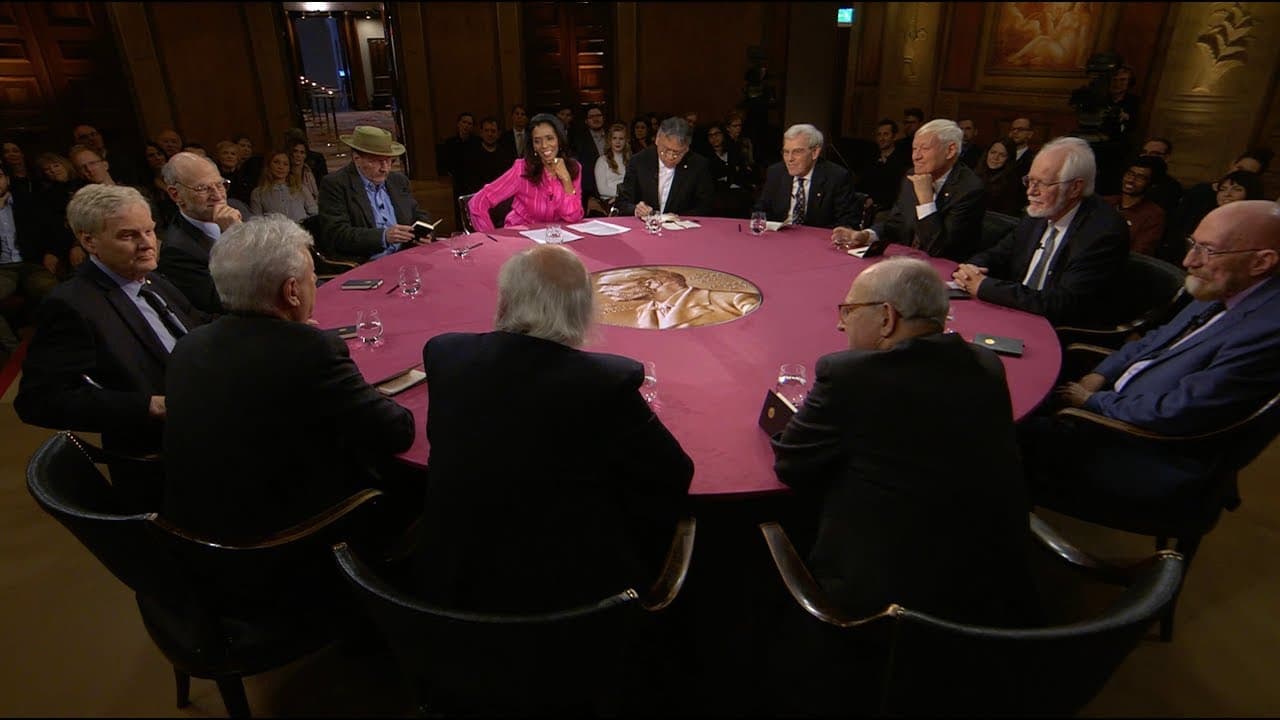
Nobel Minds 2017
TL;DR
Human decisions are not consistently rational, so behavioral economics accounts for biases and uses small environmental features, called nudges, to encourage better choices. The laureates also describe scientific discovery as a mixture of rigorous testing, emotional risk, accidents, and unconscious insight, while research on fruit flies reveals genetic clocks that regulate daily rhythms across behavior and physiology.
Transcript
hello I'm Xena but are we welcome to the concert hall here in Stockholm where this year's Nobel laureates receive their awards from His Majesty the King of Sweden for their outstanding contributions to literature economics and science this is the first time that they have been brought together in discussion on television and we're also joined in th... Read More
Key Insights
- Behavioral economics is an approach to economics that accommodates the imperfectly rational behavior illustrated by the laureates' personal stories. It questions assumptions such as the idea that people always benefit from having more choices available to them.
- The cashew-nut example shows that removing a tempting option can improve people's experience. Dinner guests thanked Richard Thaler after he removed the bowl because they wanted to stop eating but believed they would continue while the nuts remained available.
- A nudge is a small feature introduced into an environment to adjust for predictable human biases. Thaler illustrates the idea with a timed phone alarm that helps participants keep a program from running beyond its intended duration.
- Nudging is unavoidable because choices are always presented within some kind of environment. Thaler argues that the alternative is not an absence of influence, but poorly designed nudging that fails to account for how people actually decide.
- Scientific reasoning involves trying to show that a promising idea is wrong before accepting it. One chemistry laureate describes falsification as testing an idea against every available challenge, while admitting that researchers can become attached to proving their own ideas right.
- Scientific insight can emerge outside deliberate, rational thought. Kip Thorne reports that major ideas sometimes arrive while he is asleep, prompting him to write notes during the night, with roughly a third of those notes still seeming good the next morning.
- Choosing science is a risky and emotional decision as well as an intellectual one. Michael Young recalls being asked when he would find a secure job or select a path that outsiders could easily understand and trust to provide support.
- Biological clocks underpin observable daily rhythms across many organisms. Research using fruit flies identified genes and clock components that have relatives throughout the animal kingdom, including humans, and showed that clocks regulate behavior and multiple aspects of physiology in different body parts.
Install to Summarize YouTube Videos and Get Transcripts
Explore YouTube Video Summarizer or Get YouTube Transcript Extractor
Questions & Answers
Q: What is behavioral economics according to Richard Thaler?
Behavioral economics is economics designed to accommodate how people actually behave, including their biases, impulses, and departures from strict rationality. Richard Thaler connects it to the laureates' stories of reflexes, emotional choices, risk-taking, and unexpected inspiration. His account challenges a mainstream assumption that individuals and households always make consistently rational decisions or invariably prefer more choices.
Q: Why did Richard Thaler remove the bowl of cashew nuts?
Richard Thaler removed the cashew nuts because the dinner guests wanted to stop eating but expected that they would continue if the bowl stayed within reach. After he took it away, everyone thanked him. The incident became important because economic theory treated more choice as better, yet the guests were happier after an available option had been removed.
Q: How does a nudge help people make decisions?
A nudge helps by introducing a small feature into the decision environment that responds to a known bias or limitation. Thaler gives the example of setting a phone alarm for the program's allotted time. The alarm provides a timely prompt, reducing the risk that the discussion will continue too long without requiring anyone to surrender the underlying choice.
Q: Is nudging a form of manipulation?
The discussion raises manipulation as a concern when governments or advisers encourage choices such as saving for an old-age pension. Thaler's response is that there is no alternative to nudging because every choice occurs within an arranged environment. From his perspective, the meaningful comparison is between thoughtfully designed nudges and bad nudges, not between nudging and complete neutrality.
Q: Why does probabilistic reasoning matter in education?
One laureate argues that schools teach children the wrong kind of mathematics for decisions involving uncertainty. He says people should understand the odds before others try to nudge them. He proposes gambling as a mechanism for teaching the mathematics and thinking behind probabilistic reasoning, while clarifying that the objective is education rather than creating a nation of gamblers.
Q: How do Nobel laureates describe rationality in discovery?
The laureates describe discovery as combining disciplined reasoning with accidents, emotion, intuition, and unconscious thought. One researcher found that kicking malfunctioning equipment exposed a loose wire, while Kip Thorne says ideas sometimes emerge during sleep. Chemistry also relies on falsification, which means trying hard to prove a good idea wrong before concluding that it has survived serious testing.
Q: What is a biological body clock?
A biological body clock is an internal system underpinning observable daily rhythms. Jeff Hall says such rhythms can be measured in many forms and have been studied across a wide variety of organisms. Work with fruit flies showed that clock components occur in different body parts, where they influence behavior and many aspects of physiology rather than controlling only one activity.
Q: What did fruit-fly research reveal about body clocks?
Fruit-fly research allowed the laureates to isolate genes involved in biological clocks and then identify related genes elsewhere in the animal kingdom, including humans. The work also showed that different parts of a fruit fly contain clocks and display rhythms. These findings connect genetic clock mechanisms with both daily behavior and numerous physiological processes throughout an organism.
Summary
In this video, Nobel laureates from various fields discuss their personal lives and the role of rationality in their work. They also touch on the importance of science and art in society, the challenges facing scientific progress, and the need for better education and understanding of science.
Questions & Answers
Q: Do Nobel laureates act rationally in their personal lives?
While Nobel laureates are known for their logical thinking and rationality in their work, they do occasionally step outside of their rational circle in their personal lives. They shared anecdotes of instances where they acted irrationally, such as giving a piece of equipment a kick and finding a loose wire.
Q: How did each laureate deal with failures in their work?
Each laureate emphasized the importance of persistence and enjoyment in their work. They acknowledged that failures were part of the process and that progress often comes from taking risks and making big jumps. They also believe that craftsmanship and a love for what they do carry them through these failures.
Q: Is there a disconnect between scientific breakthroughs and public understanding?
Some laureates expressed concern about the lack of scientific knowledge and understanding in society. They believe that there is a need for better education and communication of science to the general public. They also discussed the importance of science fiction in inspiring people about science and the potential benefits and risks of scientific discoveries.
Q: What is the role of science in society?
The laureates agree that science plays a crucial role in society and that scientific advancements have a significant impact on our daily lives. They emphasize the need for evidence-based discourse and rational decision-making. They also believe that scientists should take an active role in explaining their work and raising the level of knowledge-based comments and debates.
Q: How can society better understand and appreciate science?
The laureates highlight the need for better education that promotes critical thinking and scientific literacy. They suggest that scientists should engage with the public through various platforms, including schools, media, and public events, to explain their work and make it more accessible. They also emphasize the importance of supporting science and research financially and creating a culture that values scientific advancements.
Q: What is the relationship between science and art?
The laureates recognize the value of both science and art in society. They believe that art and literature have the power to bridge cultural and language barriers and promote understanding among people. They also discuss the role of science fiction in inspiring interest in science and the potential for collaboration between science and the arts to create a more comprehensive and nuanced understanding of the world.
Q: Could the laureates' work help discover parallel universes or other scientific mysteries?
While their specific research topics may not directly address parallel universes, some of the laureates mention that their work in science provides newfound knowledge and tools that can contribute to understanding the mysteries of the universe. They discuss the potential of future discoveries and advancements in their respective fields to shed light on various scientific questions and phenomena.
Summary & Key Takeaways
-
The laureates challenge the assumption that accomplished scientists, economists, and writers behave rationally in every part of life. Their examples include kicking malfunctioning equipment, reacting reflexively during an earthquake, pursuing an ill-fated romance, choosing risky careers, displaying destructive tempers, and receiving useful scientific insights while asleep.
-
Richard Thaler describes behavioral economics as economics broad enough to accommodate how people actually behave. His cashew-nut example shows that additional choice is not always welcome: dinner guests thanked him for removing tempting food because its continued availability would have led them to eat more despite preferring to stop.
-
The discussion connects nudging with biological research on daily rhythms. Nudges introduce small environmental features that respond to predictable biases, while fruit-fly studies identify genes and clock components found across the animal kingdom. These clocks operate in different body parts and influence both behavior and many aspects of physiology.
Read in Other Languages (beta)
Share This Summary 📚
Summarize YouTube Videos and Get Video Transcripts with 1-Click
Try YouTube Summary with ChatGPT & Claude or YouTube Transcript Generator
Explore More Summaries from Nobel Prize 📚
Summarize YouTube Videos and Get Video Transcripts with 1-Click
Try YouTube Summary with ChatGPT & Claude or YouTube Transcript Generator