Prize Lecture: Abhijit Banerjee, Prize in Economic Sciences 2019
TL;DR
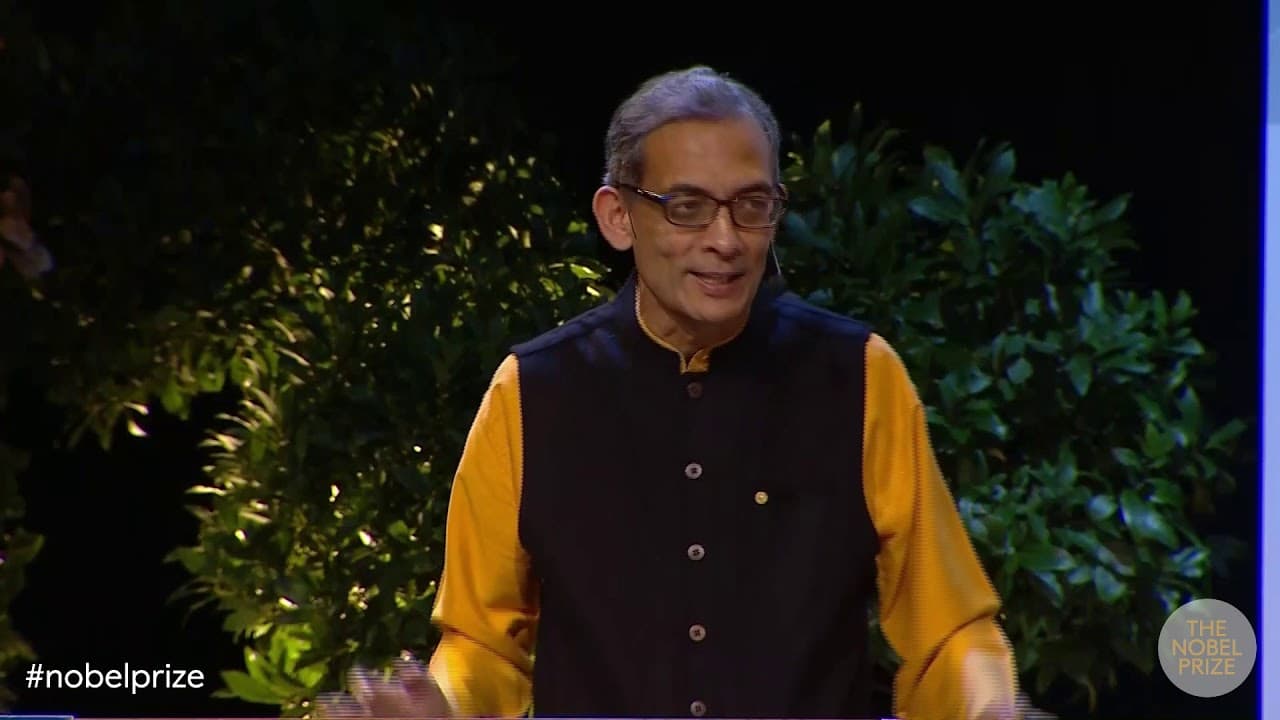
Abhijit Banerjee’s lecture explains how field experiments changed both the daily practice of economics and the questions economists ask. He describes randomized controlled trials as comparisons between randomly chosen treatment and control groups, then contrasts this empirical approach with models built from assumptions about human behavior. Read on to understand his experimental approach to alleviating global poverty.
Transcript
welcome so on this gray afternoon we have gathered here in the beautiful Lula Magna to attend the lectures of another three of the this year's laureates Abhijit Banerjee Esther Duflo and Michael Kramer so in October as you know the Royal Academy of Sciences decided to award them with the 2019 Prize in Economic Sciences for their experimental approa... Read More
Key Insights
- Randomized controlled trials estimate impact by comparing people randomly chosen to receive an intervention with people randomly chosen not to receive it. This treatment-and-control structure gives researchers a direct empirical way to assess whether the tested intervention changed the outcome.
- Field experiments have changed both the daily practice and the intellectual agenda of economics. Banerjee argues that their most profound effect may be the different questions economists now ask and the broader range of possible answers they consider.
- Traditional economic analysis seeks generalizable truths by inferring fundamental human behavior from observed data and building models from explicit assumptions. Those assumptions may concern motives such as money and expectations about how markets operate.
- The experimental approach begins with an intervention or idea, tests it in several places, and then works backward to judge whether the observed result reflects a generalizable truth or merely something that occurred in one or two settings.
- Social learning matters when information must spread through a community, including messages intended to contain an infection. Standard economic models commonly recommend choosing people who are central within a social network, especially people connected to other well-connected individuals.
- Community members can identify people who are especially effective at spreading information by naming local gossips. This practical method avoids requiring researchers to map every connection in a social network before selecting potential messengers.
- Gossips were three times as effective as other selected messengers at spreading information about mobile-phone raffles in the Karnataka experiment. They outperformed randomly chosen people and people selected because they appeared important within the community.
- Gossip-based messaging led to twice as many children being vaccinated as messaging seeded through trusted or randomly selected people. Gossips were well connected, but their advantage persisted beyond network centrality because they also enjoyed talking and spreading messages.
Install to Summarize YouTube Videos and Get Transcripts
Explore YouTube Video Summarizer or Get YouTube Transcript Extractor
Questions & Answers
Q: What does Abhijit Banerjee explain in his lecture?
Abhijit Banerjee explains how field experiments, predominantly randomized controlled trials, have changed economics. He argues that they changed both economists’ daily methods and the kinds of questions and possible answers they consider.
Q: What is Abhijit Banerjee’s Nobel Prize lecture about?
The lecture is titled “Field Experiments and the Practice of Economics.” Banerjee discusses randomized controlled trials and how an experimental approach can help economists investigate poverty, development, and broader questions about human behavior.
Q: Why did Abhijit Banerjee receive the 2019 Prize in Economic Sciences?
Abhijit Banerjee, Esther Duflo, and Michael Kremer received the 2019 Prize in Economic Sciences for their experimental approach to alleviating global poverty. Banerjee’s lecture presents field experiments as a central part of that approach.
Q: What is a randomized controlled trial in economics?
A randomized controlled trial compares people randomly chosen to receive an intervention with people randomly chosen not to receive it. Researchers compare these treatment and control groups to determine what impact the intervention had.
Q: How have field experiments changed economics?
Field experiments have changed what economists do when answering questions and the questions they choose to ask. Banerjee says the change in questions and possible answers may be the more profound impact.
Q: How does the experimental approach differ from traditional economic modeling?
The traditional approach described by Banerjee uses data to infer deep truths about human behavior and builds models from behavioral assumptions. The experimental approach starts with an intervention, observes its effects, repeats tests, and works backward toward possible generalizable truths.
Q: Do randomized controlled trials produce generalizable conclusions?
Banerjee acknowledges the criticism that testing a particular intervention may not reveal a generalizable truth. Researchers address this by testing ideas in several places and asking whether repeated findings indicate a broader explanation or only results specific to one or two settings.
Q: What role does J-PAL play in the research discussed by Banerjee?
Banerjee identifies J-PAL as the Abdul Latif Jameel Poverty Action Lab. He says about a thousand field experiments had occurred within its community and that his lecture draws lessons from the work of many researchers in that group.
Summary
Abhijit Banerjee, one of the 2019 Nobel Prize winners in Economic Sciences, discusses the role of field experiments (also known as randomized control trials or RCTs) in economics. He argues that RCTs have changed the practice of economics by challenging traditional assumptions and methodologies. Banerjee presents three common criticisms of RCTs and provides evidence to counter each criticism. He highlights the importance of studying small interventions and their cumulative impact, as well as the significance of understanding the psychological effects of poverty on productivity. Ultimately, he suggests that RCTs can help build a more nuanced and theory-driven understanding of economic behavior.
Questions & Answers
Q: What are RCTs and how have they changed economics?
RCTs, or randomized control trials, are experimental studies that compare the effects of interventions through random assignment of treatment and control groups. Banerjee argues that RCTs have changed economics in two ways: first, by changing the practice of economics and how questions are answered, and second, by changing the questions economists ask and the way they think about potential answers. RCTs have introduced a more empirical and specific approach to studying economic phenomena.
Q: What is the difference between the traditional economic approach and the RCT approach?
The traditional economic approach starts with a hypothesis or model of human behavior and uses data to make inferences about that behavior. In contrast, RCTs start with an idea or intervention and test it in different contexts to see if the observed outcomes support a generalizable truth. The traditional approach often relies on assumptions about rational behavior, while RCTs allow for more flexibility and the discovery of new insights that may challenge these assumptions.
Q: What example does Banerjee provide to illustrate the difference between the two approaches?
Banerjee discusses a study on the spread of information through social networks. Economic theory suggests that central individuals in a network would be most effective in spreading a message, but field experiments found that gossips, who were not central in the network, were three times as effective. This insight, not accounted for in economic theory, underscores the value of RCTs in discovering unexpected dynamics in economic behavior.
Q: What does Banerjee argue about the effect of giving money to the poor?
Banerjee challenges the belief that giving money to the poor will make them lazy. He cites RCTs conducted in India and Bangladesh, which found that giving cash transfers or assets to the poor did not make them lazier. In fact, the studies show that these interventions often led to higher incomes and increased productivity among the recipients. This challenges the conventional economic assumption that wealth leads to laziness.
Q: How does Banerjee address the criticism that RCTs focus on small interventions?
Banerjee argues that RCTs are not limited to small interventions and can provide insights into larger economic questions. He discusses the study on a poverty trap, where RCTs were used to investigate whether individuals remain in poverty because they lack opportunities. The findings showed that providing assets and support to the poorest individuals resulted in long-term income growth and reduced poverty, challenging the notion that people stay poor due to personal shortcomings. This demonstrates that RCTs can address significant economic issues.
Q: How does Banerjee counter the belief that RCTs are piecemeal and cannot form a comprehensive theory?
Banerjee suggests that RCTs actually contribute to building a theory by allowing economists to test specific hypotheses and piece them together over time. He gives an example of studying the psychological effects of poverty on productivity. By conducting multiple RCTs and examining various aspects of the intervention, researchers were able to understand the relationship between poverty, psychology, and productivity. RCTs provide a way to build theories incrementally and uncover nuances in economic behavior.
Q: What does Banerjee conclude about the significance of RCTs in economics?
Banerjee expresses gratitude to all the researchers who have contributed to the field of RCTs and emphasizes the transformative impact RCTs have had on development economics. He suggests that RCTs not only challenge traditional economic assumptions but also open up new avenues of inquiry and understanding. RCTs have the potential to provide more nuanced theories and better inform policy interventions in the fight against poverty.
Takeaways
Banerjee's lecture highlights the transformative power of field experiments in economics. RCTs have challenged traditional assumptions and methods, allowing researchers to study small interventions and uncover their cumulative effects. RCTs have also contributed to a deeper understanding of the psychological factors influencing economic behavior. By conducting multiple experiments and piecing together the findings, RCTs can help build more comprehensive theories. Overall, RCTs offer a promising approach for addressing global poverty and improving the practice of economics.
Summary & Key Takeaways
-
Abhijit Banerjee defines field experiments, predominantly randomized controlled trials, as comparisons between randomly selected groups that receive an intervention and groups that do not. Borrowed from medical science and adapted to social science, this simple method helps researchers determine what impact an intervention had under the conditions where it was tested.
-
Banerjee argues that randomized controlled trials have changed economics in two ways. They have altered economists’ daily practice when answering questions, and they have encouraged researchers to ask different kinds of questions. Instead of relying exclusively on predefined behavioral fundamentals, researchers can begin with observations, repeat experiments, and work backward toward broader explanations.
-
Experiments in Karnataka compared people identified as gossips with important, trusted, or randomly selected messengers. Gossips were three times as effective as others at spreading information about mobile-phone raffles, while gossip-based messaging produced twice as many vaccinated children in another experiment. Their effectiveness reflected both network position and enthusiasm for talking.
Read in Other Languages (beta)
Share This Summary 📚
Summarize YouTube Videos and Get Video Transcripts with 1-Click
Try YouTube Summary with ChatGPT & Claude or YouTube Transcript Generator
Explore More Summaries from Nobel Prize 📚

Summarize YouTube Videos and Get Video Transcripts with 1-Click
Try YouTube Summary with ChatGPT & Claude or YouTube Transcript Generator