How Does the Cosmic Distance Ladder Work?
TL;DR
Cosmic distances are determined indirectly by measuring how one observable object or event affects another, then applying geometry and ratios. Earth’s spherical shape is inferred from its circular shadow during lunar eclipses, its circumference from solar angles and ground distance, and the Moon’s distance from eclipse duration relative to its orbital period.
Transcript
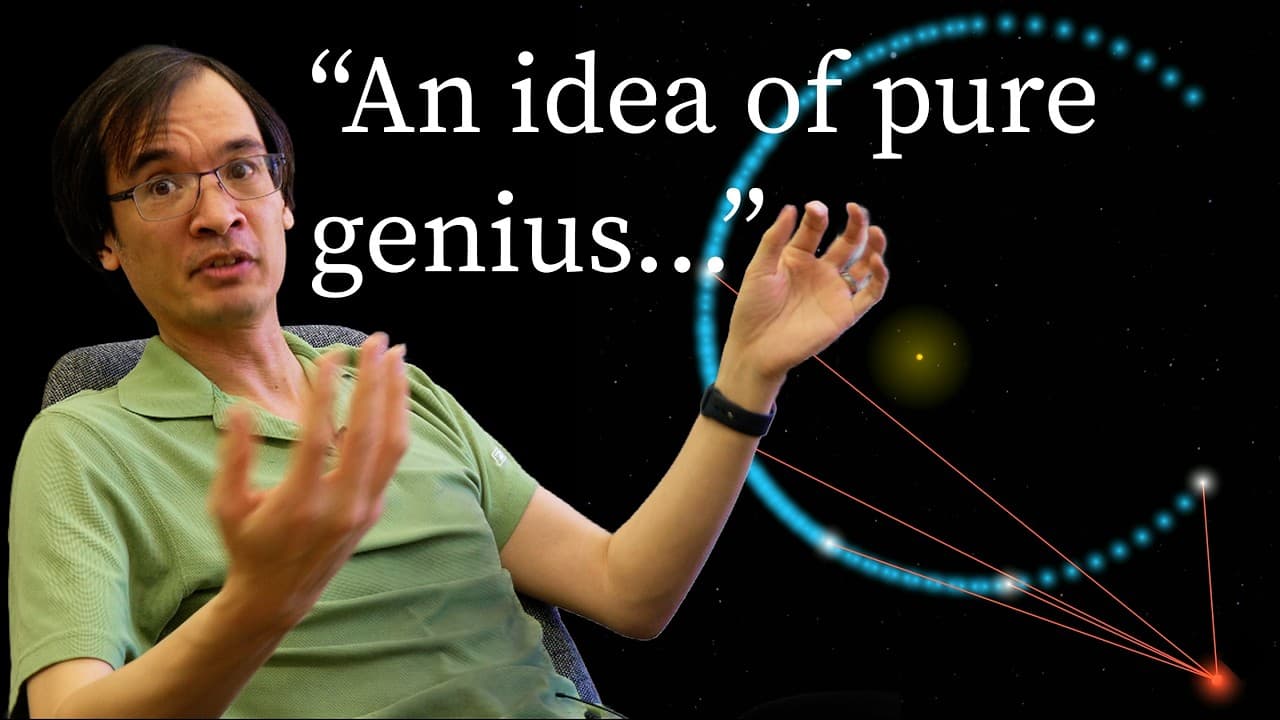
Einstein once wrote an introduction to a book on astronomy. He mentioned this idea, he called it an idea of pure genius. This is Terence Tao, one of the world's most renowned mathematicians. What he's referencing right now is how Kepler deduced the shape of Earth's orbit, which was astoundingly more clever than I had realized. But I'm getting a lit... Read More
Key Insights
- The cosmic distance ladder is a sequence of connected measurements in which determining one scale creates a reference for determining the next. In principle, a single direct ground-distance measurement can propagate mathematically from Earth’s circumference toward vastly larger astronomical distances, although accumulated errors limit this approach.
- Cosmic distances are usually measured indirectly because an observer cannot simply inspect a distant object from every useful viewpoint. The recurring strategy is to observe another object or phenomenon affected by the target, then use geometry, timing, ratios, and known reference lengths to infer the unknown distance.
- Earth’s spherical shape is supported by the consistently circular arc of its shadow during lunar eclipses. Aristotle could use the Moon as a remote screen for Earth’s shadow, gaining evidence about Earth’s shape without telescopes, spacecraft, sextants, or an external viewpoint.
- A convex three-dimensional body whose every projection is circular must be a sphere, according to the geometric argument discussed by Tao. The analogous intuition fails in two dimensions because two nonround shapes can have projections that are intervals of the same length, while three dimensions provide enough perspective.
- Eratosthenes estimated Earth’s circumference by comparing solar observations at Syene and Alexandria during the summer solstice. The Sun was overhead at Syene but about 7 degrees from vertical at Alexandria, allowing him to relate the cities’ separation to a 7-degree arc of Earth’s full circle.
- The estimate of Earth’s circumference depends on one directly measured quantity: the ground distance between Syene and Alexandria, reported as about 5,000 stadia or roughly 500 miles under conventional conversions. The historical record does not establish exactly how Eratosthenes obtained that distance.
- Eratosthenes’ result is considered accurate to about 10 percent under conventionally accepted conversions from stadia to modern units. Claims of substantially greater precision can depend on selectively choosing among uncertain conversions, so the ambiguity of the ancient unit must remain part of the assessment.
- The Earth-Moon distance can be related to Earth’s radius by comparing the Moon’s 28-day orbital period with the duration of the longest lunar eclipses, which is no more than four hours. More careful calculations account for the Moon’s radius, shadow geometry, and off-center eclipse paths.
Install to Summarize YouTube Videos and Get Transcripts
Explore YouTube Video Summarizer or Get YouTube Transcript Extractor
Questions & Answers
Q: How does the cosmic distance ladder work?
The cosmic distance ladder works by establishing one measurable scale and using it as a reference for the next, more distant scale. Direct inspection is usually impossible, so astronomers observe how one object affects another and apply mathematical relationships. In the account presented here, observations establish Earth’s shape and size first, then Earth’s radius becomes a reference for estimating the distance to the Moon.
Q: How did ancient observers know Earth is spherical?
Ancient observers could infer Earth’s spherical shape from lunar eclipses. During an eclipse, the Moon passes into Earth’s shadow, and the boundary visible across the Moon consistently appears as a circular arc. This uses the Moon as a distant screen that reveals Earth’s shadow. The observation requires no telescope or spacecraft, yet it provides convincing evidence that Earth is round.
Q: How did Eratosthenes measure Earth’s circumference?
Eratosthenes compared the Sun’s direction at Syene and Alexandria at noon on the summer solstice. The Sun was directly overhead at Syene, while it was about 7 degrees from vertical at Alexandria. He treated sunlight as effectively parallel, so the angular difference also represented the arc between the cities. He then compared their ground distance with 7 degrees out of a full 360-degree circle.
Q: Why was the summer solstice important to Eratosthenes?
The summer solstice made the overhead-Sun observation predictable. On that day, Earth’s rotational axis is tilted directly toward the Sun, and locations along the Tropic of Cancer experience the Sun directly overhead at high noon. Syene lies on that line, so Eratosthenes could compare its known solar alignment with the measurable angle of the Sun at Alexandria at the same time.
Q: How accurate was Eratosthenes’ estimate of Earth’s size?
Using conventionally accepted conversions for the ancient unit called the stadium, Eratosthenes’ estimate is described as accurate to about 10 percent. The exact assessment remains uncertain because there are multiple possible conversions between stadia and modern units. Selecting a favorable conversion can make the estimate appear more precise, so the unit ambiguity should be acknowledged rather than hidden.
Q: How was the distance between Syene and Alexandria known?
The surviving account does not record exactly how the distance was determined. One proposed explanation is that merchants traveling along the Nile estimated how many stadia their boats covered per day and multiplied that rate by the number of travel days. A humorous alternative mentioned in the discussion is that someone carefully paced the route and counted steps. The reported distance was about 5,000 stadia.
Q: How can a lunar eclipse help estimate the Moon’s distance?
A lunar eclipse provides a shadow with a scale tied to Earth’s known radius. The Moon moves through that shadow during its orbit, so the eclipse duration can be compared with the Moon’s full orbital period. The longest eclipses last no more than four hours, while the orbit takes one lunar month, described as 28 days. Their ratio links orbital distance to Earth’s size.
Q: What complications affect eclipse-based Moon measurements?
The simplest approximation treats Earth’s shadow as having a width of about two Earth radii, but the actual geometry is more complicated. The penumbra and umbra must be distinguished, the Moon’s own diameter affects contact timing, and many eclipses cross Earth’s shadow away from its center. For this reason, the ancient calculation would need to rely on the longest known eclipses and carefully selected timing points.
Summary & Key Takeaways
-
The cosmic distance ladder is a chain of indirect measurements in which each established scale supports the next. Terence Tao emphasizes that measuring a distant object usually requires observing its effect on another object, combining clever mathematical reasoning with data made possible by available technology. The method begins with Earth itself.
-
Ancient observations of lunar eclipses supplied convincing evidence that Earth is spherical because its shadow on the Moon consistently forms a circular arc. Eratosthenes then estimated Earth’s circumference by comparing the overhead Sun at Syene with a roughly 7-degree solar offset at Alexandria and using the estimated distance between the cities.
-
Once Earth’s radius is known, eclipse observations can help estimate the Earth-Moon distance. The Moon takes one lunar month, described as 28 days, to traverse its orbit, while the longest lunar eclipses last no more than four hours. Their ratio connects the Moon’s orbital scale to Earth’s known diameter.
Read in Other Languages (beta)
Share This Summary 📚
Summarize YouTube Videos and Get Video Transcripts with 1-Click
Try YouTube Summary with ChatGPT & Claude or YouTube Transcript Generator
Explore More Summaries from 3Blue1Brown 📚
Summarize YouTube Videos and Get Video Transcripts with 1-Click
Try YouTube Summary with ChatGPT & Claude or YouTube Transcript Generator