How AI Changes Software Engineering After Coding
TL;DR
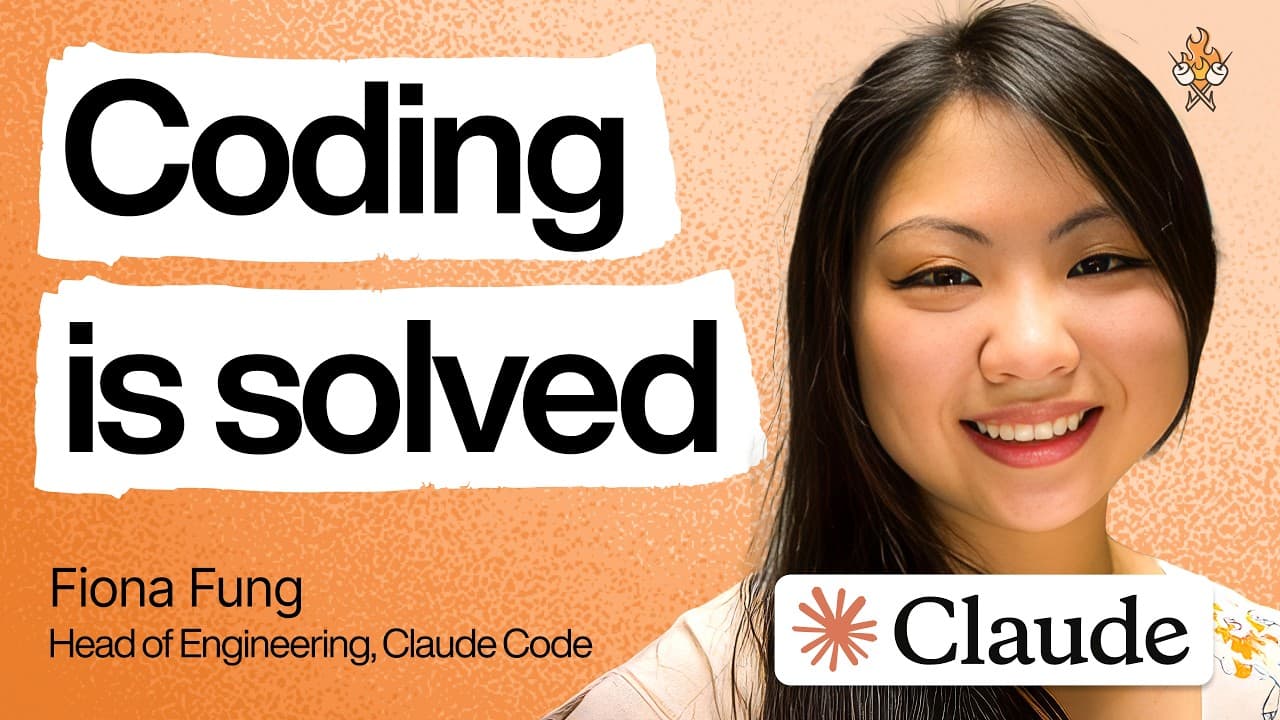
Coding is no longer the main bottleneck when AI lets teams produce software far faster, so judgment, ambition, verification, and accountability become more important. Anthropic’s experience suggests that effective builders take initiative, define clear hypotheses, use AI proactively, and preserve human collaboration while managing the widening gap between people who embrace these tools and those who resist them.
Transcript
Anthropic engineers, on average, ship eight times as much code per quarter as they did compared to 2025. [music] >> Coding is no longer the bottleneck. It's lifted the ceiling of what anyone is able to do. >> Everything is now possible in theory. Now, it's about how ambitious [music] can you be? >> It's always something we ask ourselves, what's bet... Read More
Key Insights
- Coding is no longer the primary bottleneck because AI has raised the ceiling on how much individuals and teams can build. The resulting constraint is deciding how ambitious to be, which problems deserve attention, and how to turn broad technical possibility into useful, verified outcomes.
- Anthropic engineers ship eight times as much code per quarter on average compared with the 2021–2025 period. This sharp rise in throughput illustrates how AI-assisted development can transform output while creating new demands around reviewing, testing, and understanding a much larger volume of code.
- Verification is becoming more important as code production accelerates and more disciplines contribute directly. On the Claude Code team, engineers, designers, and product managers all check in code, so teams must ensure that increased participation and throughput still produce correct and valuable results.
- High agency requires high accountability because greater freedom to build can also increase the consequences of weak decisions. People should take initiative while clearly stating what they are trying to solve, what hypothesis guides the work, and how they will determine whether the outcome succeeds.
- The strongest performers are taking initiative and using AI proactively rather than waiting for detailed direction. Fiona Fung describes agency as a defining advantage in an environment where many implementations are possible and the ability to identify and pursue worthwhile opportunities becomes increasingly valuable.
- AI-assisted work can become lonely when individuals spend much of their time interacting with an agent instead of collaborating with colleagues. The Claude Code team responded by starting pair-wise programming lunches, showing that deliberate human interaction may be needed as individual AI workflows expand.
- A gap is forming between people who actively embrace AI and people who resist it or feel frustrated by it. Fiona Fung advises responding to fear by leaning in, asking what action is possible, and concentrating on aspects of the transition that remain within personal control.
- Software engineering has repeatedly changed through new tools and distribution methods, from Vim and terminal debugging to Visual Studio, then from physical CDs to online delivery. AI continues that history, but it also changes code throughput, contributor roles, verification needs, and the scope of feasible projects.
Install to Summarize YouTube Videos and Get Transcripts
Explore YouTube Video Summarizer or Get YouTube Transcript Extractor
Questions & Answers
Q: What happens when coding is no longer the main bottleneck?
When coding stops being the main bottleneck, teams must focus more heavily on selecting valuable problems, setting ambitious goals, and verifying what they build. Faster implementation makes more ideas possible, but possibility alone does not establish usefulness. Teams also need accountability, including a clear hypothesis about the problem being solved and a reliable way to evaluate the resulting work.
Q: How much more code are Anthropic engineers shipping with AI?
Anthropic engineers reportedly ship eight times as much code per quarter on average compared with the 2021–2025 period. The increase is presented as evidence that AI has sharply expanded engineering throughput. It also creates a new challenge: teams must strengthen verification because producing more code does not remove the need to confirm that the work is correct, useful, and aligned with an intended outcome.
Q: How does AI change the role of software engineers?
AI shifts software engineers away from treating code creation as the scarcest part of development. Engineers still build software, but they increasingly need to decide what should be built, formulate hypotheses, guide agents, and verify high-volume output. Initiative and judgment become more important because faster coding expands the range of feasible projects without automatically identifying which projects deserve effort.
Q: Why is verification more important in AI-assisted development?
Verification becomes more important because AI increases code throughput and allows people from different disciplines to contribute directly. On the Claude Code team, engineers, designers, and product managers all check in code. As both the number of contributors and the volume of changes grow, teams need dependable ways to determine whether implementations behave correctly and actually solve the intended problem.
Q: What does high agency mean for AI-enabled teams?
High agency means taking initiative, acting proactively, and using available tools to pursue worthwhile outcomes rather than waiting for detailed instructions. Fiona Fung connects that freedom with high accountability. A person should be able to explain the problem being addressed, the hypothesis behind the chosen approach, and the evidence that will show whether the work delivered the intended result.
Q: Can working extensively with coding agents become isolating?
Working extensively with a coding agent can become a lonely experience because individuals may spend less time solving problems directly with colleagues. Fiona Fung says the Claude Code team noticed this risk and started pair-wise programming lunches. The practice reflects a need to preserve human collaboration intentionally, even when agents make individual development workflows faster and more independent.
Q: How should people respond to fear or frustration about AI?
Fiona Fung advises people who feel fear or frustration about AI to lean into the change and ask what they can do about it. The practical focus is on identifying what remains within personal control. This approach encourages experimentation and initiative while acknowledging that a gap is developing between people who embrace AI tools and those who resist them.
Q: How have software development tools changed over time?
Software development has moved through several major workflow changes. Fiona Fung recalls using Vim and terminal debugging at IBM, then encountering integrated development features such as breakpoints and multi-threaded debugging at Microsoft. She also experienced the transition from shipping software on physical CDs, with rigid manufacturing deadlines, to online distribution, which changed planning and release practices.
Summary & Key Takeaways
-
AI has changed software development from a process constrained by scarce engineering time into one where far more ideas are technically possible. Anthropic engineers reportedly ship eight times as much code per quarter as before, while designers and product managers also contribute code, shifting attention from production speed toward choosing valuable problems and verifying results.
-
Fiona Fung connects the current AI transition to earlier changes in software development, including the move from terminal tools to integrated development environments and from shipping software on CDs to distributing it online. Each transition altered workflows, but AI changes both who can create software and how much a team can produce.
-
High agency must be paired with high accountability when people can build rapidly with AI. Team members need freedom to act, but they should also articulate the hypothesis behind their work and verify what they produce. Human connection remains important because extensive work with coding agents can feel lonely, prompting practices such as pair-programming lunches.
Read in Other Languages (beta)
Share This Summary 📚
Summarize YouTube Videos and Get Video Transcripts with 1-Click
Try YouTube Summary with ChatGPT & Claude or YouTube Transcript Generator
Explore More Summaries from Lenny's Podcast 📚





Summarize YouTube Videos and Get Video Transcripts with 1-Click
Try YouTube Summary with ChatGPT & Claude or YouTube Transcript Generator