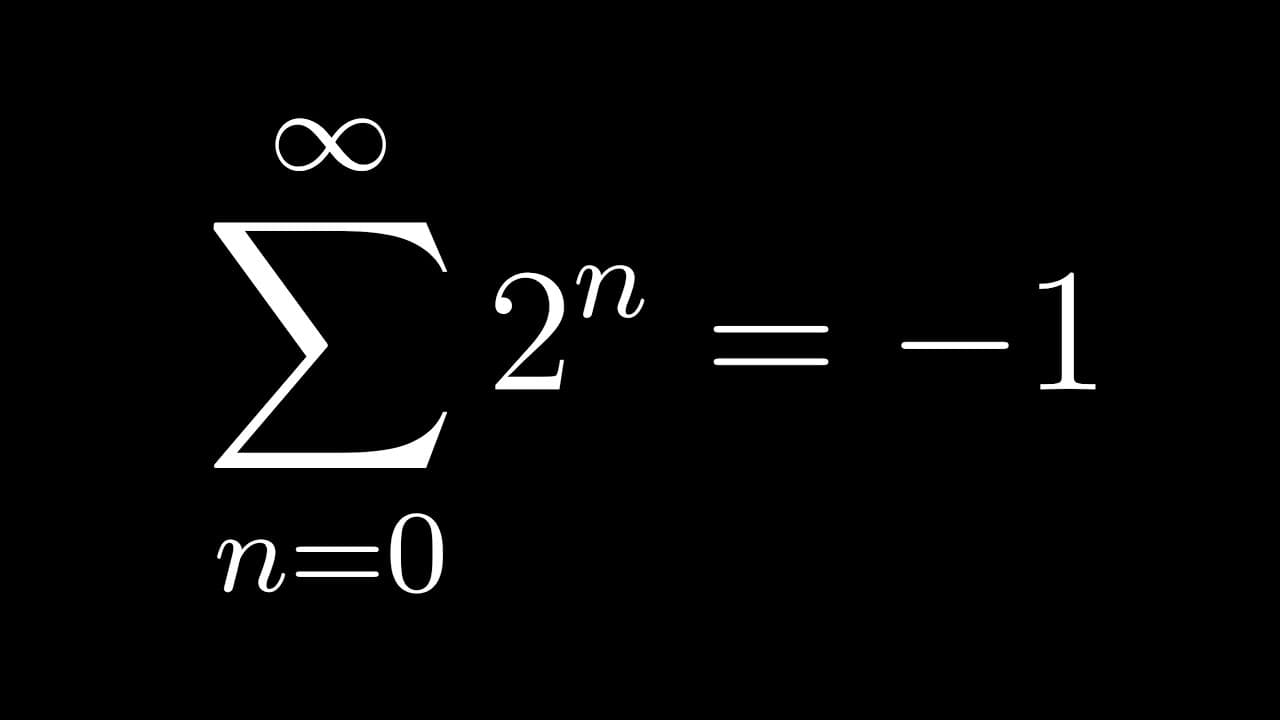
How Can 1 + 2 + 4 + 8 Equal Negative 1?
TL;DR
The series 1 + 2 + 4 + 8 can be associated with negative 1 by using a different, shift-invariant notion of distance in which successive powers of two approach zero. Its finite partial sums, 1, 3, 7, 15, and onward, are each one less than a power of two, so they do not converge under ordinary distance. Read on to see how redefining closeness makes the surprising result meaningful.
Transcript
Take 1 plus 2 plus 4 plus 8 and continue on and on adding the next power of 2 up to infinity. This might seem crazy, but there's a sense in which this infinite sum equals negative 1. If you're like me, this feels strange or obviously false when you first see it, but I promise you, by the end of this video you and I will make it make sense. To do th... Read More
Key Insights
- Infinite sums are defined using finite partial sums and their limiting behavior. No person, computer, or physical process must perform infinitely many additions, because each member of the relevant sequence comes from an ordinary finite calculation.
- Approaching a number means eventually remaining within every chosen distance of it. Merely getting closer is insufficient, since the partial sums approaching one also become closer to two without ever becoming arbitrarily close to two.
- The equation one half plus one fourth plus one eighth and so on equals one follows from successive interval cuts. The finite partial sums move toward one, and their remaining distance can be made smaller than any prescribed positive distance.
- Repeating decimal point nine equals one because its terms form an infinite sum whose partial sums approach one. Within the limit-based definition of infinite series, approaching the value and equaling the value express the same mathematical relationship.
- The geometric-series formula emerges by dividing an interval repeatedly in proportions p and one minus p. The resulting pieces sum to one, producing a formula involving successive powers of p when p lies between zero and one.
- Substituting values outside the original geometric construction creates suggestive but divergent expressions. Setting p to negative one gives an alternating sequence associated with one half, while setting p to two associates 1 + 2 + 4 + 8 and onward with negative one.
- The finite partial sums of powers of two are one less than a power of two. Consequently, treating the entire series as negative one is equivalent to finding a framework in which successive powers of two approach zero.
- A new distance can organize rational numbers through nested rooms instead of their familiar positions on a line. Shift invariance then requires equal differences to have equal distances, determining how positive and negative numbers occupy the hierarchy.
Install to Summarize YouTube Videos and Get Transcripts
Explore YouTube Video Summarizer or Get YouTube Transcript Extractor
Questions & Answers
Q: How can 1 + 2 + 4 + 8 equal negative 1?
The finite partial sums of 1 + 2 + 4 + 8 are each one less than a successive power of two. Therefore, associating the series with negative 1 amounts to using a notion of distance in which powers of two approach zero. This is not ordinary convergence on the familiar number line, but it becomes meaningful under a different, shift-invariant organization of rational numbers.
Q: Why does 1 + 2 + 4 + 8 not converge ordinarily?
Its finite partial sums are 1, 3, 7, 15, 31, and so on. Under the familiar notion of distance, those values do not approach any number, so the series has no ordinary sum.
Q: How are infinite sums defined using finite partial sums?
First, create a sequence of finite partial sums by cutting off the expression after successively more terms. The infinite sum equals a number x when, for every chosen distance from x, all sufficiently late partial sums remain within that distance.
Q: Why does one half plus one fourth plus one eighth and so on equal one?
Starting at zero, move toward one by cutting the remaining distance in half at every step. The resulting finite partial sums become arbitrarily close to one, meaning they eventually remain within any chosen distance of one. By the limit-based definition of an infinite sum, the series equals one.
Q: What does it mean for a sequence to approach a number?
A sequence approaches x when it eventually stays as close to x as any chosen distance requires. Merely getting closer is insufficient: the partial sums approaching one also get closer to two, but they never become arbitrarily close to two.
Q: Why does point nine repeating equal one?
The expression can be written as nine tenths plus nine one hundredths plus nine one thousandths and so on. Its finite partial sums approach one arbitrarily closely. Because equality for an infinite sum is defined through this limiting behavior, point nine repeating equals one.
Q: How is the geometric-series formula developed?
Divide an interval into pieces of size p and one minus p, then repeatedly divide the rightmost remaining piece in the same proportions. This produces pieces involving successive powers of p that together total one when p lies between zero and one. Dividing the resulting expression by one minus p gives the formula for the successive powers of p.
Q: What role does a new distance play in associating the series with negative one?
A new distance changes which rational numbers count as close by arranging them into nested rooms, subrooms, and progressively smaller subrooms. In this arrangement, zero can share increasingly small rooms with larger powers of two, allowing those powers to approach zero. Shift invariance requires that adding the same amount to two numbers preserve the distance between them.
Summary & Key Takeaways
-
Infinite addition is defined through finite partial sums, not by physically completing infinitely many operations. A series equals x when, for every chosen distance from x, all sufficiently late partial sums lie within that distance. Under this definition, the successive sums of one half, one fourth, and smaller powers approach and equal one.
-
Generalizing the geometric construction produces 1 + p + p squared and further powers, formally associated with 1 divided by 1 minus p. The original construction works when p lies between zero and one, but substituting negative one or two produces divergent expressions that inspire mathematicians to seek broader interpretations instead of discarding them immediately.
-
The partial sums of 1 + 2 + 4 + 8 are one less than successive powers of two. Connecting the series to negative one therefore amounts to making powers of two approach zero. This becomes conceivable by replacing ordinary line-based distance with a shift-invariant hierarchy of rooms, subrooms, and progressively smaller subrooms.
Read in Other Languages (beta)
Share This Summary 📚
Summarize YouTube Videos and Get Video Transcripts with 1-Click
Try YouTube Summary with ChatGPT & Claude or YouTube Transcript Generator
Explore More Summaries from 3Blue1Brown 📚

Summarize YouTube Videos and Get Video Transcripts with 1-Click
Try YouTube Summary with ChatGPT & Claude or YouTube Transcript Generator