How Do Variables Work in Python Compared to C?
TL;DR
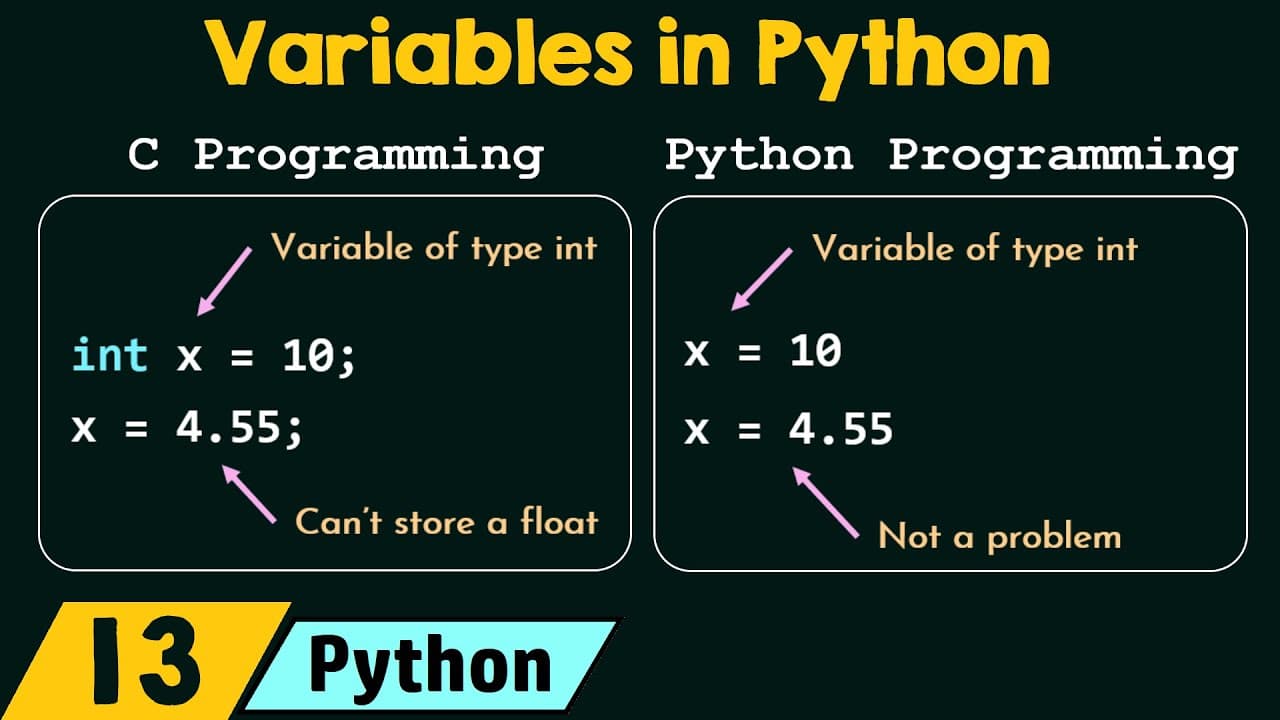
Python variables are names attached to values, while C variables must be declared with a fixed type before use. In Python, x = 10 creates a variable directly, x + y produces 30 when y = 20, and later assigning x = 40 changes the result to 60. The comparison also explains dynamic typing and what happens when C stores 4.55 in an integer variable, so read on for concrete examples.
Transcript
foreign we will try to understand what are variables in Python and we will also understand some topics related to it so without any further delay let's get started the first topic of this presentation is variables in Python the second topic is comparison with C language we will start with this topic variables in Python so what is a variable a varia... Read More
Key Insights
- A Python variable is a name attached to a value, allowing the name to be used in place of that value later in the code. Its value can change through another assignment, which gives the variable its ability to vary.
- Python variables require no declaration before use. An assignment such as x = 10 both introduces the name x and associates it with the integer value 10, without a preceding statement that specifies the variable's type.
- Variable names can participate directly in arithmetic operations. If x refers to 10 and y refers to 20, evaluating x + y produces 30 because Python uses the values associated with those names at runtime.
- Reassignment changes the value associated with a Python variable. After x initially refers to 10, executing x = 40 makes x refer to 40, so x + y evaluates to 60 when y still refers to 20.
- A C variable must be declared with a type before it is used. The example int x declares x as an integer variable, after which a separate assignment such as x = 10 can store an integer value in it.
- C variables are statically typed in the lecture's comparison. Once x is declared as an integer variable, it remains an integer variable throughout the program and can store only integer values during its lifetime.
- Assigning 4.55 to an integer variable in the presented C example loses precision. The integer variable holds 4 rather than 4.55 because it was declared to store integer values, even though the assignment does not produce an error in the example.
- Python variables are dynamically typed, meaning their types are determined at runtime from the values they reference. The same name x can refer first to integer 10 and later to floating-point 4.55 without an advance type declaration.
Install to Summarize YouTube Videos and Get Transcripts
Explore YouTube Video Summarizer or Get YouTube Transcript Extractor
Questions & Answers
Q: What is a variable in Python?
A Python variable is a name attached to a value that can be used later in code. Its value can change through another assignment, which gives the variable its ability to vary.
Q: How do you create a variable in Python?
Assign a value directly to a name, such as x = 10. Python does not require a separate declaration or advance type specification.
Q: Do Python variables need to be declared before use?
No, Python variables do not need to be declared before assignment. Writing x = 10 immediately associates x with the integer value 10, unlike the presented C example, which first uses int x.
Q: How are Python variables used in arithmetic expressions?
Variable names can be used in place of their associated values. If x = 10 and y = 20, the expression x + y evaluates to 30 because Python uses those values at runtime.
Q: How do you change the value of a Python variable?
Assign a new value to the same name. After x initially refers to 10, executing x = 40 makes x refer to 40; with y still equal to 20, x + y then produces 60.
Q: What is the difference between variables in Python and C?
In C, a variable's type must be specified before use and remains fixed throughout its lifetime. Python requires no advance type declaration, and the same name can refer to values of different types during a program.
Q: What does dynamic typing mean for Python variables?
Dynamic typing means Python determines a variable's type at runtime from its current value. For example, x can first refer to the integer 10 and later to the floating-point value 4.55 without an advance declaration.
Q: What happens when 4.55 is assigned to an integer variable in the presented C example?
The integer variable holds 4 rather than 4.55, causing a loss of precision. This happens because the variable was declared to store integer values and retains that type during its lifetime.
Summary & Key Takeaways
-
A variable in Python is a name attached to a value that can be used later in code. For example, assigning 10 to x and 20 to y allows the expression x + y to produce 30. This lets programmers use meaningful names instead of repeatedly writing values directly in operations.
-
Python variables do not need to be declared before assignment. Writing x = 10 immediately associates x with an integer value. The value can later be changed by assigning x = 40, after which x + y produces 60 when y still refers to 20. Reassignment is allowed without an error.
-
C variables require their types to be specified before use and retain those types throughout their lifetime. Python determines types at runtime from the assigned values. Consequently, x can first refer to the integer 10 and later refer to the floating-point value 4.55, demonstrating Python's dynamic typing behavior.
Read in Other Languages (beta)
Share This Summary 📚
Summarize YouTube Videos and Get Video Transcripts with 1-Click
Try YouTube Summary with ChatGPT & Claude or YouTube Transcript Generator
Explore More Summaries from Neso Academy 📚





Summarize YouTube Videos and Get Video Transcripts with 1-Click
Try YouTube Summary with ChatGPT & Claude or YouTube Transcript Generator