How Does the Endoplasmic Reticulum Work?
TL;DR
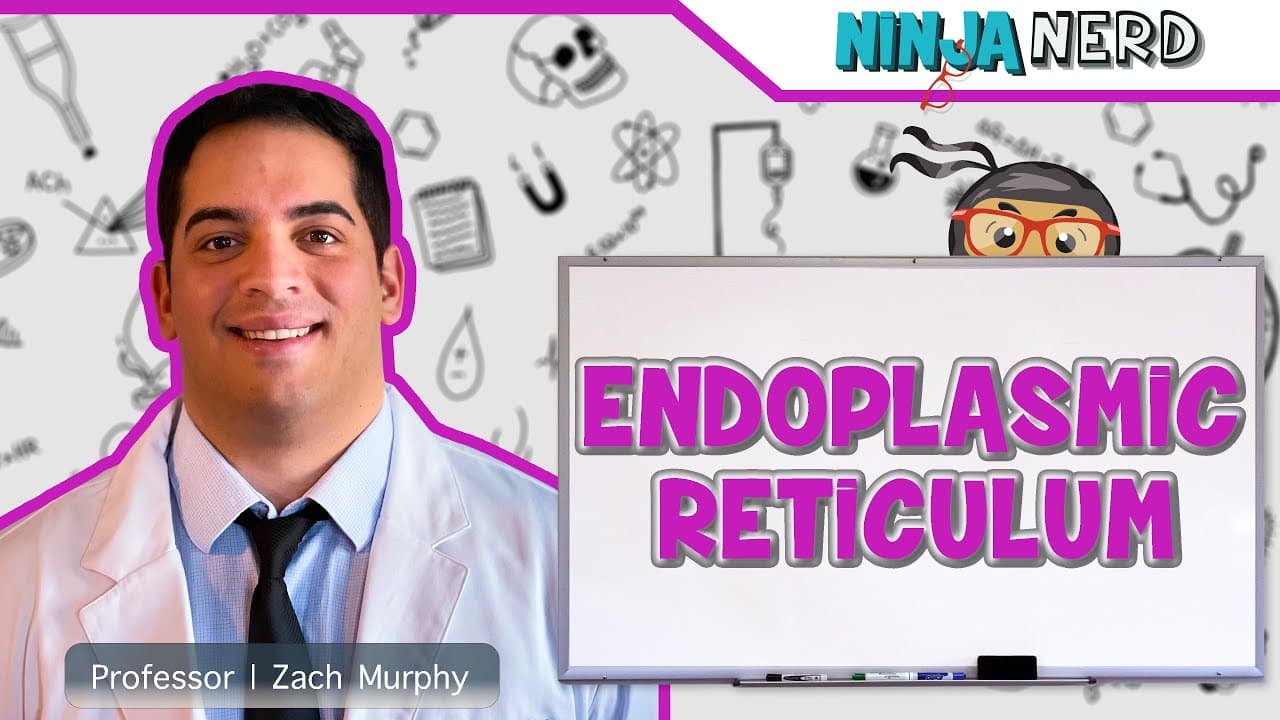
The endoplasmic reticulum is a phospholipid-bilayer passageway that helps process and transport cellular materials. Rough ER uses attached ribosomes to synthesize proteins, modifies them through N-linked glycosylation, and sends them in COPII-tagged vesicles to the Golgi apparatus, which prepares them for membrane incorporation, secretion, or use as lysosomal proteins. Smooth ER lacks surface ribosomes.
Transcript
foreign what's up Ninja nerds in this video today we're going to be talking about the endoplasmic reticulum we'll go over the structure and the function of it all right so first thing before we get started if you guys do like this video it helps you you make it make sense of this this topic please support us best way you can do that is by hitting t... Read More
Key Insights
- The endoplasmic reticulum is a membrane-enclosed network of tubular passageways that transports cellular materials, including proteins synthesized by ribosomes. Its phospholipid-bilayer membrane is continuous with the outer membrane of the nuclear envelope, connecting its structure closely to the nucleus.
- Rough ER is distinguished by the many ribosomes attached to its outer surface. Smooth ER has the same basic tubular, phospholipid-bilayer organization but lacks attached ribosomes, making ribosome presence the central structural difference between the two forms.
- Protein synthesis for the rough ER begins when DNA is transcribed into messenger RNA inside the nucleus. The messenger RNA leaves through nuclear pores, binds to rough ER ribosomes, and supplies the code that ribosomes translate into proteins.
- Rough ER modification includes N-linked glycosylation, a process in which an enzyme attaches an oligosaccharide to a specific asparagine amino acid on a protein. Adding this sugar residue changes the unmodified protein into a modified glycoprotein.
- COPII protein acts as a destination tag on vesicles budding from the rough ER. This tag directs vesicles containing modified glycoproteins toward the Golgi apparatus, where the vesicle fuses with the Golgi and delivers its protein cargo.
- The Golgi apparatus receives rough ER cargo at its cis side. It performs additional modifications and packaging before directing proteins toward the trans side for delivery to the cell membrane, extracellular space, or lysosomal pathway.
- Rough ER products can become membrane proteins after their transport vesicles fuse with the cell membrane. Depending on the protein, the incorporated product may function as a channel, carrier, enzyme, or another type of membrane-associated protein.
- Rough ER products can also become secretory or lysosomal proteins. Secretory proteins are released when vesicles fuse with the cell membrane, while other processed proteins are incorporated into lysosomes and help those specialized organelles break down materials inside the cell.
Install to Summarize YouTube Videos and Get Transcripts
Explore YouTube Video Summarizer or Get YouTube Transcript Extractor
Questions & Answers
Q: What is the structure of the endoplasmic reticulum?
The endoplasmic reticulum is a membranous, tubular structure made from a phospholipid bilayer. Its membrane is continuous with the outer membrane of the nuclear envelope. It occurs in two forms, rough ER and smooth ER. Rough ER has many ribosomes attached to its surface, whereas smooth ER has no surface ribosomes. That difference provides the main structural distinction presented in the lecture.
Q: What is the difference between rough ER and smooth ER?
Rough ER and smooth ER are both tubular membrane systems made from phospholipid bilayers and connected with the outer nuclear membrane. Their key structural difference is the presence of ribosomes. Rough ER is studded with ribosomes, which gives it a rough appearance and supports protein synthesis. Smooth ER lacks attached ribosomes, so its outer surface appears smooth.
Q: How does rough ER synthesize proteins?
DNA inside the nucleus first produces messenger RNA through transcription. The messenger RNA then exits through nuclear pores and binds to ribosomes attached to the rough ER. Working with transfer RNA and ribosomal RNA, the ribosomes translate the messenger RNA code and synthesize proteins. These proteins are pushed into the ER lumen, where they travel through the organelle and undergo modification.
Q: What is N-linked glycosylation in the rough ER?
N-linked glycosylation is a major protein modification performed in the rough ER. An enzyme binds to a newly synthesized protein, recognizes a specific asparagine amino acid, and attaches an oligosaccharide, or group of sugar molecules, to that site. This converts the original protein into a modified glycoprotein that can be packaged for transport and additional processing.
Q: How do proteins travel from rough ER to the Golgi apparatus?
After a protein has entered the rough ER lumen and undergone modification, it is enclosed in a small vesicle that buds from the ER membrane. COPII protein is placed on the vesicle as a tag indicating that its destination is the Golgi apparatus. The vesicle travels to the Golgi, fuses with its cis side, and delivers the modified protein for further processing.
Q: What happens to proteins after they reach the Golgi apparatus?
The Golgi apparatus receives proteins delivered from the rough ER, performs additional modifications, and packages them for specific destinations. The lecture identifies three possible outcomes: incorporation into the cell membrane, release from the cell as a secretory protein, or use as a lysosomal protein. Cargo enters at the cis side and is directed toward the trans side for delivery.
Q: What types of proteins are produced through the rough ER pathway?
The rough ER pathway produces proteins destined for three major outcomes described in the lecture. Some become membrane proteins, such as channels, carriers, enzymes, or other membrane-associated components. Some become secretory proteins, including possible hormones or neurotransmitters that are released outside the cell. Others become lysosomal proteins incorporated into lysosomes for breaking down materials within the cell.
Q: How can a rough ER protein become a membrane or secretory protein?
A rough ER protein is modified, packaged into a COPII-tagged vesicle, and delivered to the Golgi apparatus for further processing. The Golgi then packages it into another vesicle. If that vesicle fuses with the cell membrane, the protein can remain incorporated as a membrane protein. Alternatively, the vesicle can release its protein cargo outside the cell, creating a secretory protein.
Summary & Key Takeaways
-
The endoplasmic reticulum consists of membranous tubules that are continuous with the outer membrane of the nuclear envelope. Both major types have phospholipid-bilayer membranes. Rough ER appears rough because ribosomes cover its surface, while smooth ER lacks attached ribosomes. This structural distinction is the clearest way to identify the two types.
-
Protein production begins when DNA is transcribed into messenger RNA inside the nucleus. Messenger RNA exits through nuclear pores and binds to ribosomes on the rough ER. The ribosomes translate its code into proteins, which enter the ER lumen and move through the organelle while enzymes modify them for later transport and cellular use.
-
The rough ER adds oligosaccharides to asparagine residues through N-linked glycosylation, producing glycoproteins. Modified proteins bud from the ER inside COPII-tagged vesicles and travel to the cis side of the Golgi apparatus. After further modification and packaging, they can become membrane proteins, secreted proteins, or proteins incorporated into lysosomes.
Read in Other Languages (beta)
Share This Summary 📚
Summarize YouTube Videos and Get Video Transcripts with 1-Click
Try YouTube Summary with ChatGPT & Claude or YouTube Transcript Generator
Explore More Summaries from Ninja Nerd 📚

Summarize YouTube Videos and Get Video Transcripts with 1-Click
Try YouTube Summary with ChatGPT & Claude or YouTube Transcript Generator