How Do Membrane Thickness and Area Affect Breathing?
TL;DR
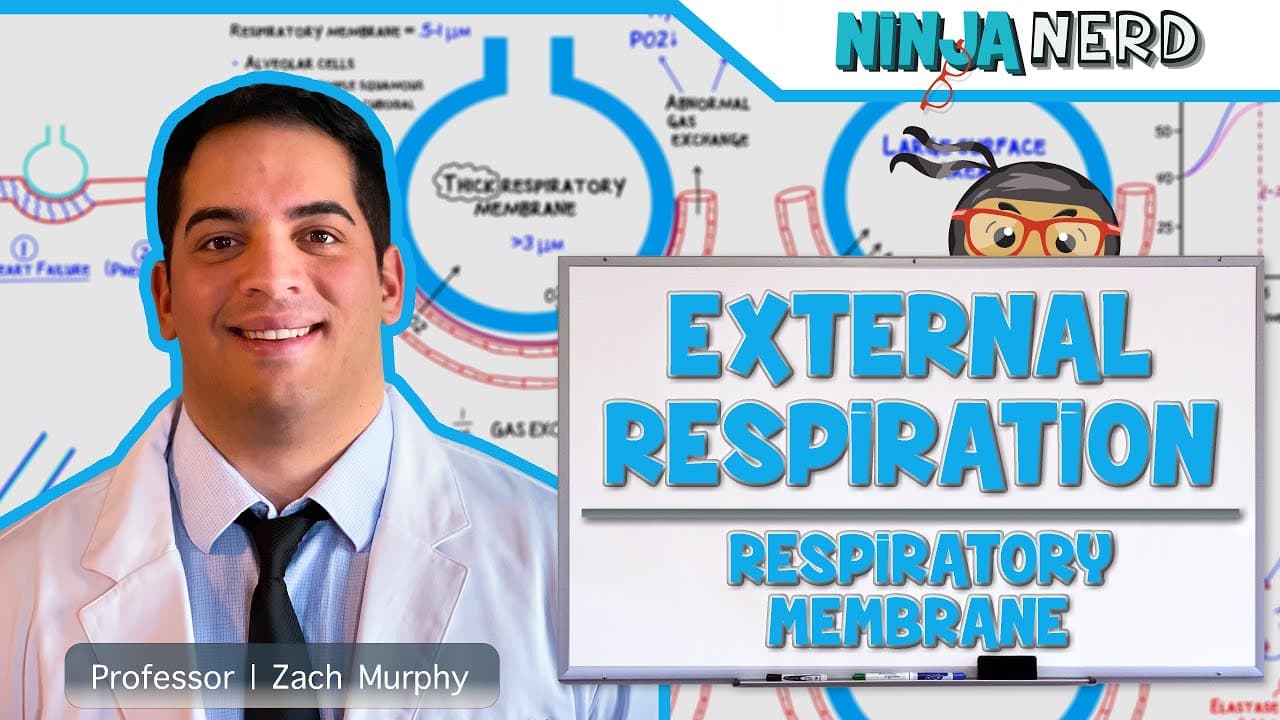
Gas exchange improves when the respiratory membrane is thin and has a large surface area, because oxygen and carbon dioxide can diffuse more efficiently between alveoli and pulmonary capillaries. Edema, pneumonia, and pulmonary fibrosis increase diffusion distance, while emphysema and lung resection reduce available surface area, so each can impair oxygen delivery to the blood.
Transcript
I ninja in this video we're going to go specifically over again external respiration but we're going to focus in on what next we already talked about ventilation and perfusion where you have a video on that if you haven't seen that one go watch that one after that now we're going to focus on thickness and surface area of the respiratory membrane no... Read More
Key Insights
- The respiratory membrane is the thin barrier across which oxygen moves from alveoli into pulmonary blood and carbon dioxide moves from blood into alveoli. Its structure and dimensions directly influence the efficiency of external respiration.
- Type 1 alveolar cells are thin, flat, simple squamous cells specialized for gas exchange. Their shape minimizes the distance that oxygen and carbon dioxide must travel between the alveolar space and pulmonary capillaries.
- Type 2 alveolar cells are simple cuboidal cells involved primarily in surfactant production. Surfactant relates to surface tension, while the flatter type 1 cells perform the principal gas exchange role described in the lecture.
- Normal respiratory membrane thickness is generally about 0.5–1 micrometers, although some literature may extend the range toward 2 micrometers. This short diffusion distance supports efficient movement of respiratory gases.
- Increased respiratory membrane thickness is a barrier to diffusion because it lengthens the path traveled by oxygen and carbon dioxide. The resulting decrease in gas exchange can lower blood oxygen and raise blood carbon dioxide.
- Left-sided heart failure can thicken the respiratory membrane when blood backs up into the pulmonary circulation and fluid enters alveolar regions. The waterlogged, edematous lungs then provide a longer diffusion distance and contribute to shortness of breath.
- Pneumonia can impair gas exchange when tissue damage triggers inflammatory mediators, blood vessel dilation, increased permeability, and fluid leakage. The accumulated fluid thickens the respiratory barrier and makes oxygen and carbon dioxide diffusion more difficult.
- Reduced respiratory surface area limits the total space available for diffusion. Emphysema and lung resection are identified as conditions that decrease surface area, thereby reducing gas exchange and oxygen delivery to the blood.
Install to Summarize YouTube Videos and Get Transcripts
Explore YouTube Video Summarizer or Get YouTube Transcript Extractor
Questions & Answers
Q: What structures make up the respiratory membrane?
The respiratory membrane includes the alveolar epithelial cells and the basement membrane, also called the basal lamina, with pulmonary capillaries and their endothelial lining immediately surrounding the barrier. Type 1 alveolar cells are thin simple squamous cells that participate in gas exchange. Type 2 alveolar cells are simple cuboidal cells associated mainly with surfactant production and surface tension.
Q: How does respiratory membrane thickness affect gas exchange?
Respiratory membrane thickness determines the distance oxygen and carbon dioxide must travel during external respiration. A thicker membrane creates a longer diffusion path, so less oxygen moves from the alveoli into the blood and less carbon dioxide moves from the blood into the alveoli. This produces abnormal gas exchange and can also disrupt the ventilation and perfusion relationship.
Q: What is the normal thickness of the respiratory membrane?
The respiratory membrane is generally described as about 0.5–1 micrometers thick, although the lecture notes that some literature may extend the range toward 2 micrometers. This small thickness keeps the separation between alveolar gas and pulmonary capillary blood short, allowing oxygen and carbon dioxide to diffuse efficiently down their respective partial pressure gradients.
Q: Why does left-sided heart failure cause shortness of breath?
Left-sided heart failure can prevent the left ventricle from pumping blood effectively into the systemic circulation. Blood then backs up into the pulmonary circulation, and fluid may leak into alveolar regions. This pulmonary edema makes the respiratory membrane thicker, lengthens the diffusion path, reduces oxygen transfer, impairs carbon dioxide removal, and contributes to shortness of breath.
Q: How does pneumonia interfere with external respiration?
Pneumonia can damage epithelial tissue and surrounding lung structures. The tissue injury releases inflammatory mediators such as histamine, causing nearby blood vessels to dilate and become more permeable. Fluid then leaks into the affected spaces and thickens the respiratory barrier. Oxygen and carbon dioxide must cross a longer distance, resulting in impaired gas exchange and difficulty breathing.
Q: What blood gas changes can result from a thick respiratory membrane?
A thick respiratory membrane reduces the amount of oxygen crossing from alveoli into pulmonary blood, so the blood’s partial pressure of oxygen can fall and hypoxemia can develop. Carbon dioxide also crosses into the alveoli less effectively, so its partial pressure in blood can rise. The lecture explains that sufficiently elevated carbon dioxide can contribute to respiratory acidosis.
Q: How does respiratory membrane surface area affect diffusion?
Respiratory membrane surface area determines how much space is available for oxygen and carbon dioxide diffusion between alveoli and pulmonary capillaries. Under Fick’s Law of Diffusion, decreased surface area limits total gas transfer even when the remaining barrier is thin. Emphysema and lung resection are cited as causes of reduced area and diminished oxygen delivery to blood.
Q: What happens when the respiratory membrane becomes unusually thin?
An unusually thin respiratory membrane provides a shorter distance for oxygen and carbon dioxide diffusion. More oxygen can move from the alveoli into the blood, while more carbon dioxide can move from the blood into the alveoli, producing very effective gas exchange. The lecture notes that very low blood carbon dioxide, depending on the situation, can contribute to respiratory alkalosis.
Summary & Key Takeaways
-
The respiratory membrane forms the barrier between alveolar air and pulmonary capillary blood. Its components include alveolar cells, the basement membrane or basal lamina, and the capillary endothelial lining. Type 1 alveolar cells are thin, simple squamous cells involved in gas exchange, while type 2 cells produce surfactant related to surface tension.
-
Respiratory membrane thickness determines how far gases must diffuse. A normal thickness is generally about 0.5–1 micrometers, although some literature extends the range toward 2 micrometers. Increased thickness creates a longer path for oxygen entering blood and carbon dioxide entering alveoli, which reduces gas exchange and can disrupt ventilation and perfusion.
-
Surface area also controls diffusion efficiency under Fick’s Law of Diffusion. Emphysema and lung resection reduce the area available for gas exchange, limiting oxygen delivery to the blood. Increased thickness from pulmonary fibrosis, edema, pneumonia, or fluid accumulation during left-sided heart failure likewise impairs external respiration by slowing diffusion across the membrane.
Read in Other Languages (beta)
Share This Summary 📚
Summarize YouTube Videos and Get Video Transcripts with 1-Click
Try YouTube Summary with ChatGPT & Claude or YouTube Transcript Generator
Explore More Summaries from Ninja Nerd 📚






Summarize YouTube Videos and Get Video Transcripts with 1-Click
Try YouTube Summary with ChatGPT & Claude or YouTube Transcript Generator